A group of Democratic attorneys general are backing a Biden administration effort to crack down on so-called “ghost guns,” untraceable homemade firearms that account for an increasing share of those seized by law enforcement.
In court papers Friday, 20 blue state attorneys general urged a federal judge to reject a legal challenge to new restrictions on gun part kits that currently allow guns without serial numbers to assembled in as little as 30 minutes — and without requiring background check.
“Without meaningful federal oversight, unserialized guns have regularly fallen into the hands of prohibited persons, with often deadly results,” the attorneys general from Washington, D.C., California, New York and other states told a federal judge in Texas in an amicus brief.
According to Justice Department data, nearly 20,000 suspected ghost guns were recovered last year by law enforcement in criminal investigations, a more than tenfold increase from 2016. Over that six-year timeframe, nearly 700 homicide or attempted homicide investigations have involved ghost guns.
To stem the proliferation of these weapons, the Biden administration issued a rule that expanded the definition of firearms to include homemade guns and gun part kits. As a result of the new rule, which is set to take effect next month, commercial gun kit manufacturers must be licensed, include serial numbers and conduct a background check prior to a sale.
The move aims to deliver on a pledge that then-candidate Joe Biden made on the campaign trail to curtail ghost guns, which the president has argued are far too easy to access.
“Anyone can order it in the mail, anyone,” Biden said at White House ceremony in April announcing the new rule. “Folks, a felon, a terrorist, a domestic abuser, can go from a gun kit to a gun in as little as 30 minutes.”
The administration’s move prompted a legal challenge from a Texas-based gun parts manufacturer, Division 80, which filed a federal lawsuit in May. The challengers say the rule lacks an adequate legal justification and threatens to put them and other manufacturers out of business or in legal jeopardy. They are represented by a law firm headed by John Ashcroft, who served as U.S. attorney general under George W. Bush.
A number of states have passed laws that ban ghost gun or impose additional requirements on manufacturers. But the blue state attorneys general in their amicus brief argued that without federal oversight, states laws can easily be skirted.
“Though individual states have worked diligently to protect their citizens from gun violence and address this emerging threat, there is a natural limit to states’ abilities to combat a nationwide problem that crosses state borders,” they wrote. “Absent federal enforcement, ghost guns have continued to proliferate, including in the very states that have been trying to keep them out.”
The Constitution is a legal document that structures government and protects rights. Sometimes overlooked, however, is the reality that it is also a statement of values and principles on which the structure of government and the protection of rights is based.
These values and principles are not law — but they can suggest non-legal obligations that the government owes to its citizens or that citizens owe to each other.
Sometimes the obligation is stated explicitly as the foundation for the protection of a right. For example, a few months ago a racist killer influenced by white supremacist ideology and so-called “replacement theory” massacred Black Americans at a super market in Buffalo, N.Y. We know from bitter experience that white supremacy and replacement theory leads to violence and murder. We know this. Yet our constitutional system prohibits government from suppressing such pernicious speech.
The First Amendment generally prevents government from prohibiting speech that may influence individuals to commit crimes — even horrible crimes like the massacre in Buffalo. As the Supreme Court made clear in the seminal case of Brandenburg v. Ohio, this kind of speech, characterized as incitement, can only be prohibited if it will lead to imminent violence or unlawful conduct. This is a bedrock First Amendment rule today. The speech that warped the mind of the murderer in Buffalo cannot satisfy this incitement test because it did not immediately result in violence.
It is important to understand the reasoning justifying this meaning of incitement which protects such evil speech. The principle underlying the Brandenburg rule imposes an implicit obligation on the State and the people, a principle that requires us to counter evil counsel as loudly and forcefully as we can.
As Justices Holmes and Brandeis wrote in dissenting opinions that eventually led to the Brandenburg decision, dangerous speech could only by suppressed by government if the violence and other unlawful conduct it is inciting is imminent. If there is time to counter and refute evil counsel before it leads to harm, the constitutionally appropriate remedy for bad speech is good speech — not the prohibition of speech.
Thus, the foundation of this key free speech doctrine is grounded in the expectation that good people will not remain silent when they are confronted with evil speech.
It relies on the willingness of good people to speak up when there is time to do so and counter evil counsel to reduce the likelihood that bad speech will lead to unlawful acts or violence.
If good people are silent, evil speech cannot be effectively refuted.
Our free speech doctrine in a very real sense imposes a constitutional obligation on good people to speak up.
And that obligation falls with special weight on those of us who can speak the loudest and can be heard by the largest audiences. Government officials, among others, are in this category of speakers. Their official positions give them a microphone which extends the reach of their voice. The First Amendment doctrine about incitement prevents officials from silencing evil ideas — but the reasoning underlying that doctrine obliges them to speak up loudly against evil speech.
Other private speakers with loud voices — such as media and the clergy — are similarly obligated. And the average citizen’s voice, joining with others, needs to be heard as well.
Consider another principle underlying accepted constitutional law. The Fifth Amendment (made applicable to the states by the Fourteenth Amendment) explicitly requires the government to pay just compensation to the owner when it takes private property. But what justifies this compensatory requirement? The Supreme Court in Armstrong v. United States explained that the purpose of this provision was “to bar Government from forcing some people alone to bear public burdens which in all fairness and justice, should be borne by the public as a whole.”
This principle extends beyond compensating property owners for takings. It supports an implicit obligation to compensate — or at least mitigate — the costs incurred when the state furthers the public good in a way that disproportionately burdens individuals or a small group. Consider some examples. Government often accommodates religious exercise either as a result of constitutional mandates or as a discretionary political act. While the protection of religious exercise is particularly valuable to the individuals whose religious practices are being burdened, a strong argument recognizes that religious liberty is a public good. Our society in general benefits in important ways from our commitment to religious freedom.
Sometimes, however, accommodating religion imposes costs on identifiable third parties. In Burwell v. Hobby Lobby, a major issue involved the cost to women employees who would lose valuable insurance coverage for medical contraceptives if employers were exempt on religious grounds from the regulations requiring them to provide such health insurance coverage to their employees. If, as I suggest, religious liberty is a public good, a theory of constitutional obligation would support the government (the public as a whole) assuming the cost of such coverage for the women employees denied insurance coverage to protect the religious liberty of their employers.
Or consider the baker who, for religious reasons, will not create a cake to celebrate the wedding of a same-sex couple. If we exempt the baker from the requirements of anti-discrimination laws in the name of religious freedom, does the state have an obligation to alleviate the cost to the victims of the baker’s discrimination? In this situation, monetary or material compensation may not be feasible. But there may be other ways for the government to mitigate the burden same-sex couples will experience. Perhaps the government could make available through web sites a list of the wedding cake bakers in the area who would welcome the patronage of same-sex couples.
A final example involves state laws banning abortion, which require pregnant women to carry a fetus to term and birth. Here, because the woman wants to terminate her pregnancy, she is not a private beneficiary of the state law. The state believes by prohibiting abortion it is furthering the public good. Obviously, however, this law imposes very substantial burdens on women, including physical, psychological, and economic costs. The state and public will not be able to come close to sharing all of these costs. But it can do some things. For example, in the case of a fetus who will be born with severely debilitating ailments, the state could take on the responsibility of providing top quality medical care, assistance, and support for these children after birth.
Constitutional obligations, while not law, are derived from constitutional principles. They have many virtues, not the least of which is that they move us — perhaps only slightly but to some extent — away from constitutional controversies being entirely a zero-sum game.
Alan Brownstein is a professor of law emeritus at the University of California, Davis School of Law. He has written numerous articles for academic journals and opinion pieces for other media on a range of constitutional law subjects. He is a member of the American Law Institute and served on the Legal Committee of the Northern California American Civil Liberties Union. He received his B.A. degree from Antioch College and earned his J.D. (magna cum laude) from Harvard Law School, where he served as a Case Editor of the Harvard Law Review.
Environmental groups are pushing for the confirmation of a leader for the Environmental Protection Agency’s (EPA) enforcement team, arguing that filling the vacancy will help mitigate climate change.
In a statement issued on Monday, leaders from the Environmental Defense Fund, Earthjustice, League of Conservation Voters, National Wildlife Federation, and Natural Resources Defense Council called on the Senate to prioritize the confirmation of David Uhlmann to be the EPA’s enforcement chief.
“As leaders of the largest environmental groups in the United States, we join together to urge the United States Senate to prioritize floor time to confirm David M. Uhlmann to serve as the Assistant Administrator for Enforcement and Compliance Assurance at EPA,” they said.
The leaders of the groups also invoked climate change, saying that confirming Uhlmann will enable the agency to better enforce existing climate rules after the Supreme Court recently took away a major regulatory tool to prevent power plant emissions.
“His confirmation also will allow EPA to increase its efforts to enforce existing climate regulations, an immediate step that the Senate can take in the aftermath of last week’s Supreme Court decision in West Virginia v. EPA curtailing the Agency’s ability to address climate change,” said the statement, which was first reported by The Washington Post.
The Hill reported late last year that in fiscal year 2021, the EPA referred its lowest number of criminal cases to the Justice Department in decades.
At the time, advocates called for more investigators, arguing that having more cops patrolling the environment prevents environmental misconduct and holds polluting companies accountable for wrongdoing.
Meanwhile, senators are also working on a reconciliation deal that could spur major investments in clean energy and combating climate change if they can get the entire caucus on board.
A Navy sailor was found dead aboard the USS Carl Vinson aircraft carrier on Sunday while the ship was docked at Naval Air Station North Island, Calif, according to the service.
Navy Region Southwest Federal Fire Department responded to the scene and pronounced the sailor dead, the Navy said in a statement.
The service is investigating the circumstances of the death, though there are no indications of suicide or foul play, the statement noted.
The Navy will not release the name of the sailor until 24 hours after the next of kin notification, per Defense Department policy.
The Carl Vinson, which has been in the California area since February, notably suffered a F-35C fighter jet crash on Jan. 24 while deployed in the South China Sea.
The aircraft crashed onto the deck of the ship as it was landing, fell into the water, and was not recovered until early March. The mishap injured seven sailors.
To receive The Hill’s 12:30 Report in your inbox, please sign up here: https://bit.ly/3qmIoS9
–> A midday take on what’s happening in politics and how to have a sense of humor about it.*
*Ha. Haha. Hahah. Sniff. Haha. Sniff. Ha–breaks down crying hysterically.
HAPPENING THIS WEEK
Just like this season of ‘Stranger Things,’ we are entering Volume 2 of Jan. 6 hearings:
The Jan. 6 hearings resume this week with two hearings, one of which will reportedly happen during prime time.
What to expect this week: Portions of recorded testimony from former Trump White House counsel Pat Cipollone, who spoke with the committee last week.
The expected theme of Tuesday’s 1 p.m. hearing: The role of far-right extremist groups. Think: Proud Boys and Oath Keepers
When is the prime-time hearing?: It hasn’t been formally announced, but multiple news outlets are reporting that Thursday’s hearing will happen during prime time. That hearing is expected to focus on former President Trump’s actions as the riot unfolded.
“President Biden on Monday capped off a celebration of a recently passed bipartisan gun safety law with a call to take further action, including a ban on assault weapons.”
The event: Biden held an event on the South Lawn of the White House to celebrate the passage of the Bipartisan Safer Communities Act.
From Biden: “We’re living in a country awash in weapons of war. What is the rationale for these weapons outside war zones? … Assault weapons need to be banned. They were banned. I led the fight in 1994. And then under pressure from the NRA and the gun manufacturers and others, that ban was lifted in 2004. In that 10 years it was law, mass shootings went down.” More from Biden, via The Hill’s Brett Samuels
IT’S MONDAY. Welcome back! I’m Cate Martel with a quick recap of the morning and what’s coming up. Did someone forward this newsletter to you? Sign up here.
🧾In Congress
➤ BESIDES THE JAN. 6 HEARINGS, WHAT ELSE IS HAPPENING THIS WEEK IN CONGRESS?:
Abortion bills: The House is expected to consider — and pass — two bills to protect access to abortion. These bills would need 60+ votes to clear the Senate, which is unlikely, but House Democrats are set on passing anything they can.
Alert system for active shooter situations: The House will vote on the Active Shooter Alert Act, a communication system for alerting individuals when an active shooter is nearby.
Senate noms: The Senate is returning with a slew of nomination votes. Including: “SteveDettelbach, who President Biden nominated to serve as director of the Bureau of Alcohol, Tobacco, Firearms, and Explosives (ATF).”
“Senate Majority Leader Charles Schumer (D-N.Y.) is making a last-ditch effort to pass a budget reconciliation bill during the July and early August work period.”
What’s on the table?: A proposal to lower the cost of prescription drug costs, extending Medicare’s solvency and potentially raising taxes on the wealthy.
How would Schumer get there?: Continuing negotiations with Sen. Joe Manchin (D-W.Va.).
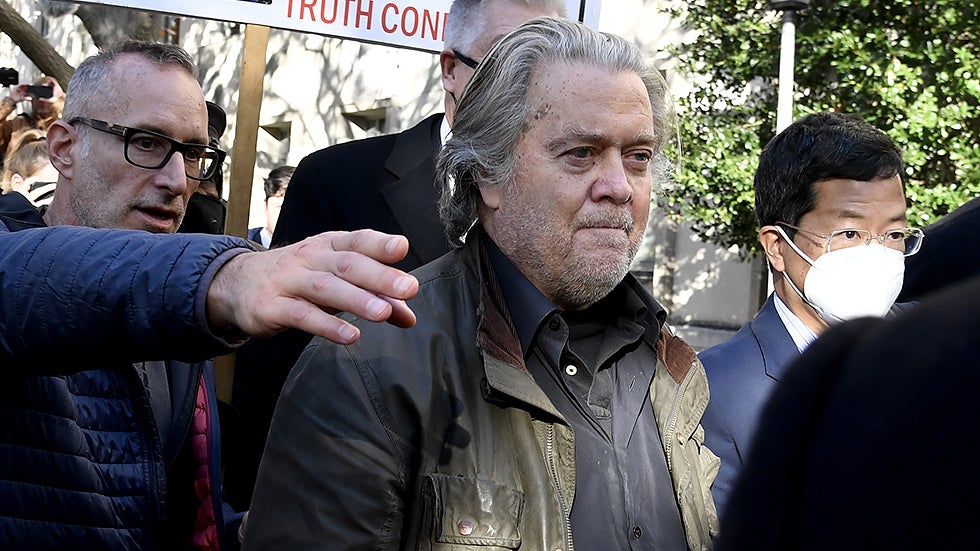
Via The Hill’s Harper Neidig, “Federal prosecutors revealed on Monday that the Justice Department interviewed former President Trump’s attorney last month regarding their contempt case against Stephen Bannon.”
Why this is worth noting: “The revelations come less than two days after Bannon’s lawyers said in a letter to the House Jan. 6 select committee that their client is now willing to testify before the panel, partly because Trump decided to ‘waive’ any assertions of executive privilege over his former adviser.” The full story
➤ THE DEPARTMENT OF JUSTICE IS ARGUING BANNON’S REVERSAL IS A STUNT: Via NBC’s Ryan J. Reilly, “The Justice Department said the Trump associate’s purported desire to reverse his stance and testify before the House Jan. 6 committee is nothing more than a ‘last-ditch attempt to avoid accountability.’”
Interesting observation — Soooo, who would staff Trump’s next election bid?:
“Key players in former President Trump’s last campaign have quietly distanced themselves from the president, raising real questions about who would staff his campaign as he edges closer to a bid for reelection in 2024.”
Who Trump sources think will play a major role: “Susie Wiles, the chair of Trump’s Save America PAC. Wiles managed Sen. Rick Scott’s (R-Fla.) first gubernatorial campaign and played a leading role in Florida Gov. Ron DeSantis’s (R) statewide campaign. She also served as a strategist based in Florida for Trump’s 2016 and 2020 presidential campaigns.”
And: “Taylor Budowich andLiz Harrington have served as spokespeople for Trump and his leadership PAC and could both work in similar roles on any campaign, sources said.”
Via The New York Times’s Shane Goldmacher, “President Biden is facing an alarming level of doubt from inside his own party, with 64 percent of Democratic voters saying they would prefer a new standard-bearer in the 2024 presidential campaign, according to a New York Times/Siena College poll, as voters nationwide have soured on his leadership, giving him a meager 33 percent job-approval rating.”
Americans are pretty pessimistic: “Only 13 percent of American voters said the nation was on the right track — the lowest point in Times polling since the depths of the financial crisis more than a decade ago.”
The first potential over-the-counter birth control pill:
Via The Hill’s Peter Sullivan, “The Food and Drug Administration (FDA) on Monday received an application for the first over-the counter birth control pill.”
What we know: “The application for a daily birth control pill available without a prescription comes from the drug company HRA Pharma. The FDA will likely take months to review the application but the application itself is an important milestone.” What to expect
➤ ‘STATES WITH ABORTION BANS RISK LOSING THEIR ECONOMIC EDGE’: Via The New York Times’s Alexander Burns, “The Supreme Court’s decision to overturn Roe v. Wade has prompted Democratic governors to pitch their states as better alternatives for business.” What this could mean for red and blue states
TIME’s Eric Cortellessa tweeted, “This weekend in Rehoboth, a secret service officer on POTUS’s detail fell off his bike with Biden a few feet behind him. ‘It wasn’t me!’ Biden screamed to onlookers.”
⏱On tap
The Senate is in. The House is holding a pro forma session. President Biden and Vice President Harris are in Washington, D.C.
9 a.m.: Biden received the President’s Daily Brief.
3 p.m.: The Senate returns from recess.
5 p.m.: Biden and Harris receive a briefing from National Aeronautics and Space Administration (NASA) officials and preview the first images from the Webb Space Telescope.
Wednesday: The Hill is hosting an event, “Securing America’s Retirement.” Featured speakers: Sen. Pat Toomey (R-Pa.), BPC chief economist JasonFichtner and Ohio School Employees Retirement System’s Farouki Majeed. Details and RSVPs
July 19: The Hill is hosting an event, “America’s Unfinished Business: The Hill’s Future of Health Care 2022.” Featured speakers: Anthony Fauci, CMS Administrator Chiquita Brooks-LaSure, AMA president Jack Resneck and MarkMcClellan. Details and RSVPs
All times Eastern.
📺What to watch
11 a.m.: Biden hosted an event commemorating the passage of the Bipartisan Safer Communities Act. Biden and Harris spoke at the event. Livestream
3:45 p.m.: White House press secretary Karine Jean-Pierre holds a press briefing. Livestream
🧁In lighter news
Today is National Blueberry Muffin Day.
It’s almost Black Friday in July:
Here’s a list of some of the best Prime Day 2022 deals, via Wirecutter.
As the COVID-19 pandemic continues into its third year, the economic fallout is top-of-mind for most Americans.
Eighty-seven percent of those polled reported inflation-related anxiety in June, a rise from previous figures reported in May.
Results varied based on age group and race.
Inflation hitting a 40 year high has not gone unnoticed by everyday Americans. Nearly 90 percent of those polled in a recent survey said they were either anxious or very anxious about the rise.
This total marks an increase of eight percentage points compared with the same poll conducted in May. The current American Psychiatric Association (APA)’s Healthy Minds Monthly Poll was carried out between June 18 and 20, 2022 among 2,210 adult participants.
Just over half of Americans are concerned about a personal loss of income happening to them, compared with 35 percent concerned about gun violence, and 29 percent about a natural disaster.
Among those most concerned about a loss of income are Hispanic adults, mothers, millennials, and GenZers, while nearly half of the latter cohort was also concerned about gun violence.
America is changing faster than ever! Add Changing America to your Facebook or Twitter feed to stay on top of the news.
“Healthy Minds Monthly is showing us that the economy seems to have supplanted COVID as a major factor in American’s day-to-day anxiety,” said Rebecca Brendel, president of the APA in a press release.
“This context is important for psychiatrists and other mental health clinicians to take into account as we see our patients, especially as it pertains to affordability and availability of care.”
One of the main barriers to receiving mental health care happens to be affordability.
The poll also detailed lower anxiety rates related to the COVID-19 pandemic. Since May, this total has decreased from 49 percent to 47 percent in the general population. Among Black Americans, concern decreased by 16 percent month-over-month.
Concerns regarding inflation and the high cost of living are reflected in President Biden’s low approval ratings. In response to rising costs, 14 states have already approved sending stimulus checks to residents.
Millions of Californians are slated to receive checks for $1,050, while Georgia residents will receive one-time rebates.
SAN DIEGO (KSWB) — San Diego is known for many things including the area’s incredible beaches, near-perfect weather, Comic-Con, and Balboa Park, just to name a few. But “America’s Finest City” is also known for a large population of an adorable and incredibly protective creature: sea lions.
In a now-viral video posted to Tiktok, two ferocious sea lions can be seen taking on a large crowd of La Jolla Cove visitors who were getting a little too close for comfort to the animal locals.
Charlianne Yeyna, a Riverside County resident visiting San Diego for the weekend, said she decided to pick up her phone and start recording after noticing a woman attempting to take a picture of one of the sleeping sea lions. The sea lion woke up mid-picture and began to chase the woman in the direction of the large crowd on the beach, Yeyna said.
At least two dozen people can be seen running from the two sea lions as the animals quickly waddle across the sand toward the crowd.
Since being posted Saturday evening, the video has amassed more than 7.3 million views and 970,000 likes on the social media app.
Yeyna said that despite their aggressive approach, the animals went back into the water and no one appeared to be hurt.
According to the Dolphin Research Center, beaches and coves in Southern California are increasingly populated by sea lions during the months of May through July as this is the prime breeding time for the aquatic animals.
President Biden on Monday was interrupted by Manuel Oliver, the father of Parkland shooting victim Joaquin Oliver, during an event at the White House held to celebrate the passage of the bipartisan gun control bill.
Oliver was eventually escorted out of the event on the White House lawn.
Biden was saying the country could make meaningful progress on gun violence when he was interrupted by Oliver, who stood to make his voice clear. The event was carried live on some cable television networks.
“Because, make no mistake—,” Biden said when he stopped to try to hear what Oliver was saying.
“Sit down, you’ll hear what I have to say, if you think—” Biden said.
Oliver appeared to be suggesting the legislation did not go far enough, but much of his comments were inaudible to the crowd.
“I’ve been trying to tell you this for years, for years,” Oliver said.
“We have one, let me finish my comment… let him talk, let him talk,” Biden said.
White House then escorted Oliver out of the event. The event was full of advocates from various gun violence prevention groups and survivors and family members of victims of mass shootings from across the country.
“Because, make no mistake about it, this legislation is real progress but more has to be done,” Biden continued.
Oliver went on CNN earlier on Monday to criticize the use of the word celebration for Monday’s event.
“It’s been a while that I’ve been calling out that using the words celebration, getting together, it’s like we’re going to a party, to a wedding today, you know, we all received invitations. And meanwhile, you can see these mothers in Uvalde that just saw how their kids were massacred inside a school,” he said.
He argued that the bipartisan gun control bill is not enough and that there should have been tougher provisions in the legislation.
“I really wish there was more in this package of bills and I will do everything whatever I can to get more in this package of bills,” he told CNN. “This is not the beginning or the end… this is part of a process and there was no reason for this event to be called as it’s called right now. We are celebrating and getting together in the White House— there’s no space for that word.”
The gun control legislation has been criticized for not going far as Democrats and advocates would have wanted and Biden has been criticized for largely waiting on the sidelines for a bipartisan group of senators to finalize the bill.
The shooting at a Fourth of July parade in Highland Park, Ill., which came weeks after Biden signed this bill into law, also left Democrats and allies frustrated the administration isn’t doing enough to help prevent the next attack.
Biden reiterated his calls for an assault weapons ban and other actions towards gun violence prevention like expanding background checks on Monday at the event.
He has called on Congress to reinstate a 2004 ban on assault weapons since the start of his administration but a ban is hardly likely to pass the Senate, where Democrats need 10 Republicans to vote with them to overcome the 60-vote threshold to advance most legislation.
President Biden on Monday capped off a celebration of a recently passed bipartisan gun safety law with a call to take further action, including a ban on assault weapons.
Biden spoke to a crowd of hundreds of lawmakers, advocates and relatives of gun violence victims on the South Lawn of the White House to mark the passage and signing last month of the Bipartisan Safer Communities Act in the wake of a school shooting in Uvalde, Texas, that left nearly 20 children dead.
At the end of his remarks, Biden acknowledged more needed to be done, focusing in particular on the availability of high-powered weapons.
“We’re living in a country awash in weapons of war,” Biden said. “What is the rationale for these weapons outside war zones?”
“Assault weapons need to be banned,” Biden continued. “They were banned. I led the fight in 1994. And then under pressure from the NRA and the gun manufacturers and others, that ban was lifted in 2004. In that 10 years it was law, mass shootings went down.”
“I’m determined to ban these weapons again and high capacity magazines… I’m not going to stop until we do it,” the president added.
Biden also called for safe storage laws that would make an individual liable for not locking up their guns if that weapon was used in a crime.
The president has previously called for banning assault weapons in the wake of shootings in Uvalde, Texas, and Buffalo, New York, among other mass shootings. But such a measure does not have enough support in the House or Senate, where Democrats hold narrow majorities.
The bipartisan bill passed last month marked the most significant gun legislation Congress has passed in decades as 15 Republican senators joined Democrats to ensure its passage.
The legislation enhances background checks for gun purchasers between the age of 18 and 21, makes obtaining firearms through straw purchases or trafficking a federal offense and clarifies the definition of a federally licensed firearm dealer.
It also closes the so-called boyfriend loophole by barring individuals from possessing a firearm for at least five years if they are convicted of a misdemeanor crime of violence involving a current or former romantic partner.