

Share:
New York Times endorses Hochul
The New York Times on Sunday endorsed sitting Gov. Kathy Hochul in the upcoming Democratic primary, arguing that she has already proved she can lead the state during uncertain times across the nation on issues ranging from gun control and abortion rights.
The Times editorial board said that under Hochul, “New York is among the few that have been dedicated to defending these essential norms that are under attack elsewhere in the country.”
“It’s a moment, in other words, when leadership matters. Gov. Kathy Hochul is already leading on these questions, and she deserves an additional four years as chief executive of New York,” the board added.
The endorsement comes about two weeks ahead of the June 28 gubernatorial primary race in which Hochul is leading the pack against New York City Public Advocate Jumaane Williams and Rep. Tom Suozzi (D-N.Y.).
In May, Hochul earned 45 percent support among primary voters, according to The Hill-Emerson College poll. About 12 percent said they would vote for Suozzi and another 22 percent of voters were undecided.
Hochul, the former lieutenant governor of New York who replaced former Gov. Andrew Cuomo (D) after he resigned in scandal last year, is running for her first full term.
She has not been without scandal of her own. Her former running mate and former Lt. Gov. Brian Benjamin was forced to step down after he was indicted on bribery charges in the spring. She has since replaced him with former state Rep. Antonio Delgado (D).
The Times editorial board said that despite the scandal, Hochul had managed to stay above the drama and focus on core issues, such as putting $35 million into expanded access to reproductive care and enhanced security at clinics as well as passing stricter gun control laws after a mass shooting in Buffalo, N.Y., in May.
“Ms. Hochul has shown herself capable of tending to the state’s needs while leaving behind the drama and tiresome bravado of the many governors who served before her, a bracing change,” The Times editorial board wrote. “Ms. Hochul has the opportunity to draw a clear contrast with Republicans by emphasizing the role that government can play in improving New Yorkers’ quality of life and in increasing access to opportunity.”
–Updated at 8:00 a.m.
Source: TEST FEED1
Share:
I’m no fan of Liz Cheney, but she has earned my respect
The U.S. House Committee investigating the Jan. 6 Capitol insurrection held a prime-time public hearing on June 9 that was viewed by an audience of 20 million. Wyoming Republican Representative Liz Cheney, vice chair of the committee, played a key role in laying out the facts.
Rather than offering her own partisan views and speculations, Cheney relied exclusively on the words of members of the Trump team and family and those who directly experienced the insurrection as evidence for her claims. Her discourse sounded like that of a prosecutor, previewing the case against Trump that would be made in upcoming hearings.
History, in my opinion, will recall that Cheney, unlike most of her Republican colleagues in the House and Senate, did the right thing — that principle and morality, not political gamesmanship, motivated her behavior. Cheney rhetorically indicted the overwhelming number of Republicans in Congress who continue to remain silent because of their fealty to and fear of the former president. Her indictment was pointed and profound.
Make no mistake: Cheney had the courage of her convictions.
She wasn’t afraid to stand up and speak. Cheney was not influenced by the political reality that in Wyoming she lags behind her Trump-supported opponent in the polls by as much as 30 points. Her love of our country’s democratic republic trumped (no pun intended) political ambition. Sadly, the same cannot be said about most of Cheney’s colleagues.
To be clear, I disagree with Cheney on most issues, including Supreme Court appointments, gun control policies and plans to address current economic problems; ironically, she voted 90 percent of the time with Trump. Nevertheless, at least for today, I am Cheney’s fan and cheerleader. Despite what her detractors are saying, Cheney spoke as an American and not as a politician. It would be hard to refute that.
Why is Cheney’s behavior so remarkable and important? Because saving our Constitutional democracy and the rule of law is far more important than any other matter facing the nation. Problems like inflation are temporary, ephemeral and transitory even though painful in the moment; history documents that these problems always abate. By contrast, however, once democracy is lost, it is lost — and the consequences last forever, hurting all of us more than rising gas and food prices.
Perhaps most noteworthy was Cheney’s withering message to her fellow Republicans. It was rhetorically powerful and no doubt will be remembered for a long time: “Tonight, I say this to our Republican colleagues who are defending the indefensible: There will come a day when Donald Trump is gone, but your dishonor will remain.”
Richard Cherwitz is Ernest S. Sharpe Centennial Professor Emeritus in the Moody College of Communication’s Department of Rhetoric and Writing at University of Texas, Austin, and a founding director of the Intellectual Entrepreneurship Consortium, a nationally-acclaimed cross-disciplinary initiative designed to leverage knowledge for social good by educating “citizen-scholars.”
Source: TEST FEED1
Share:
The Hill's Morning Report — Deal on gun violence reached, but will it pass?
It’s a crucial week on Capitol Hill. Negotiators in both parties moved a step closer to completing a years-long quest to pass gun violence legislation by striking a framework deal on Sunday, and the Jan. 6 Committee convenes today for its next phase of hearings.
A group of 20 members unveiled the gun safety framework after more than two weeks of discussions in the aftermath of a mass shooting at an elementary school in Uvalde, Texas.
Included in the nine-point outline are proposed federal resources for state red flag laws to keep guns away from individuals considered by courts to be dangers to a community, more funding for mental health services, new safety measures at schools and new criminal background check requirements for gun buyers younger than 21.
“Today, we are announcing a commonsense, bipartisan proposal to protect America’s children, keep our schools safe and reduce the threat of violence across our country,” the lawmakers said in a joint statement.
The bottom line: The gun safety accord, which is more modest than provisions President Biden and Democrats proposed, is seen as a breakthrough after a decade of tragedy, advocacy and national arguments that Congress needs to act.
Key figures were quick to throw their weight behind it. Senate Majority Leader Charles Schumer (D-N.Y.) said that he would put a bill on the floor right away once legislative text is hammered out. Sen. John Cornyn (Texas), the lead GOP negotiator, had indicated last week that he was hopeful a vote would take place before the July 4 recess.
Biden also lauded the accord, labeling it “the most significant gun safety legislation to pass Congress in decades.” He added that he intends to sign it once it reaches the Resolute Desk.
“Obviously, it does not do everything that I think is needed, but it reflects important steps in the right direction,” Biden said in a statement. “The sooner it comes to my desk, the sooner I can sign it, and the sooner we can use these measures to save lives.”
▪ The New York Times: Senators reach bipartisan deal on gun safety.
▪ The Wall Street Journal: Senators reach deal on addressing gun violence.
Perhaps the most notable development was that 10 Senate Republicans signed onto the framework — the exact number needed in order for any gun violence legislation to pass the upper chamber. As The Hill’s Alexander Bolton notes, the new Senate GOP members who backed the proposal are Sens. Roy Blunt (Mo.), a member of leadership, Rob Portman (Ohio), Richard Burr (N.C.) and Mitt Romney (Utah).
Blunt, Portman, a leadership ally, and Burr are all retiring at the end of the year.
One key senator, however, had not jumped fully on board Sunday. Minority Leader Mitch McConnell (R-Ky.) applauded the work of negotiators, saying he hopes they would come to a consensus on a “bipartisan product” (The Hill).
“I continue to hope their discussions yield a bipartisan product that makes significant headway on key issues like mental health and school safety, respects the Second Amendment, earns broad support in the Senate, and makes a difference for our country,” he said.

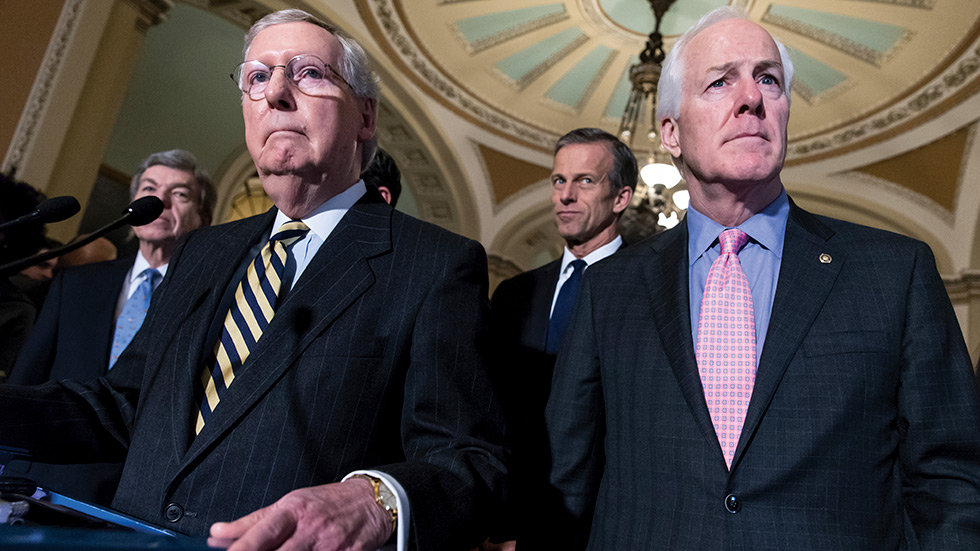
© Associated Press / J. Scott Applewhite | Sens. Mitch McConnell (R-Ky.) and John Cornyn (R-Texas) in 2016.
The new Democrats joining the group are Sens. Cory Booker (N.J.), Mark Kelly (Ariz.) and Debbie Stabenow (Mich.), a member of the Democratic leadership. Sen. Angus King (Maine), an independent who caucuses with Democrats, also signed on.
As Biden and others have already noted, this package is more modest than what the party would pass if it had its druthers. The House approved a measure last week that would raise the age to purchase a semi-automatic weapon from 18 to 21 and nationalize red flag laws. It has no chance of passage in the Senate.
Related Articles
▪ Alexander Bolton, The Hill: How gun talks are weighing on Cornyn’s candidacy for Senate GOP leader.
▪ The Wall Street Journal: Why Congress won’t ban assault weapons.
▪ Politico: Sen. Marco Rubio (R-Fla.) embraces his low-key side.
LEADING THE DAY
➤ CONGRESS
Three hearings this week convened by the House Jan. 6 committee will feature prominent witnesses who will describe how former President Trump and his allies allegedly conspired to overturn what they knew to be the lawful results of the 2020 presidential election, leading to a mob attack on the Capitol.
▪ The Hill: Hearings to focus on Trump’s “dereliction of duty,” committee member Rep. Elaine Luria (D-Va.) told NBC News’ “Meet the Press” on Sunday.
▪ The Hill: Trump’s “Big Lie” to take center stage during today’s Jan. 6 hearing.
▪ The Associated Press: What’s next for the Jan. 6 panel.
Former Trump campaign manager Bill Stepien, who was subpoenaed to be among witnesses this morning, reportedly “supervised the conversion” within Trump’s campaign around “Stop the Steal” messaging and associated fundraising, the committee says. That messaging “included the promotion of certain false claims related to voting machines despite an internal campaign memo in which campaign staff determined such claims were false,” according to House investigators (The Hill and The New York Times).
The committee wants to flesh out its narrative with a brisk lineup of witnesses to make the case that Trump and his top lieutenants knew in November that Trump lost the election, pressured state officials to support false claims and asserted unfounded election fraud in dozens of lawsuits later lost in courts nationwide.
Other witnesses today will include former Fox News political editor Chris Stirewalt; former U.S. Attorney for the Northern District of Georgia Byung J. “BJay” Pak; longtime election attorney for Republicans Benjamin Ginsberg; and Al Schmidt, former city commissioner of Philadelphia.
Stirewalt — now with cable’s NewsNation, part of Nexstar, which also owns The Hill — was part of a team at Fox News that made the 2020 decision to correctly call Arizona for candidate Biden on election night, a move that infuriated Trump and his top aides, some of whom reportedly complained directly to Fox leadership about the relatively early race call.
Rep. Adam Schiff (D-Calif.), a longtime Trump critic, Jan. 6 panel member and House Intelligence Committee chairman, said on Sunday that he wants potentially criminal aspects of evidence uncovered by investigators to be weighed by the government’s top law enforcers. “I would like to see the Justice Department investigate any credible allegation of criminal activity on the part of Donald Trump,” he said (The Associated Press).
The panel’s Wednesday hearing will turn to witnesses who served in the Justice Department at the end of the Trump term who have said they were encouraged to spread “false stolen election claims in the days before Jan. 6,” which they say they made clear to Trump were untrue. Former acting Attorney General Jeffrey Rosen will testify, among others (Bloomberg News). Rosen succeeded former Attorney General William Barr after he resigned in December 2020. Rosen has previously said he refused to cooperate with a White House pressure campaign to assert election fraud that did not exist.
Thursday’s hearing will focus on Trump’s efforts to pressure former Vice President Mike Pence to stop Congress from certifying some electoral votes for Biden on Jan. 6 — something the vice president had no power to do and refused to do. Former Pence aide Greg Jacob will testify (NBC News and Newsweek).
▪ The Hill: How the Jan. 6 panel is trying to reach the apathetic and apoplectic.
▪ The Hill: More than 20 million TV viewers tuned in to Thursday’s prime-time House hearing, according to Nielsen estimates.
▪ The Hill’s Memo, Niall Stanage: Jan. 6 hearings open a new front in the battle to control the political agenda.

© Associated Press / Andrew Harnik | House panel investigating the Jan. 6 attack on Thursday.
IN FOCUS/SHARP TAKES
➤ ADMINISTRATION
Inflation in the United States and Europe is sky high. Gas prices average more than $5 a gallon in this country and rise daily, much to the chagrin of consumers. And the Federal Reserve on Wednesday is expected to announce another interest rate hike on Wednesday as it taps the economic brakes hoping to tame inflation while also averting a U.S. recession.
Many economists have their doubts. Even Treasury Secretary Janet Yellen has said the Fed will need “luck.”
Biden’s 2021 hopes have been dashed that the administration and Congress would manage the pandemic and stimulus spending to bolster a good-news economic rebound in a midterm election year. U.S. demand outpaced supply and the highest inflation in four decades arrived, reports The Hill’s Sylvan Lane.
Republican critics say Biden is disingenuous at best in trying to blame Russian President Vladimir Putin, COVID-19, shippers and Congress for higher prices for goods and services while also telling voters inflation is his No. 1 priority as president (New York Post).
Former Treasury Secretary Larry Summers, who served both the Clinton and Obama administrations, has been increasingly critical of the Fed during interviews and asserts a data-driven case that a U.S. recession is “more likely than not” in the next two years (The Hill and Bloomberg Television).
The Hill and The Washington Post: Gas prices present a glaring problem for Biden.
Axios: Biden is planning to visit Israel and the Palestinian Authority on July 14 and 15, and travel from there to Saudi Arabia on July 15, according to Israeli officials. The White House has not confirmed those dates. The tentative agenda for the visit to Saudi Arabia includes a summit with the leaders of Bahrain, Egypt, Jordan, Kuwait, Iraq, Oman, Qatar, the United Arab Emirates and Saudi Arabia, Axios previously reported.
Biden said Saturday that any trip he might make to Saudi Arabia in a few weeks will not relate to leaning on the kingdom to pump more oil (The Hill). “The commitments from the Saudis don’t relate to anything having to do with energy,” he told reporters. “It happens to be a larger meeting taking place in Saudi Arabia. That’s the reason I’m going,” he added, seeming to confirm his travel plans.
“And it has to do with national security for them, for Israelis,” he continued. “It has to do with much larger issues.”
▪ The Hill: Biden’s political gamble with any Saudi Arabia stop.
▪ The Associated Press: “Great resignation” reaches White House with staff turnover.

© Associated Press / Evan Vucci | President Biden on Saturday.
➤ POLITICS
Another week, another set of primaries as voters in South Carolina, Nevada, Maine and North Dakota head to the polls on Tuesday.
The GOP side is rife with interesting races that could result in major upsets, be tell-tale signs of Trump’sstanding within the GOP or offer clues for the future of the party in the coming weeks and months.
On the Senate side, all eyes are on Nevada where former state Attorney General Adam Laxalt (R), the presumptive nominee, has found himself in a tough fight with Sam Brown, a U.S. Army veteran and a small business owner. According to a poll released last week by Ohio Predictive Insights, Laxalt leads with 48 percent to 34 percent for Brown.
Unsurprisingly, Trump’s support is playing a big role for Laxalt.
“Trump’s endorsement was important in that race,” said Greg Ferraro, a Nevada-based GOP strategist who advised former Gov. Brian Sandoval (R), who predicted that Laxalt wins by a low double-digit margin. If Brown has any chance to pull the upset or even cut into that margin, it’s going to have to be the grassroots that does the trick, he added.
“Superior boots on the ground equals an Election Day surprise showing,” Ferraro continued, adding that it’s not clear either side has an advantage on the ground. “Republicans traditionally vote in bigger numbers on Election Day, so maybe there’s a chance, but I think this race is cooked.”
Trump’s standing is also under the microscope in South Carolina in a pair of congressional races as he looks to unseat Reps. Nancy Mace (R) and Tom Rice (R), the latter of whom is among the 10 House Republicans who voted to impeach him for his role in the Jan. 6 Capitol riot.
▪ The New York Times: Two targets of Trump’s ire take different paths in South Carolina.
▪ The Hill: Why House Majority Whip James Clyburn (D-S.C.) is flexing his political muscles in this year’s primaries.
▪ The Associated Press: Vulnerable Democrats run against Washington — and their party.
Meanwhile, Democrats in the Battle Born State are pushing for their presidential contest to become the first-in-the-nation primary in 2024, a move that would not only shake up the primary process but also highlight the growing importance of Latino and Asian American voters.
As The Hill’s Julia Manchester writes, Democratic activists have pointed to a number of factors why they should jump the line, with the state’s strong union presence serving as a prime example. However, it’s Nevada’s growing Latino and Asian American populations that are the driving force for the potential move as activists argue Democrats should work to win over the two groups amid growing concerns that their support for the party is waning.
▪ The Hill: Rep. Alexandria Ocasio-Cortez (D-N.Y.) declines to say if she’ll endorse Biden in 2024.
▪ Tal Axelrod, The Hill: Seven key primary races still to come before November.
▪ The Associated Press: Sarah Palin nabs early lead in Alaska House special primary.
📝 Introducing NotedDC, The Hill’s curated commentary on the beat of the Beltway. Click here to subscribe to our latest newsletter.
OPINION
■ The Senate’s bipartisan gun deal is an encouraging first step, by The Washington Post editorial board. https://wapo.st/3zxm9xY
■ There has to be a better way to run the government, by Ezra Klein, columnist, The New York Times. https://nyti.ms/3NNSbtX
WHERE AND WHEN
The House meets at noon.
The Senate convenes at 3 p.m. and resumes consideration of the Honoring our PACT Act of 2021, which is expected to pass with bipartisan support. The bill would expand eligibility for Veterans Affairs health care for post-9/11 combat veterans, including those exposed to toxic chemicals. A slightly different measure passed the House by a 256-174 vote (The Hill).
The president returns to the White House at 12:05 p.m. from Delaware. He receives the President’s Daily Brief at 12:30 p.m. in the Oval Office. Biden will sign into law at 2 p.m. the “Commission To Study the Potential Creation of a National Museum of Asian Pacific American History and Culture Act.”
Vice President Harris will join the president for the East Room bill signing at 2 p.m.
Secretary of State Antony Blinken will host a working lunch at noon with South Korean Foreign Minister Park Jin at the State Department. The two diplomats will participate in a joint press conference at 1:45 p.m.
The White House daily briefing is scheduled at 3 p.m.
The Bipartisan Policy Center hosts the first in a series of live debates beginning in Boston at noon between Sen. Bernie Sanders (I-Vt.) and Sen. Lindsey Graham (R-S.C.). Bret Baier of Fox News will moderate and Fox is streaming the event.
🖥 Hill.TV’s “Rising” program features news and interviews at http://thehill.com/hilltv, on YouTube and on Facebook at 10:30 a.m. ET. Also, check out the “Rising” podcast here.
ELSEWHERE
➤ INTERNATIONAL
Russia on Sunday destroyed a bridge connecting Sievierodonetsk to Lysychansk, its twin city, cutting off an escape route for civilians and Ukrainian forces as intense fighting continues in one of the preeminent battles of the nearly four-month war. According to Reuters, Russian forces have taken most of the city, though Ukrainian troops are in control of an industrial area and chemical plant that is sheltering hundreds of civilians.
The Associated Press: The battle of Donbas could prove decisive in the Ukraine war.
In France, President Emmanuel Macron’s centrist alliance will likely keep its parliamentary majority after the first of two rounds of voting. According to projections, Macron’s party and its allies received nearly 26 percent of the vote (The Associated Press).
➤ PANDEMIC & POX
Reminder: On Sunday night, the U.S. pre-departure testing requirement ended for travelers returning to the United States. The Centers for Disease Control and Prevention continues to recommend COVID-19 testing prior to air travel of any kind and could reinstate a pre-departure testing requirement, if needed later (CNN). The airline industry wanted the change, but may not be ready for it (Bloomberg News).
The Food and Drug Administration on Sunday said that Pfizer’s COVID-19 vaccines appear to be safe and effective for children younger than 5, a key step toward a long-awaited decision to begin vaccinating the youngest American children. The FDA plans a Wednesday meeting where outside experts will vote on whether the shots are ready for the nation’s 18 million babies, toddlers and preschoolers. Youngsters under 5 are the only group not yet eligible for COVID-19 vaccination in this country (The Associated Press and The Hill).
The Hill’s Nathaniel Weixel reports on why the Biden administration faces an uphill challenge to get children under age 5 vaccinated against COVID-19.
Massachusetts on Sunday confirmed two more cases of monkeypox in adult men, making a total of three known cases of the communicable disease since May (MassLive).
Total U.S. coronavirus deaths reported as of this morning, according to Johns Hopkins University (trackers all vary slightly): 1,011,275. Current average U.S. COVID-19 daily deaths are 284, according to the Centers for Disease Control and Prevention.
As of today, 77.2 percent of the U.S. population has received at least one dose of a COVID-19 vaccine and 66.1 percent is “fully vaccinated,” according to the Bloomberg News global vaccine tracker and the government’s definition. The percentage of Americans who have received third or booster doses is 3.1.
THE CLOSER

© Associated Press / Charles Sykes, Invision, AP | Ariana DeBose hosted the 75th Annual Tony Awards Show on Sunday.
And finally … A revival of Stephen Sondheim’s “Company” with a woman in the lead showcased the fondness Broadway has for the late iconic composer by earning five Tony awards on Sunday, including best musical revival during a celebration of theater. “The Lehman Trilogy,” an exploration of western capitalism through the fortunes of a single family during the financial crisis of 2008, won best new play, and there was much more (The Associated Press).
Host Ariana DeBose told the crowd it was the season “Broadway got its groove back,” after singing to the song “This Is Your Round of Applause,” which mashed up musical theater favorites, such as “Chicago, “The Wiz,” “Evita,” “Rent,” “Hair,” “Cabaret,” “Hairspray” and “West Side Story,” the movie remake for which she recently won an Oscar.
Variety lists the 75th Annual Tony Awards winners HERE.
Stay Engaged
We want to hear from you! Email: Alexis Simendinger and Al Weaver. Follow us on Twitter (@alweaver22 & @asimendinger) and suggest this newsletter to friends!
Source: TEST FEED1
Share:
Juan Williams: How the GOP stokes white fear of Black gun violence
The GOP, an 83 percent white party, has found the villain behind its own failure to seriously grapple with gun violence.
The bad guys are Blacks and Latinos.
Say what? Let’s listen.
It was “two black racists [who] killed eight police officers in Dallas and Baton Rouge” in 2016, Sen. Chuck Grassley (R-Iowa), said at a Senate hearing last week.
Here’s Sen. Ted Cruz (R-Texas), also trying to dilute ties between gun violence and white supremacists, identifying a New York gunman who shot at people in a subway as a “Black supremacist.”
Here’s Sen. Mike Lee (R-Utah), at the same hearing of the Senate Judiciary Committee. He identified an Asian woman and a Black man as the villains who threw “a Molotov cocktail into a police vehicle during the antifa riots.”
The Washington Post’s Dana Milbank picked up on those senators’ comments in a column last week. And they’re part of a larger pattern.
From Arizona, here is GOP Senate candidate, Blake Masters. He said the real gun problem is coming from “people in Chicago, in St. Louis, shooting each other. Very often, you know, Black people, frankly.”
The core logic from these white, male, right-wing conservatives falls apart if the listener knows that mass shootings in the U.S. are overwhelmingly committed by white gunmen.
More than half of the mass shootings committed in the U.S. since 1982 have been by whites, 53 percent. The perpetrator was Black or Latino in 25 percent of the cases, according to a report by Statista published last week.
The white senators’ flawed thinking ignores the reality it was right-wing attacks, often rooted in white supremacy, that led to “28 of 30 political violence fatalities” in 2021, as Milbank noted based on data from the Center for Strategic and International Studies.
Sen. Amy Klobuchar (D-Minn.) said at the Senate hearing that FBI statistics show “of the racially or ethnically motivated violent extremists it was investigating in 2020…87 percent were white supremacists.”
Klobuchar added, “White supremacist violence is a nationwide problem.”
I have been criticized by liberals for saying the biggest statistical threat to my life is a gun in the hand of another Black person.
Now the surge in gun violence by white men requires the same honest debate about race and guns.
Part of that honesty comes in acknowledging that the outline of the modest bipartisan deal on guns revealed on Sunday does not seriously tackle America’s gun epidemic.
More broadly, listening to Republicans oppose any limits to gun ownership is to hear a racial argument on a loop.
They posture as martyrs daring to point out the epidemic of gunfire in big city minority neighborhoods to justify their opposition to oversight of the sale of guns.
Playing to fears of Black crime among whites is a sure bet to get attention for Republicans.
It got votes for former President Trump.
While speaking to overwhelmingly white audiences in 2016, Trump stirred up racial animus by saying “honestly, places like Afghanistan are safer than some of our inner cities.” Then he famously asked Black voters to vote for him by saying, “What the hell do you have to lose?”
Despite more than 250 mass shootings in the U.S. so far this year, Senate Republicans are imitating Trump in dealing with gun violence.
Having created a scary picture of life in Black and Brown America they promise that no one in their white base should have to go through background checks, age requirements, mental health reviews or limits on purchasing assault weapons and massive amounts of ammunition.
Implicit to their argument is that white Americans who want a gun should not be inconvenienced by the shocking gun violence now in our schools, grocery stores and churches.
Despite the crass politics, polls show most Americans, including most white Americans and most gun owners, favor background checks and limits on the sale of assault weapons.
Last week, polling showed “56 percent of gun owners say it is more important to curb gun violence than protect gun rights,” according to an NPR/PBS NewsHour/Marist poll.
Overall, the poll found that 59 percent of all Americans believe controlling gun violence is more important than protecting gun rights. Ninety-two percent of Democrats and 54 percent of independents are in this category.
But 35 percent of all Americans — including 70 percent of Republicans — think protecting gun rights should be the primary concern.
What goes unsaid in that poll is that 83 percent of Republicans are white, according to Gallup. The GOP also wins the backing of 57 percent of non-college-educated whites and 60 percent of rural southerners, according to a 2020 Pew Report.
It’s also worth noting that “three quarters of Black Americans say the Republican Party is racist,” according to a Washington Post/Ipsos poll conducted in April and May.
A Black man who lost his 86-year-old mother to a white gunman told the Senate panel last week, “My mother’s life mattered.” He told the senators that their “actions here today will tell us how much it matters to you.”
The Republicans in the Senate are not talking to him. They are talking up white fear.
Juan Williams is an author and a political analyst for Fox News Channel.
Source: TEST FEED1
Share:
Nevada Democrats’ bid to hold first primary underscores diversifying US
Nevada Democrats are pushing for the state to hold the first-in-the-nation primary in the next presidential cycle, a move that would not only shake up the primary process but also shine a spotlight on the growing importance of Latino and Asian American voters.
Democratic activists have pointed to a number of factors, including Nevada’s strong union presence, as arguments for why the state should go first in the party’s primary.
But it’s the state’s growing Latino and Asian American populations that are increasingly being cited in arguments for the state to go first, with activists saying Democrats should work to win over the two groups amid growing concerns over their popularity with those voters.
“There is a growing number of Democrats across the country that are supporting this effort to have a more diverse first state that is more reflective and representative of the entire American population and that is what Nevada is,” said Artie Blanco, a Nevada Democratic National Committee member as well as a member of the DNC’s Rules and Bylaws Committee. “Nevada is America in a sense.”
The state’s two most populous counties, Clark County and Washoe County, have seen major surges in population growth over the last decade. According to data from the 2020 Census, the Latino population increased by 23 percent in Clark County and 30 percent in Washoe County. Latinos make up a total of 29.2 percent of Nevada’s population, making it the fifth-highest share of Latinos of any state. Meanwhile, the state’s Asian American Pacific Islander population increased by 39.5 percent, making up over 8 percent of the state’s population. Nevada’s Black population grew by 39.4 percent, making up 9.8 percent of the population.
“I think our country looks more like Nevada than they look like Ohio or New Hampshire,” said Cecia Alvarado, Nevada executive director of Somos Votantes, a group aimed at engaging Latino voters.
Latino voters in particular have become a highly sought-after voting bloc, with Republicans and Democrats vying for their support. While Biden won the state’s Latino population in 2020, former President Trump, like in other states, appeared to make gains with Nevada Latino voters. According to data from Latino Decisions, 81 percent of Latinos in the state reported voting for then-Democratic nominee Hillary Clinton in 2016 and 16 percent voted for Trump. Four years later, 70 percent of the state’s Latino population voted for Biden and 25 percent supported Trump.
While the U.S. Latino vote is by no means a monolith, the trend in Nevada among Latino voters appeared to reflect a trend in other states where Republicans made gains with Latino voters. And polling shows that the trend could be an issue for Democrats going into the midterms.
A March survey from the Democratic firm Blueprint Polling showed that Latino voters favored Trump over Biden in the state by 19 percent in a hypothetical presidential rematch. In the governor’s race, 36 percent of Latinos said they supported incumbent Gov. Steve Sisolak (D), while 34 percent said they supported Republican gubernatorial primary frontrunner, Sheriff Joe Lombardo. Another 29 percent said they were undecided about the governor’s race.
The same poll showed incumbent Democratic Sen. Catherine Cortez-Masto (Nev.) tied with former state Attorney General Adam Laxalt in a hypothetical matchup among Latino voters. Twenty-three percent of Latino voters said they were undecided about the matchup.
Nevada Democrats said that making Nevada the first primary state will allow them to test their message with critical voting blocs, like the Latino vote, in an effort to further understand the issues and messages the group cares about.
“It’s really also a way to show that you can engage voters early on,” Alvarado said, adding that the geographic makeup of the state allows campaigns to “test what it looks like running early campaigns reaching Latino voters or reaching other communities.”
Sen. Jacky Rosen (D-Nev.) echoed this sentiment in an interview with The Hill.
“We are in every single community hearing what everybody’s worried about,” Rosen said. “And so in our Latino community as well as our other communities, we know what people are worried about, education for their kids, health care prescription drug prices. They may have other specific issues but overall, families worry about the same things.”
Rosen noted that making Nevada a first-in-the-nation primary would also be beneficial going into what are often nail-biter elections in the state. Biden won the state by less than three points in 2020 and the non-partisan Cook Political Report has rated the state’s upcoming Senate and gubernatorial races toss-ups.
“Nevada’s electorate reflects the entire country and the Democratic primary process needs to really understand that Nevada, of course, our state motto is ‘battle born,’ but that we’re battleground,” the senator said.
New Hampshire and Iowa have long lauded their states’ rich traditions of retail politics, with political candidates making appearances at state fairs and local diners and coming face to face with individual voters. However, Nevada Democrats say the same case can be made in their state as well.
The Culinary Union is a massive political force in the state when it comes to campaigning. The union is made up of 60,000 members in Las Vegas and Reno. Additionally, the union is the state’s largest immigrant, Latino, and Asian American Pacific Islander organization.
“The candidates come and there’s opportunities,” said Ted Pappageorge, Secretary-Treasurer for the Culinary Union. “But what really drives our members’ voting tendencies is door to door, workers talking to workers.”
“That worker-to-worker discussion is what moves folks because the truth of the matter is working people don’t necessarily like politicians,” he said. “We have to really bring folks to the door they trust and that’s their own coworkers.
Unlike in past years, Nevada will hold a primary instead of a caucus, a move that many say will expand the voting pool.
“The truth is, if you’re much more skilled at caucusing, you can win,” Pappageorge said. “In Nevada, we think the election process makes more sense and is more inclusive.”
Nevada’s Democratic Party submitted its application to be the first presidential primary to the Democratic National Committee last week, citing its diversity.
“As one of the single most diverse and fastest-growing states in the country, presidential candidates will be hearing voices that truly represent the changing needs, values, and vision of Americans,” the party said in a statement.
If Nevada does become a first in the nation primary state, it would not be the first time it jumped the calendar. In 2008, Democrats bumped South Carolina and Nevada up to the third and fourth spots, respectively.
But the party is facing competition from other state Democratic parties looking to move up in the calendar and others, like New Hampshire, which is trying to defend its coveted first-in-the-nation spot. Other states vying for the top spot include Michigan, Illinois, Nebraska, and Oklahoma. Iowa, which experienced a botched Democratic caucus in 2020 and lacks racial diversity among its voters, has been forced to reapply. Iowa Democrats have said they are seeking to simplify the caucus process in the state.
The DNC’s Rules and Bylaws Committee will start hearing pitches from states this month and a new early-state lineup is set to be recommended by July.
“Iowa and New Hampshire those states are great and wonderful,” Rosen said. “But they don’t reflect the face of the rest of the nation in the same way that Nevada does. And so to build that winning coalition that you’re going to need across the entire nation you need to hear the voices, you can hear them in Nevada, and I think the earlier people hear them, the better it is for everyone.”
Source: TEST FEED1
Share:
Democrats: Biden must drop the word ‘rational’ when talking about Republicans
Democrats say President Biden needs to stop calling some Republicans “rational” as he did last month, and instead call out the GOP for holding up key policy issues including gun control.
They say Biden’s views on the goodwill of Republicans are antiquated and that it ultimately undermines their party’s strategy in an election year.
“Biden and Democratic leadership have a fundamentally different mentality about how to win,” said Democratic strategist Christy Setzer. “They think it’s about appealing to the “middle” and showing that we’re reasonable and can play nicely even with intemperate people
“Maybe that’s how you win in a fair fight on the merits, but we haven’t had that game for a long, long time,” Setzer added. “Now, they need to show how insane the GOP is as compared to the majority of Americans who want, for example, ‘responsible gun ownership,’ who want to outright ban AR-15s. We’re the only rational ones left.”
Speaking to reporters last month about the ongoing gun control talks on Capitol Hill, Biden singled out Republicans, saying they could be helpful in the process.
“I consider McConnell a rational Republican. I mean, Cornyn is as well,” the president said of Senate Minority Leader Mitch McConnell (R-Ky.) and Sen. John Cornyn (R-Texas), both of whom he served alongside in the upper chamber. “I think there’s a recognition on their part that things can’t continue like this.”
When he went on ABC’s Jimmy Kimmel Live earlier this week, Biden paid yet another compliment to McConnell.
“I’ve always had a straight relationship with the majority, the Republican leader, Mitch McConnell, he’s a guy that when he says something, he means it,” Biden told Kimmel. “I disagree with a lot of what he says, but he means it.”
But Democrats are taking issue with that bipartisan strategy.
“On the one hand, I get what he’s trying to do in that he doesn’t want to unnecessarily box Republicans in,” said Democratic strategist Jim Manley, who served as a senior aide to the late Senate Majority Leader Harry Reid (D-Nev.)
“But the idea that he goes on Jimmy Kimmel and calls McConnell his good friend is infuriating and indicates once again that he doesn’t understand how much the Republican Party has changed since he left the Senate,” Manley added.
“I have no idea whether he believes it or not but Sen. McConnell is no one’s friend and the Republican Party has no interest in helping him to legislate.”
Manley said Biden should have learned his lesson from the Obama era, when Republicans sought to block the former president’s legislative priorities at every turn.
“What’s especially infuriating is as vice president, he had a front row seat to Senate Republicans trying to undermine Obama’s presidency,” Manley added. “It’s sheer madness.”
Another strategist agreed.
“It’s not that he wishes we could go back to a better time, or doesn’t like calling out Republicans by name versus trying to negotiate, it’s does he actually believe they’re trying to help him? Because then it’s a much larger strategic problem,” said one Democratic strategist.
“…This is history repeating itself,” the strategist said. “Obama thought they could deal, this gave McConnell the power to intentionally delay and kill stuff knowing the blowback would be on Obama who promised to make the place work again.
“When Obama finally realized that and whipped out his pen, his numbers shot back up again,” the strategist added.
Democrats have grown increasingly frustrated with Biden in recent months, as issues including record-high inflation and soaring gas prices continue to dominate the news cycle with little end in sight.
The Democrats worry that Biden has appeared flat-footed on the issues, including the recent shortage of baby formula, and have urged him to be more proactive.
Polls also indicate that Americans have lost patience with Biden.
An NPR/PBS/Marist College poll out on Thursday showed Biden with the lowest approval rating since the start of his administration at 38 percent. A Quinnipiac University poll which also came out this week revealed that Biden has a 33 percent approval rating.
But some Democrats say Biden needs all the options available to him, even if that means telegraphing his relationship with Republicans, an element that helped catapult him to the White House when he touted his history in the Senate and his long-standing friendships with those across the aisle during his presidential campaign.
“Everyone in the political ecosystem has a role and the president’s role is to keep options and pathways open,” said Joel Payne, the Democratic strategist. “By definition Mitch McConnell needs to be one of those pathways.
“That does not mean that others cannot use sharper language or sharper descriptors for McConnell but the president needs to be able to maintain the flexibility to work with Republicans,” Payne said.
When he appeared on Kimmel’s show this week, Biden acknowledged that the Republican Party had changed in recent years.
“This is not your father’s Republican Party,” he told the late-night host. “This is a MAGA party, a very different Republican Party and you find people who are worried, I believe, that if they vote for rational gun policy, they’re gonna be primaried and they’re going to lose in a hard-right Republican Party.”
But Democrats say that kind of dialogue isn’t enough.
“He needs to say, ‘This is who we are, and this is who they are,” the strategist said. “And I mean completely spell out who they are.”
Source: TEST FEED1
Share:
Why Biden's bet on a rapid economic rebound may have backfired
President Biden’s bet on a rapid rebound from the coronavirus recession may have backfired.
The president and his top economic officials rallied Democrats around a $1.9 trillion stimulus bill in March 2021, urging Congress not to repeat the mistakes of the Great Recession and cut off support for the economy too soon. The bill was also Biden’s way of delivering on the promise made during the pivotal Georgia Senate runoffs, which gave his party a slim Senate majority: elect Democrats and get another round of stimulus checks.
Just more than a year after Biden signed the bill, U.S. unemployment rate is nearly at pre-pandemic levels, the economy has added more than 10 million jobs, and gross domestic product is well above where it was when COVID-19 shattered the economy. By those measures alone, the recovery under his watch was far stronger than the slow trudge out of the Great Recession.
But despite the rapid rebound, Biden’s approval rating is at all-time lows as Americans feel the brunt of high inflation — a risk few within and beyond the administration took seriously when he signed the American Rescue Plan (ARP).
Consumer prices rose 1 percent in May alone and by 8.6 percent over the past 12 months, according to data released Friday by the Labor Department. Prices for food, gasoline, shelter and travel led the May inflation burst, giving Americans few ways to avoid higher prices.
“The Fed and the White House were trying to avoid the kind of long slog decade-long recovery that there was after the Great Recession,” said Skanda Amarnath, executive director at research non-profit Employ America.
“For some people, there was a certain complacency about inflation as a possibility. That’s probably true too. But that was viewed as a much more remote tail risk.”
It’s a risk voters are feeling. Eighty-five percent of voters said they think inflation is a very serious or somewhat serious problem, according to an Economist/YouGov poll from earlier this month. In the same, poll, 44 percent of respondents said Biden has “a lot” of responsibility for the inflation rate and 31 percent said he has “some.”
Top Biden administration and Fed officials — along with dozens of economists — expected inflation to cool off last year as the world adjusted to life after COVID-19. Vaccination campaigns, reopening schools and a shift in spending from goods to services all figured to bring prices down and workers back into the job market.
But COVID-19 adjusted quicker. The emergence of the delta and omicron variants didn’t curb consumer spending or cost the economy jobs. Instead, it shifted a glut of saved-up money toward goods, which had been in high demand since the start of the pandemic, instead of services.
The new variants also led to factory shutdowns, port backlogs and other pandemic-related snarls, making it even harder for manufacturers and suppliers to meet even higher demand powered in part by federal stimulus.
“Inflation wasn’t transitory because COVID was not transitory. Parts of China are still locked down. We’re not even through the COVID shock,” said Claudia Sahm, a former Federal Reserve research director.
And while some of those pressures have begin to ease, the war in Ukraine has pushed inflation even higher with severe shocks to the global supply of oil, natural gas, wheat and other crucial commodities.
“There were people at the time who said given the gap, given how many people we have out of work, the American Rescue Plan is more than enough. That seems it could be especially true if you counted the excess savings as energy stored in the battery that could be used to get the economy rolling,” said Alan Cole, former chief economist for Republicans on the Joint Economic Committee.
“The US has had higher inflation generally than most advanced economies, and I don’t think anyone’s saying the ARP created all of it—or if they are, they are not telling the truth. But the ARP kind of contributed more at the margins.”
Republican lawmakers, who voted in unison against the American Rescue Plan, have claimed vindication after warning Biden’s bill would trigger an inflation spiral. GOP lawmakers have centered their midterm campaign message — including their response to the Capitol riot investigation — around Biden’s failure to keep prices stable as the economy expanded.
“[My] constituents ask me about the historic gas prices, skyrocketing inflation, and the baby formula shortage,” tweeted Rep. Elise Stefanik (R-N.Y.), the third-ranking House Republican, on Thursday.
“Why aren’t Democrats holding primetime hearings about these crises impacting the American people?”
Stefanik’s barb came two days after Treasury Secretary Janet Yellen admitted to lawmakers during House and Senate hearings that the administration misjudged inflation and likely spurred it higher through the stimulus plan. Yellen defended the ARP’s role in spurring the economy, though she acknowledged how critical it would be for the administration to balance out its impact on the economy.
Most economists say it’s hard to blame the White House for trying to repair the economy as quickly as possible. Even former Treasury Secretary Larry Summers, the top Democratic critic of Biden’s economic policy, spurned the ARP because he believed the money would be better spent on the president’s broader Build Back Better agenda. That bill has fallen by the wayside amid concerns from Sen. Joe Manchin (D-W.Va.) about its potential impact on inflation.
Even so, experts agree there is far more Biden could do to try to bring prices down.
In a fiery Friday speech, Biden blasted big oil companies for reeling in record profits instead of expanding production with gas prices above $5 per gallon on average nationwide.
“Why don’t they drill more? Because they make more money not producing oil. Prices go up on the one hand. No. 2, the reason they are not drilling is they are buying back their own stock, should be taxed quite frankly. Buying back their own stock and not making new investments,” he said.
But Amarnath said Biden should work with the industry to increase output through agreements to purchase oil for the federal reserve at set prices, giving them cover if market prices for oil go down amid the glut of products. Amarnath also said the U.S. government should deploy the Treasury Department’s exchange stabilization fund (ESF) to help keep prices down for crucial commodities hindered by the war in Ukraine, sanctions on Russia and Chinese lockdowns.
“Having some individualized attention on these markets would help but you’d have to really do that systematically ahead of time. That takes a lot of work and that kind of work, just to be blunt, doesn’t happen anywhere within the government.”
Sahm also expressed concerns about Biden’s plan to lean on the Fed to bring down inflation when much of the forces driving prices higher are beyond the bank’s control.
“[The Fed] should have moved sooner last year and it probably would have had some effect on inflation, but it would have had no effect on food and gas prices,” Sahm said.
“When the Fed lowers inflation, it does it by reducing people’s ability to spend. It’s not a happy way that we get inflation down,” she continued. “The Fed’s lever is impoverishing people. Hardship in the United States is never equally shared.”
Source: TEST FEED1
Share:
This week: Jan. 6 hearings continue, Senate to move toxic burn pits bill
The Jan. 6 select committee is scheduled to hold three more public hearings this week, as the panel looks to sell its case to the American people that former President Trump was at the heart of a plan to keep himself in power.
The hearings — set for Monday, Wednesday and Thursday — come after the select committee held a prime-time hearing last week that featured emotional live testimony, gripping new footage of the Jan. 6 attack, and clips of people in Trump’s inner circle speaking with the panel’s investigators.
The next three hearings, scheduled to take place during the day, are set to focus on how Trump knew his allegations of election fraud were false, his efforts to compel the Department of Justice (DOJ) to open probes into his claims, and the then-president’s attempts to pressure Vice President Mike Pence to block the election certification on Jan. 6.
Each hearing will center on a component of Trump’s “sophisticated seven-part plan to overturn the presidential election and prevent the transfer of presidential power,” Rep. Liz Cheney (R-Wyo.), the vice chair of the panel, said last week.
On the Senate side, lawmakers will continue consideration of toxic burn pits legislation, which would increase Veterans Affairs (VA) health care eligibility for veterans exposed to toxic burn pits. Passage of the bill could happen as soon as this week.
Senators will also likely be discussing and weighing in on the newly announced bipartisan agreement on firearm legislation, which laid out nine proposals to deter gun violence.
Jan. 6 hearings
The select committee’s second hearing, scheduled for 10 a.m. on Monday, will center on Trump’s “big lie,” focusing on how the president knew his claims of election fraud were false.
“Tomorrow’s hearing is focused on the big lie: the decision by the former president to ignore the will of the voters, declare victory in an election he lost, spread claims of fraud and then decide to ignore the rulings of courts when the judgment of course didn’t go his way,” a committee aide told reporters on a call.
“The former President didn’t have the numbers to win the election; he was told, he chose to declare victory anyway. The claims of fraud the former president embraced were baseless. He was told that again and again, and he continued to repeat those claims anyway,” the aide added.
To make that case to the public, the committee is set to hear testimony from former Trump campaign manager Bill Stepien, who led the ex-president’s 2020 reelection campaign.
The panel issued Stepien a subpoena in November, writing that he “supervised the conversion” of Trump’s presidential campaign around “Stop the Steal” messaging and fundraising.
Stepien also reportedly led a campaign “asking states to delay or deny certification of electoral votes and by sending multiple slate of electoral votes to the United States Congress,” according to the committee.
The former campaign manager is currently an advisor to the campaign of Harriet Hageman, the Wyoming Republican mounting a primary bid against Cheney. Hageman has Trump’s endorsement.
Chris Stirewalt, the former Fox News political editor, will testify alongside Stepien on Monday, according to the committee. Stirewalt was among the group of people at Fox News who decided to declare President Biden the winner of the 2020 presidential election in Arizona.
In a second panel on Monday, former U.S. Attorney for the Northern District of Georgia BJ Pak, ex-Philadelphia City Commissioner Al Schmidt, and conservative election attorney Benjamin Ginsberg are scheduled to testify.
The hearing will mark the first time Pak has spoken publicly since resigning from his post. He stepped down after Trump became outraged when the DOJ would not probe his claims of voter fraud. Schmidt, a Republican, became a target of Trump’s anger when he declined to call the 2020 presidential election rigged.
Wednesday’s hearing, scheduled to begin at 10 a.m., will focus on Trump’s efforts to compel the DOJ to launch a probe into his claims of election fraud in an effort to delay the election certification, according to Cheney.
The vice chair said the panel will illustrate that “President Trump corruptly planned to replace the Attorney General of the United States so the U.S. Justice Department would spread his false stolen election claims.”
And on Thursday, the panel will center its presentation on Trump’s attempts to pressure Pence to block the certification of the election results.
The committee has not yet released the witnesses for the third and fourth hearings. The panel has said it will hold eight hearings in total.
Toxic burn pits legislation
The Senate will continue its consideration of toxic burn pits legislation this week, with potential passage as soon as Wednesday.
The bill, titled the Honoring our PACT Act, seeks to broaden health care eligibility for veterans who were exposed to toxic burn pits. To achieve that, the legislation would establish a presumption of service connection for about two dozen types of cancers and respiratory illnesses, such as chronic bronchitis and asthma.
The Senate filed cloture on the bill last week. The upper chamber is slated to hold two amendment votes on the legislation before final passage.
The House passed the toxic burn pits legislation in March, 256-174. The vote mainly broke along party lines, with just thirty-four Republicans joining Democrats in supporting the measure.
Sen. Jon Tester (D-Mont.), chairman of the Veterans Affairs Committee, called on the Senate to pass the bill in the coming days.
“This week, Congress must do right by our toxic-exposed veterans and pass the bipartisan Sergeant First Class Heath Robinson Honoring Our PACT Act. Our vets and their families cannot wait any longer,” Tester wrote on Twitter Sunday.
Last week on the Senate floor, Tester said the upper chamber was “on the verge of honoring our commitment to our country’s toxic exposed veterans and their families.”
Gun talks
Senators unveiled a bipartisan gun agreement on Sunday with 10 Democrats and 10 Republicans signing on in support, giving it a good chance of passing the full chamber.
The announcement was the culmination of two weeks of bipartisan negotiations, which began after last month’s mass shootings in Buffalo, N.Y. and Uvalde, Texas. Ten Black people were killed at a grocery store in Buffalo, and 19 students and two adults were fatally shot at an elementary school in Uvalde.
The group of 20 senators called the agreement “a commonsense, bipartisan proposal to protect America’s children, keep our schools safe, and reduce the threat of violence across our country.”
The agreement announced on Sunday only represents a framework of principles — the senators still have to release legislative text.
The nine-point proposal would give states and tribes resources to establish red flag laws — which seek to keep firearms away from people deemed a threat to themselves and others — and invest in mental health and suicide prevention programs.
Additionally, the plan would put resources into programs to establish safe measures in and around schools, require enhanced reviews of gun buyers under 21 years old, and enact penalties for straw purchases of guns — when individuals who cannot clear a background check buy guns firearms through a proxy.
President Biden on Sunday said he would sign the proposal, writing in a statement that it “would be the most significant gun safety legislation to pass Congress in decades.”
“With bipartisan support, there are no excuses for delay, and no reason why it should not quickly move through the Senate and the House,” he said. “Each day that passes, more children are killed in this country: the sooner it comes to my desk, the sooner I can sign it, and the sooner we can use these measures to save lives.”
The president noted, however, that the proposal “does not do everything that I think is needed, but it reflects important steps in the right direction.”
Source: TEST FEED1
Share:
‘Forever chemicals’ linked to high blood pressure in middle-aged women: study
Middle-aged women who have greater blood concentrations of toxic “forever chemicals” may be at greater risk of developing high blood pressure, a new study has found.
These women were more likely to become hypertensive than those who had lower levels of the compounds, also called per- and polyfluroalkyl substances (PFAS), according to a study published on Monday in the American Heart Association journal Hypertension.
Notorious for their presence in jet-fuel firefighting foam and in industrial discharge, PFAS are a set of synthetic chemicals found in a wealth of household products, including nonstick pans, waterproof apparel and cosmetics.
“PFAS are known as ‘forever chemicals’ because they never degrade in the environment and contaminate drinking water, soil, air, food and numerous products we consume or encounter routinely,” lead author Ning Ding, a postdoctoral fellow in the department of epidemiology at the University of Michigan School of Public Health, said in a statement.
Thus far, scientists have demonstrated a “probable link” between PFAS and diagnosed high cholesterol, ulcerative colitis, thyroid disease, testicular cancer, kidney cancer and pregnancy-induced hypertension. This latest study extends that last category to another subset of women.
“Women seem to be particularly vulnerable when exposed to these chemicals,” Ding said.
“Our study is the first to examine the association between ‘forever chemicals’ and hypertension in middle-aged women,” she continued. “Exposure may be an underappreciated risk factor for women’s cardiovascular disease risk.”
Ding and her colleagues drew these conclusions by harnessing data from the Study of Women’s Health Across the Nation-Multi-Pollutant Study, an initiative launched in 2016 to investigate the impacts of multiple environmental chemical exposures on mid-life women from diverse racial and ethnic backgrounds.
The researchers examined blood concentrations of PFAS and the risk of high blood pressure among more than 1,000 women, ages 45 to 56 years old, who had normal blood pressure when they enrolled in the study.
The women were tracked almost annually from 1999 to 2017 and were recruited from five sites across the country, according to the authors.
Of the study’s 11,722 “person-years” — the number of years multiplied by the members of an affected population — 470 women developed high blood pressure, the scientists found.
Women with higher levels of specific types of PFAS, of which there are thousands, were more likely to develop hypertension, according to the study.
Those who fell in the highest one-third for levels of PFOS, PFOA and PFOS precursor EtFOSAA incurred 42 percent, 47 percent and 42 percent greater risk of developing high blood pressure respectively, compared to women in the lowest one-third.
Women in the highest one-third for all seven types of PFAS investigated had a 71 percent increased risk of developing high blood pressure, the authors found.
“We have known for some time that PFAS disrupt metabolism in the body, yet, we didn’t expect the strength of the association we found,” senior author Sung Kyun Park, an associate professor of epidemiology and environmental health sciences at the University of Michigan School of Public Health, said in a statement.
“We hope that these findings alert clinicians about the importance of PFAS and that they need to understand and recognize PFAS as an important potential risk factor for blood pressure control,” Park added.
Source: TEST FEED1