

Share:
Webb: 2022 electoral midpoint
Monday, June 6, was the longest calendar day of 2022, the anniversary of Operation Overlord that helped free the European continent and a day when we thank the greatest generation. Someone remind Joe Biden and his administration of this. We have not officially reached the calendar-based halfway point of 2022, which will be on July 1, but Tuesday, June 7, marked a relative midpoint for political primaries across the country. Seven states — California, Iowa, Mississippi, Montana, New Jersey, South Dakota and New Mexico — have held a variety of primaries up and down the ballot, as well as the congressional midterms.
Biden is not fully incompetent when it comes to politics, but he is a proven, skilled political liar. He knows how to use whatever is necessary to stay in power. He has and will continue to wield whatever he can, from the Oval Office to the bureaucracies and agencies to cultural events, tragic or otherwise, to his own end. Ignore the distractions. Just as much as I do not like palace intrigue stories when told about Republicans, I do not waste time on palace intrigue for Democrats in the White House.
Be wary of smart defense played by the media to soften the hard realities of Democrat failures. It is effective strategy to get a story out of the way early because of the short-term memory of the American voter. Case in point is the Hunter Biden story, the Trump-Russia collusion prosecution, the political theater of the Jan. 6 commission or any new issue that may arise or be revisited between now and Nov. 8.
Here are perspectives that go from Main Street to the Capitol Club in Washington, D.C.
Municipal and county Republican parties
Take nothing for granted at the local level. this is where political aspirations begin, and if the right people are not chosen, trained and elected, the proven incumbency rate of holding a seat becomes the hindrance to changes. Find a way to get involved and learn how the system works, how it does not work well at times and, if possible, how to fix it.
State Republican parties
State GOP leaders continue to fail in many states where they have potential with either the politics of attrition to weaken Democrats, or where recent changes in issues and attention by the population offers them a chance to win seats. Case in point is the state of New Jersey, where the recent gubernatorial election showed a statewide trend that could take a deep blue state back into the purple column. Yet the state leadership has not shown itself to be active.
The National Republican Congressional Committee
The NRCC is the campaign arm for current Republican members and candidates. Yet beyond fundraising, it is questionable what coordination the committee truly has with other party structures. Raising money is important to run campaigns, but better cooperation and coordination with other party structures is necessary. Votes translate up and down ballots. For example, a strong state legislative candidate can help a congressional candidate or vice versa.
The Republican National Committee
Once the primaries are completed in each state, the RNC must successfully coordinate with local party leaders and the consultant class. Too often there are consultants who make their living on elections and not necessarily on a winning record. In simple terms, some in the consultant class need to go.
Activists, Democrats, special interest organizations or anyone interested in America over leftism
Pragmatism will produce more wins. The Reagan rule should be your guide. As an American, your 80 percent friend is not your 20 percent enemy.
Citizen responsibility, last but not least
If you are concerned about election integrity, then get off the sidelines and get involved. Work for a campaign, work the polls, become a poll watcher, or take on the important responsibility of being a challenger on Election Day.
Our system has been perverted, and there is much to do to fix it. This is the result of decades-long efforts by the left. It should be easy to vote and hard to cheat, but in fact now it is easier to cheat than ever before. Whether outcome determinant or not, cheating is cheating. Put aside your lack of faith in the system and focus on putting candidates in office who will help make our electoral system secure and effective for the American voter regardless of party affiliation.
First you win, then make “good and constitutional” policy.
One election cycle will not do it, but a successful change to constitutional governance and conservative principles led by the Republican Party is a needed start. The Republican Party is the registered voter, and the organizations mentioned here and others exist to ensure the platform is implemented successfully.
Webb is host of “The David Webb Show” on SiriusXM Patriot 125, a Fox Nation host, Fox News contributor and a frequent television commentator. His column appears twice a month in The Hill.
Source: TEST FEED1
Share:
Zelensky: Winter will be 'most difficult' for Ukraine
President Volodymyr Zelensky said late Tuesday that the upcoming winter season will be “the most difficult” in Ukraine’s history as an independent nation, adding that the country will not be selling gas and coal internationally to save the resources for its citizens.
During a virtual address to the nation, Zelensky said he and other government officials are preparing plans for the winter season.
“In the current situation due to Russia’s aggression, this will indeed be the most difficult winter of all the years of independence,” he said in the translated address. “But! Everything is alright. We must go through it so that our people feel the normal work of the state.”
He added that the officials, including Prime Minister Denys Shmyhal, also discussed “issues of purchasing a sufficient amount of gas for the heating season, coal accumulation, and electricity production,” later noting that the country will not be selling the resources abroad.
“All domestic production will be directed to the internal needs of our citizens,” Zelensky said.
He added that Ukraine is exploring ways to increase electricity export capabilities.
“And after the historical accession of our country to the unified energy network of Europe, such exports not only allow us to increase our foreign exchange earnings, but also directly influence the stabilization of the energy situation in neighboring countries, which reduce Russian energy consumption,” he said.
He also noted that any thermal power plants, as well as combined heat and power plants and boiler houses, that were destroyed by Russian strikes will be repaired through the Ministry of Energy of Ukraine.
The Ukrainian president emphasized that the government will try to ensure that gas and electricity tariffs don’t change in the heating season.
“People already face enough difficulties because of the war,” he added.
In the address, Zelensky also discussed the Russian invasion of Ukraine, noting the “absolutely heroic defense” of Donbas.
While it appeared that Ukrainian troops may be forced to pull back from the region, Zelensky told Ukrainians that the defense is still holding strong.
“It is felt, absolutely felt, that the occupiers did not believe that the resistance of our military would be so strong, and now they are trying to attract additional resources in the Donbas direction,” he said.
Source: TEST FEED1
Share:
Mellman: Polls vs. initiative results
Last week, The New York Times’s astute chief political analyst, Nate Cohn, raised serious doubts about polling on background checks for gun purchasers and, by extension, about the efficacy of issue polling generally.
The heart of his case: “When voters in four Democratic-leaning states got the opportunity to enact expanded gun background checks into law [through ballot initiatives], the overwhelming support suggested by national surveys was nowhere to be found.”
Cohn nods to the counterargument—“Initiative and referendum results are not a perfect or simple measure of public opinion”—but he seems to repose more faith in the ballot measure results than in the poll data.
I don’t.
You wouldn’t know from his article’s text that the background checks measures won in three of the four states, but Cohn’s argument is not about winning and losing.
A raft of polls find 80 percent to 90 percent of voters favoring background checks for all gun purchasers. Yet, ballot measures to do just that garnered far less support, with “yes” votes ranging from 48 percent to 63 percent.
Having done the polling for one of these measures (that won narrowly), and for scores of other high stakes initiatives, I conclude that initiative results are frequently poor measures of public opinion on the underlying issue.
First, ballot language usually transforms simple, clear ideas into complex, off-putting legalese.
A typical poll question on background checks from the ABC-Washington Post poll asked, “Would you support or oppose requiring background checks on all potential gun buyers, including private sales and gun shows?”
On the ballot voters saw, “Shall Chapter 202 of the Nevada Revised Statutes be amended to prohibit, except in certain circumstances, a person from selling or transferring a firearm to another person unless a federally licensed dealer first conducts a federal background check on the potential buyer or transferee?”
Much more complicated. Much less clear.
We tested several versions of potential ballot language, drafted by lawyers to describe the same measure. Support levels for the identical measure differed by 25 points, depending on the precise wording.
In studying hundreds of initiative polls on a host of topics, from taxes to gaming, medical research, vaccination mandates, abortion, education, civil rights, building projects and more, I’ve never seen ballot language that fares as well as the plain English version of the idea.
To offer but one example from another realm (in which we weren’t involved), polls consistently find 89 percent to 95 percent support for requiring labels on genetically modified food. Nonetheless, Washington state voters defeated a measure mandating such labels.
Public polls employing wording akin to the ballot language found support ranging from 45 percent to 66 percent — far lower than for the concept.
Second, there is the campaign. Defeating ballot measures is about finding the flaw in the law. The flaw need not be relevant to the core concept. Too often, if opponents can’t find a flaw, they invent one.
In the Nevada gun-show-loophole fight, opponents argued that lending your gun to your niece while hunting together would make you a criminal. Never mind that the measure specifically exempted such situations, a fact confirmed by law enforcement in ads.
Despite its falsity, the attack moved votes.
Opponents of the Washington GMO measure, hostile to any GMO labeling, sponsored ads suggesting the measure was a good idea that didn’t go far enough because it exempted some GMO foods. In essence they argued, “let’s have a stronger law.” Extremely disingenuous, but quite effective.
Finally, there’s the matter of identity. From the very beginning, we warned our Nevada clients that over half the electorate were gun owners, Republicans or both, and if this vote was transformed from an “issue” to an expression of identity, we would be in trouble.
Our opponents knew this too and worked toward that goal with important success, as a solid phalanx of GOP leaders and gun groups opposed the measure.
Complex ballot language, dishonest or disingenuous campaigning and identity politics combine to divorce initiative results from public opinion on background checks, and lots of other issues.
Mellman is president of The Mellman Group and has helped elect 30 U.S. senators, 12 governors and dozens of House members. Mellman served as pollster to Senate Democratic leaders for over 20 years, as president of the American Association of Political Consultants, and is president of Democratic Majority for Israel.
Source: TEST FEED1
Share:
Budowsky: Save our children from mass murder weapons
If the United States Senate cannot summon the moral decency to at least ban the sale of assault weapons to people below 21 years of age, who are killing our children in ghoulish numbers, it will be a dereliction of duty that will increase the number of mass murders of our children, which history will condemn and huge numbers of voters will reject.
I dedicate this column to the children of America, who have a God-given right to live full lives, and not be murdered by killers with machine guns because a generation of political adults lacks the honor and decency to respect the views of a significant majority of Americans — and take the actions to save a generation of child victims from being mass murdered.
Before Audrey Hepburn became one of the great movie stars in history, she was a child growing up in Nazi-occupied Europe who personally experienced the horrors and crimes the Nazis committed against children. She gave a lifetime devotion to children who she passionately loved and supported throughout her life.
One of Hepburn’s greatest deeds was to become global ambassador for UNICEF. She journeyed to the most impoverished places in the world, to visit children who were near death’s door from starvation, disease and war. She held those children in her loving arms, hugged them, held their hands and vowed to be their voice to the people and powerful around the world.
In some of the truest words ever spoken, Hepburn said these children cannot speak for themselves, so we must speak for them. With these words, as best I can, I seek to speak for the wonderful children at Uvalde who desperately called 911, and the children at all schools in all communities who had their lives stolen by mass murderers, and for all victims of all ages who deserve a damn sight better than some senators appear prepared to offer.
If the Good Lord would grant me one wish, it would be that Hepburn and her children could visit with Sen. John Cornyn (R-Texas) to discuss current events in the Senate.
All members of the House and Senate, justices serving on the Supreme Court, officials in state government, and those working in the media should treat saving our children in danger of being mass murdered as a sacred generational duty.
President Biden, who played a significant role in passage of the assault weapons ban in 1994, set the high standard in his recent sweeping and excellent speech, some of which should be enacted by Congress today.
On matters of public affairs seeking to save the lives of the children, shouldn’t we all view these children as our own children? Shouldn’t we not only hear their pleas to live, but become their voice to preserve, protect and defend their lives?
With mass murders of children and adults rising after the end of the 1994 assault weapons ban, and destined to continue doing so after the Senate votes, would senators be proud, if they refuse to enact any limits on assault weapons, that their votes will lead to more mass murders of more children that they could have prevented?
This will be a major issue in the midterm elections that will benefit candidates who stand, along with a significant majority of voters, for the generational duty of saving our children — and their elders — from weapons of mass death!
Leading proposals to save the lives of the children and their elders are supported by two-thirds to 90 percent of all voters. Recently, 250 Texas Republicans, conservatives and gun enthusiasts signed a letter calling for significant action on guns, including raising the minimum age to buy assault weapons.
Leading billionaires and millionaires, alongside massive numbers of small donors, could well make extraordinary donations to candidates who yearn to save the children from mass murder weapons — and keep the American Dream alive for their children, our children, America’s children and God’s children!
Budowsky was an aide to former Sen. Lloyd Bentsen (D-Texas) and former Rep. Bill Alexander (D-Ark.), who was chief deputy majority whip of the House of Representatives.
Source: TEST FEED1
Share:
The Hill's Morning Report — Biden giving negotiators room on guns
The debate over gun violence legislation took multiple turns on Tuesday as President Biden waded into the Senate’s continued talks and multiple outside figures made emotional pleas calling for changes to laws concerning firearms and domestic terrorism.
Biden, who has allowed senators to work among themselves on a gun proposal in recent days, met with Sen. Chris Murphy (D-Conn.) at the White House, marking his first major involvement in private discussions since they kicked off. The White House indicated that Biden is likely to accept the ultimate deal, no matter how modest.
“He believes any step is a step forward,” said White House press secretary Karine Jean-Pierre.
Biden and Murphy met for nearly 40 minutes, with the president indicating that he will continue to give negotiators room to operate without interference, according to the Connecticut Democrat.
“Nobody knows the Senate better than President Biden, and he knows that we’ve got to work out our compromise on our own,” Murphy told reporters at the White House following the meeting. He added that the goal remains to get a deal by week’s end but said Senate Majority Leader Charles Schumer (D-N.Y.) “has been clear that if we need some extra time to dot the I’s and cross the T’s, we’ll get it.”
“I’m grateful that the White House is giving us the space necessary to get a deal done,” Murphy said. “Every day we get closer to an agreement, not further away,” Murphy also told reporters on Capitol Hill later in the day.
Talks between Murphy and Sens. John Cornyn (R-Texas), Kyrsten Sinema (D-Ariz.) and Thom Tillis (R-N.C.) have continued to center on incentivizing states to pass red flag laws and funding for mental health and school safety as well as to strengthen background checks.
According to Tillis, the four senators are discussing an extended waiting period for individuals under 21 to give more time to conduct background checks and access juvenile records that reveal mental health issues or histories of crime.
“What we’re talking about most are background checks, juvenile records, the areas where we can get consensus,” Tillis said (The Wall Street Journal).
▪ The Washington Post: Hopes for quick gun deal fade as Senate negotiators plead for patience.
▪ Politico: Democrats’ big bet on guns: Take a narrow deal now, push GOP later.
▪ Alexander Bolton, The Hill: Senate Minority Leader Mitch McConnell (R-Ky.) puts his imprint on the Senate’s gun talks.
▪ NBC News: Cornyn, “linchpin” of a gun safety deal, seeks to tame GOP fears on gun rights.
Meanwhile, it was a pair of non-Washington figures who made headlines in the quest for action in Congress.
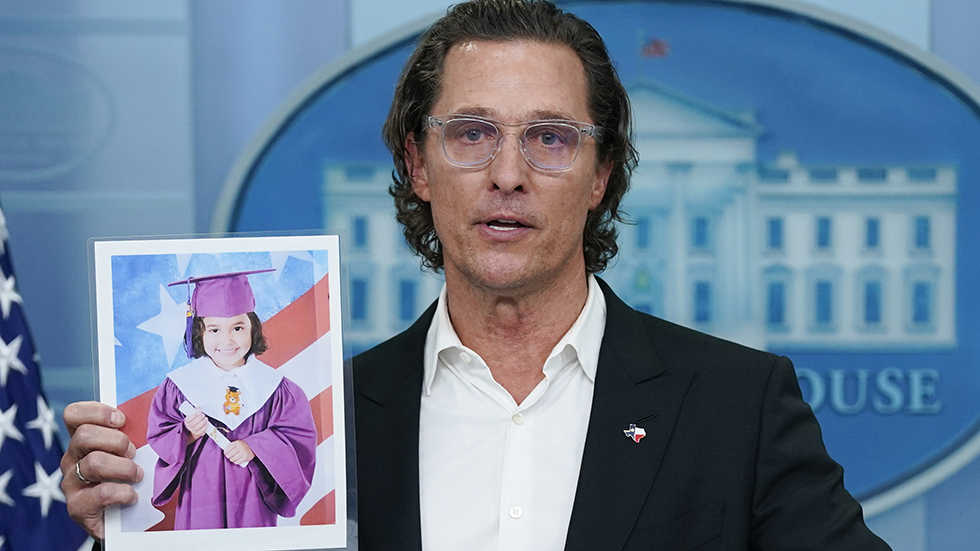
Matthew McConaughey, the famed actor and Uvalde, Texas, native, appeared at Tuesday’s White House briefing to make an impassioned appeal for “real change” and told the stories of a number of the victims of the mass shooting at Robb Elementary School he learned while on the ground in the town (The Hill).
“We want secure and safe schools, and we want gun laws that won’t make it so easy for the bad guys to get these damn guns,” McConaughey, who last year declined a bid for the Texas governorship, said, relaying what he heard from many Second Amendment supporters in the town. “Responsible gun owners are fed up with the Second Amendment being abused and hijacked by some deranged individuals.”
“As divided as our country is, this gun responsibility issue is one we agree on more than we don’t. It really is. But this should be a nonpartisan issue,” he continued during his 20-minute appearance. “We start by making these lives matter.”

© Associated Press / Evan Vucci | Matthew McConaughey in the White House briefing room on Tuesday.
On Capitol Hill, Garnell Whitfield Jr. — the son of Ruth Whitfield, 86, one of the 10 victims killed in the mass shooting at a Buffalo grocery store last month — told lawmakers on Monday the shooter “did not act alone” in the massacre, having been radicalized by white supremacists.
Whitfield, Jr., testifying before the Senate Judiciary Committee, asked legislators what they could do to stop white supremacy and proceeded to call out the lack of action to weed out extremists, including the gunman in Buffalo (The Hill).
“We’re angry. We’re mad as hell. Because this should have never happened. We’re good citizens. Good people. We believe in God, we trust in God, but this wasn’t an act of God. This was an act of a person, and he did not act alone,” Whitfield said. “His anger and hatred were metastasized like a cancer by people with big microphones in high places screaming that Black people were going to take away their jobs and opportunities.”
Whitfield Jr. challenged senators to “yield your positions” if they do nothing after the recent mass shootings (ABC News).
Related Articles
▪ The Hill and The Washington Post: Former Vice President Mike Pence is woven into the Jan. 6 committee investigation. For example, the committee wants to know whether former President Trump and his political aides played any role in encouraging the Secret Service to remove Pence from the Capitol after the building was stormed by Trump supporters — and before Pence had overseen the certification of Biden’s victory.
▪ The New York Times: Proud Boys charged with sedition in Capitol attack.
▪ The Associated Press: Proud Boys documentarian to be among first Jan. 6 witnesses.
▪ The Hill and The Associated Press: As the House hearings begin, few have more on the line than Jan. 6 committee member and Trump critic Rep. Liz Cheney (R-Wyo.).
▪ Niall Stanage, The Hill: Five questions that hang over the Jan. 6 committee’s public hearings.
Virtual Event Invite
Closing the Gaps in Health Insurance, today at 1 p.m. ET
A record number of Americans are insured yet many remain vulnerable to significant medical expenses, including high premiums, out-of-pocket costs and prior authorization burdens. The Hill sits down with Majority Whip Jim Clyburn (D-S.C.), Rep. David Schweikert (R-Ariz.) and more to discuss closing the gaps in health insurance. RSVP today.
LEADING THE DAY
➤ ADMINISTRATION
While senators deliberate about how to respond to an epidemic of mass shootings, Biden today flies to California to promote hemispheric economic policies he’s touting as the host of the Summit of the Americas being held in Los Angeles. He will appear tonight in a taped interview on ABC’s “Jimmy Kimmel Live!” It is expected to be a friendly setting in which domestic worries, including inflation and guns, are topics.
The president may address a chilling domestic terror threat warning on Tuesday from the Department of Homeland Security (DHS), which described online forums that have encouraged copycat mass shootings following the carnage in Uvalde, Texas. The department’s intelligence analysts say some online platforms are telling followers that the U.S. government staged the killings at Robb Elementary School in order to push gun control measures through Congress (CNN and CBS News). The DHS said it is worried about events this summer, including the Supreme Court’s pending abortion rights ruling, as well as midterm elections in November.
“As the United States enters mid-term election season this year, we assess that calls for violence by domestic violent extremists directed at democratic institutions, political candidates, party offices, election events, and election workers will likely increase,” the bulletin said.
Biden has repeatedly said inflation is his No. 1 domestic concern. On Tuesday, Treasury Secretary Janet Yellen told senators that rising prices for consumers in everything from gasoline and energy to food and rent are “unacceptable,” but she said inflation also is a global problem (Fox Business and CNN Business).
Yellen also defended pandemic spending and said it is time to “act big,” even as inflation persists and is likely to linger (The New York Times).
“To dampen inflationary pressures without undermining the strength of the labor market, an appropriate budgetary stance is needed to complement monetary policy actions by the Federal Reserve,” she said. “Moving forward, elements of the president’s proposed legislation — including the clean energy initiatives and plans to reform the prescription drug market — can help lower the costs paid by American consumers.”
▪ Reuters and The New York Times: TheWorld Bank slashed its global growth forecast to 2.9 percent, blaming inflation and the war in Ukraine, adding that many countries now face recessions.
▪ Reuters and The Hill: Business groups are aggressively lobbying Biden to undo tariffs on hundreds of billions of dollars of goods imported from China to help ease inflation.
▪ Bloomberg News: Biden plans solar manufacturing push to end project slowdown.
▪ The Hill: Biden has turned repeatedly to the Defense Production Act, to the GOP’s scorn.
➤ POLITICS
Primary day in seven states came and went on Tuesday, and voters made clear once again their preference for a tough-on-crime agenda.
In California, it is too early to project a number of races given the outstanding vote across the state. However, two races caught the attention of the masses, headlined by the recall of San Francisco District Attorney Chesa Boudin, marking a stunning setback for progressive advocates of criminal justice reform.
Sixty percent of San Franciscans voted to remove Boudin from office. The ouster comes months after voters did the same to three school board members. His replacement will now be chosen by Mayor London Breed (D), who is expected to tap someone with a more moderate reputation (The Hill).
Meanwhile, Rep. Karen Bass (D-Calif.) and businessman Rick Caruso emerged on Tuesday as the finalists in Los Angeles’ mayoral race. Bass, an influential member of the Congressional Black Caucus, is considered the favorite, but Caruso has made his mark on the race, having pumped roughly $34 million into his bid that is focused on a rise in crime (The Hill).
In Iowa, retired Navy Adm. Michael Franken is set for his general election campaign after taking home the state’s Democratic Senate nomination on Tuesday night.
Franken, a relative newcomer to the political scene, defeated former Rep. Abby Finkenauer (D-Iowa) for the party nod, taking home 55.2 percent to only 40 percent for the former northeast Iowa lawmaker (The Hill). The win propels him into a November contest against Sen. Chuck Grassley (R-Iowa), 89, who is seeking his eighth term in the upper chamber and has a history of winning reelection by wide margins (The Hill).
Along with California and Iowa, voters in Mississippi, Montana, New Jersey, New Mexico and South Dakota also went to the polls.
Most of the key happenings took place on the House map. In South Dakota, Rep. Dusty Johnson (R) beat back a primary challenge from Tuffy Howard (The Hill). In the Garden State, former New Jersey state Senate GOP leader Tom Kean Jr. topped a seven-way primary to set up a rematch with incumbent Rep. Tom Malinowski (D-N.J.) in the state’s 7th District (The Hill).
Finally, in Mississippi, Rep. Steve Palazzo (R) is headed into a runoff in the state’s 4th District after he failed to reach the 50 percent threshold in the GOP primary battle. The race became ripe with challengers after an ethics watchdog group found last year there was “substantial” evidence he misused campaign funds to improve a riverfront home before a sale and unethically used his office to help his brother reenlist in the Navy (The Hill).
The New York Times: Robert Menendez Jr., son of a senator, wins a Democratic House primary in New Jersey.
The New York Times: Six takeaways from Tuesday’s elections.

© Associated Press / Rogelio V. Solis | An election worker cuts out “I Voted” stickers in Bolton, Miss., on Tuesday.
▪ Reid Wilson, The Hill: States consider nixing antiquated slavery language from founding documents.
▪ The Hill: Gisele Fetterman says her husband, the Democratic Senate candidate in Pennsylvania, may not return to the campaign trail for another month.
Elsewhere on the political scene, Rep. Alexandria Ocasio-Cortez (D-N.Y.) escalated her feud with Rep. Sean Patrick Maloney (D-N.Y.), chairman of the House Democratic campaign arm, on Tuesday by endorsing his main primary opponent.
The progressive lawmaker threw her support behind state Sen. Alessandra Biaggi (D) in the new 17th District, handing her a boost three weeks before the Empire State’s primary contests.
The move also comes weeks after Maloney declined to run in the district he largely currently represents, which angered progressives. That group included Ocasio-Cortez, who called for Maloney to step down from his perch atop the Democratic Congressional Campaign Committee if any member-on-member primaries were created by his move, but none ultimately were.
Maloney told The New York Times that while he has “nothing but respect” for Ocasio-Cortez, “local voices are what matters in this race and they’re overwhelmingly supporting me.”
▪ Politico: “Better than President Trump”: Florida Gov. Ron DeSantis’s (R) clout swells in the West.
▪ NBC-Orlando: DeSantis signs bill aimed at making Florida schools safer.
IN FOCUS/SHARP TAKES
➤ UKRAINE CRISIS
Russia has made capturing control of Ukraine’s Donbas region its near-term goal in a war that is grinding ahead with ferocious shelling on both sides. Today, Ukrainian troops holding out in the ruins of Sievierodonetsk are under renewed heavy assault from Russian forces who see the capture of the industrial city as key to control of the surrounding Luhansk region (Reuters).
On Tuesday, Russia claimed to have taken control of 97 percent of Luhansk, one of the two provinces in the region, bringing Russian President Vladimir Putin closer to a strategic goal of seizing the eastern industrial heartland of Ukraine’s coal mines and factories.
Russian Defense Minister Sergei Shoigu said Moscow’s forces hold nearly all of Luhansk province. And it appears that Russia now occupies roughly half of Donetsk province, according to Ukrainian officials and military analysts (The Associated Press).
The Washington Post: Dramatic destruction is visible across eastern Ukraine, according to satellite photos.
Ukrainian President Volodymyr Zelensky said Tuesday that Ukraine will fight to recover all its territory occupied by Russian forces (Reuters). The mayor of Sievierodonetsk on Tuesday claimed Ukrainian forces were still “holding the city” (The Washington Post), but today, the region’s governor said Ukrainian military forces may have to pull back to stronger positions in the embattled eastern city (Reuters).
Zelensky asserted in his Tuesday evening video address that Russia made no significant advances in the Donetsk province (The Associated Press).
Earlier, Russia said the Ukrainian ports of Mariupol and Berdyansk, which Moscow’s forces recently captured, were de-mined and ready to ship grain, which is considered essential to global food supplies, including in Africa (The Washington Post and Reuters).
Russia also began to increase some oil exports to Asian buyers to help offset the European Union ban on its petroleum (Reuters).
The Hill: Oil prices this summer could hit $140 a barrel, predicts Goldman Sachs, although it foresees a price decline in the fourth quarter of the year.
Former Russian President Dmitry Medvedev blasted the U.S. and the West — via the messaging app Telegram — describing nations allied behind Ukraine as “bastards” and “scum” on Tuesday. Medvedev, now the deputy head of Russia’s Security Council, said, “They want that Russia and all of us die,” adding that “as long as I’m alive, I will do everything to make them disappear” (MarketWatch and The Mirror).

© Associated Press / Natacha Pisarenko | Civilian militia training outside Kyiv, Ukraine, on Tuesday.
📝 Introducing NotedDC, The Hill’s curated commentary on the beat of the Beltway. Click here to subscribe to our latest newsletter.
OPINION
■ Mugged by reality, again. Is a decade of destructive progressive ideology finally coming to an end? by Bret Stephens, columnist, The New York Times. https://nyti.ms/3O1X5mR
■ Ignore the GOP spin. The nation still hasn’t reckoned with Jan. 6, by The Washington Post editorial board. https://wapo.st/3Nyz0Eg
WHERE AND WHEN
The House meets at 10 a.m.
The Senate convenes at 10 a.m. and resumes consideration of the nomination of Lisa Gomez to be an assistant secretary of Labor.
The president flies to Los Angeles to host this week’s Summit of the Americas. He will tape an appearance on “Jimmy Kimmel Live!” in the afternoon upon arrival. Biden will officially greet heads of delegations attending the summit at 4 p.m. PDT. The president and first lady Jill Biden at 5:15 p.m. PDT will participate in the inaugural summit ceremony and the president will speak.
Vice President Harris is in California. She will speak about the root causes of migration to a gathering of CEOs gathered for the Summit of the Americas at the InterContinental Hotel in Los Angeles at 11 a.m. PDT. She will visit Dream Big Children’s Center to discuss small business policies with employees and customers at 2 p.m. PDT. The vice president at 5 p.m. PDT at the Microsoft Theater in Los Angeles will make brief remarks at the inaugural ceremony of the Summit of the Americas.
Secretary of State Antony Blinken is in Los Angeles where he will participate in a morning discussion and Q&A session at a CEO Summit with Myron Brilliant, U.S. Chamber executive vice president and head of international affairs.Blinken at 9:30 a.m. PDT leads a meeting of the implementation review group associated with the Summit of the Americas. The secretary meets with Canadian Foreign Minister Mélanie Joly and Panamanian Foreign Minister Erika Mouynes for a panel discussion at L.A.’s Civil Society Forum at 11:30 a.m. PDT. He will visit the Young Entrepreneurs Expo at the Young Americas Forum at 1:45 p.m. PDT in L.A.
Treasury’s Yellen at 10 a.m. will testify before the House Committee on Ways and Means.
Second gentleman Doug Emhoff is in California and will deliver welcoming remarks this morning at the Young Americas Forum. He will visit the University of Southern California to meet with representatives from USC Shoah Foundation at 10 a.m. PDT. Emhoff will accompany Harris at 5 p.m. PDT to the inaugural ceremony of the Summit of the Americas in L.A.
🖥 Hill.TV’s “Rising” program features news and interviews at http://thehill.com/hilltv, on YouTube and on Facebook at 10:30 a.m. ET. Also, check out the “Rising” podcast here.
ELSEWHERE
➤ ENERGY
The Center for Environmental Health and the Center for Biological Diversity filed suit on Tuesday alleging the Environmental Protection Agency (EPA) has failed to sufficiently address smog pollution in Los Angeles and Sacramento, Calif., as well as New Hampshire. The two groups accused the EPA of failing to take action to reduce smog levels below the 2008 ozone National Ambient Air Quality Standards in those areas. According to the lawsuit, the EPA in 2017 published a rule identifying 15 states and the District of Columbia that had not properly submitted implementation plans for compliance (The Hill).
➤ CANCER
The drug dostarlimab, used in a clinical trial of 18 patients that was sponsored by the drug company GlaxoSmithKline, stunned physicians by obliterating all traces of rectal cancer in each participant. Luis Diaz of Memorial Sloan Kettering Cancer Center described the results in a Sunday New England Journal of Medicine paper. He said he knew of no other study in which a treatment erased evidence of a type of cancer in every patient. None of the participants had clinically significant complications; the study results will need to be replicated and studied further (The New York Times). … Separately, a liquid biopsy may be able to tell which colon cancer patients can skip chemotherapy, according to research presented this week at the American Society of Clinical Oncology in Chicago (Reuters and The Associated Press).
➤ POX & PANDEMIC
The Food and Drug Administration’s (FDA) expert advisory committee voted unanimously on Tuesday to recommend Novavax’s two-dose COVID-19 vaccine for use in those 18 and older in the U.S., putting the drug closer to approval by the FDA, possibly this week. The Centers for Disease Control and Prevention also must sign off. Some at the FDA believe Novavax’s vaccine, created with traditional protein technology around for decades, would potentially appeal to people who have not gotten immunized because they are wary about the messenger RNA technology used by Pfizer and Moderna (CNBC).
Total U.S. coronavirus deaths reported as of this morning, according to Johns Hopkins University (trackers all vary slightly): 1,009,338. Current average U.S. COVID-19 daily deaths are 287, according to the Centers for Disease Control and Prevention.
THE CLOSER

© Associated Press / Jose Luis Magana | Corpse flower or Amorphophallus titanum at U.S. Botanic Garden, 2016.
And finally … It is odiferously foul. An eight-foot corpse flower bloomed inside the U.S. Botanic Garden’s courtyard on Thursday, inviting visitors to sniff the rare, 9-year-old plant, which looks like something from outer space and smells like rotting flesh. Peak stink lasts about 36 hours in the blooming phase (WTOP).
The oddity is located next door to Congress. Kismet.
Stay Engaged
We want to hear from you! Email: Alexis Simendinger and Al Weaver. Follow us on Twitter (@alweaver22 & @asimendinger) and suggest this newsletter to friends!
Source: TEST FEED1
Share:
Both parties identify risks, rewards in Jan. 6 hearing
Republicans and Democrats alike are bracing for the upcoming House hearings on the Jan. 6, 2021, Capitol riot, seeking out tea leaves for what the proceedings could mean for two crucial election cycles.
The House select committee’s hearings, set to start in prime time on Thursday, have Republicans both skeptical of and aligned with Donald Trump bullish the former president — barring an unforeseen bombshell — gets bailed out by the public’s focus on inflation and other frustrations with the Biden administration.
Democrats, meanwhile, are hoping the prime-time viewing offers a chance to turn the spotlight away from issues that could be politically damaging and toward what they see as a threat to democracy, with committee members previewing a damning account of the insurrection. But even that strategy risks sparking the perception that the party is tone deaf to the economic anxieties of everyday Americans, leaving Republicans optimistic that the hearings won’t change a heavily favorable political atmosphere.
“The challenge right now is the only people focused on Jan. 6 live inside the Beltway and work inside the Beltway. Voters are not paying the least bit of attention to any of this stuff. They are focused on gasoline prices, they’re focused on cost of living, they’re focused on supply chain problems, they are focused on a myriad of other issues. And this is process, this is politics as usual,” said GOP pollster Robert Blizzard.
That optimism flies in the face of what committee members are boasting will be must-see viewing.
The committee has hired a television producer to stitch together a narrative of the day of the Capitol attack as well as the surrounding efforts to overturn Trump’s loss in 2020, which panel members allege amount to a direct threat to democracy itself.
On top of that, the committee is stacked with staunch Trump foes, including Reps. Liz Cheney (R-Wyo.) and Jamie Raskin (D-Md.), who have indicated the former president is a top political target as he mulls a 2024 presidential bid.
“The select committee has found evidence about a lot more than incitement here, and we’re going to be laying out the evidence about all of the actors who were pivotal to what took place on Jan. 6,” Raskin said during an interview with Washington Post Live on Monday.
“I think that Donald Trump and the White House were at the center of these events.”
However, the committee faces stiff headwinds in trying to drag Trump down enough to diminish his standing.
An NBC News poll released Monday showed that 45 percent of Americans say Trump was responsible for the riot, a drop from 52 percent of Americans who said the same thing in January 2021.
On top of that, the hearings will need to break through noise around the economy, the coronavirus pandemic, Russia’s invasion of Ukraine and more, leading to speculation that voters will just simply tune out hearings that ordinarily would make top headlines.
“The people who could be persuaded to change their opinion or to form an opinion that they now don’t have are not going to be watching this,” said GOP strategist David Kochel. “They view everything as a partisan act, and it’s not relevant to their lives.”
What’s more, Trump is already a defined figure after decades in the public spotlight and seven years since he launched his first presidential bid in 2015.
“There’s no voter out there sitting around today thinking, ‘Well, I still haven’t decided about Donald Trump. I’m waiting for the Jan. 6 commission to issue its report.’ Trump has been decided for voters,” Blizzard said.
Several of the half-dozen sources who spoke to The Hill said the hearings could have the same effect as the one former special counsel Robert Mueller appeared at in 2019 to discuss his findings regarding allegations of collusion between the 2016 Trump campaign and Russia.
Democrats at the time cast the appearance as a blockbuster display by a hard-nosed investigator but were disappointed after Mueller’s halting testimony.
“Everybody said Mueller’s the ultimate fighter, he doesn’t lose, he’s methodical, he’s a genius, he’s a workhorse. He got a couple of convictions, and at the end of the day, he didn’t lay a glove on the boss. Trump’s a competitor, and from a competitive standpoint, it was a victory,” said one Trump ally. “Victories always have you stand up a little bit taller and get your rhetoric a little bit hotter.”
Still, uncertainty hovers over the hearings, and both Republicans and Democrats say a bombshell could change that calculus in 2024.
The panel has already interviewed several former Trump administration officials and obtained communications that members say portray a full-court press to alter the results of the 2020 election. And while some of the evidence has already been leaked to the media, it’s unclear what the panel may have up its sleeve.
“If this goes really badly for the president, it could be that primary voters might say, ‘We’re going to go for the Trumpiest candidate who’s not Trump because they won’t have this particular baggage to worry about,’ ” said Kochel. “If these hearings go the way the Democrats want, that’s a possibility.”
Some Republicans did voice concern that Trump could derail their narrative if he feels the need to respond to the hearings, noting that voters in midterm primaries have shown they don’t care as much as he does about voter fraud allegations in an election that happened two years ago.
“Trump can’t help himself but to probably answer every single piece of information that comes out of this committee hearing. And voters, even ones who agree with him about the election of 2020, are no longer focused on it,” said GOP strategist Mike DuHaime. “Even the vast majority of voters who think that there were some problems with 2020 don’t believe somehow Joe Biden is going to be un-sworn in and that Trump is going to magically come back.”
Democrats, for their part, are welcoming a possible change in narrative.
“It’s a risk for Trump and his servants in the House Republican caucus because it instantly, on TV, in prime time, refocuses the story and America’s attention on the last place that they want it, which is Donald Trump’s role and his supporters’ role and House Republicans’ role in the most terrifying seditious attack on American democracy in 200 years,” said Democratic strategist Jon Reinish.
Reinish said Democrats should handle the hearings the same way Republicans once handled an investigation into a terrorist attack at a U.S. Consulate in Benghazi, Libya, in 2012, which the GOP used to lambast Democrats. But now, such a strategy could risk backfiring for precisely the same reasons the panel’s impact may be blunted in the first place.
“I think it could be really almost a blowback against the Democrats. There’s all these other issues going on between inflation, the border, you’ve got other issues rising in terms of gun violence, you’ve got abortion as an issue, the economy, just anxiety in general. And this is the focus?” Blizzard said. “This is not to belittle the day, but this is not something that voters are focused on right now when they can’t even afford to fill up their gas tanks.”
Source: TEST FEED1
Share:
Business lobby presses Biden to nix China tariffs
Business groups are aggressively lobbying President Biden to undo tariffs on hundreds of billions of dollars’ worth of Chinese imports, arguing that doing so would help ease inflation.
They say that lifting those tariffs would lower the costs Americans pay for an array of common products, including clothing items, sunscreen, soap, furniture, appliances, bicycles and consumer electronics.
Biden administration officials are divided over the issue, with some disputing the notion that tariff relief would significantly impact inflation, and labor unions with close ties to the president pushing the White House to keep the tariffs in place.
Still, business lobbyists say that right now is their best chance yet to convince Biden to lessen or outright ax China tariffs first imposed by the Trump administration in 2018 and 2019.
“All the options need to be on the table to help address inflation, and this is the quickest and easiest one that we can take right now,” said Jonathan Gold, vice president of supply chain and customs policy at the National Retail Federation.
“It’s not a cure-all, but it’s certainly going to help a lot of companies and consumers if we can reduce the cost of some of these goods, especially some of the necessities that jumped because of tariffs.”
Biden has said that he will do whatever it takes to fight inflation, including potentially revising the Trump-era tariffs. Commerce Secretary Gina Raimondo said in a televised interview with CNN on Sunday that Biden has tasked his team with analyzing whether lifting some tariffs could cool consumer prices.
“I will say it depends on what we’re talking about and what kinds of products,” Raimondo said, noting that tariffs on Chinese steel and aluminum would stay in place to protect U.S. companies. “There are other products, household goods, bicycles, et cetera, and it may make sense. And I know the president is looking at that.”
Lifting the tariffs, which apply to roughly $335 billion in Chinese goods, would boost the bottom line of some of the largest retailers, manufacturers, tech giants and other U.S. companies that pay tariffs of up to 25 percent to import affected goods from China.
Corporate lobbying groups are focusing their messaging around the costs that are passed on to consumers, often citing a Congressional Budget Office study estimating that Section 301 tariffs cost the average American household more than $1,200 in real income in 2020 and hiked consumer prices by 0.5 percent.
“Not only are these taxes highly regressive, hitting lower-income Americans hardest on basic needs, but they can be removed with the stroke of a pen,” said Steve Lamar, president of the American Apparel and Footwear Association.
Business groups also cite a study from the pro-free trade Peterson Institute for International Economics finding that reducing tariffs on all imported goods could ease inflation by 1.3 percent. The same study found that lifting tariffs on just Chinese imports would only lower inflation by less than 0.3 percent in the near term, but the total impact could reach 1 percent in the long run.
“The tariffs absolutely contribute to today’s high cost of living,” said John Murphy, senior vice president for international policy at the U.S. Chamber of Commerce. “They are taxes paid by Americans, and most of them lack any strategic rationale.”
The White House is frantically searching for ways to slow down 40-year-high inflation, which rose 8.3 percent in the past 12 months ending in April due to supply shocks stemming from pandemic slowdowns.
But U.S. Trade Representative Katherine Tai has cast doubt on the effectiveness of tariff relief to fight inflation, calling the Peterson Institute study “something between fiction and an interesting academic exercise” last month.
Tai, who doesn’t want to lose leverage in trade negotiations with China by lifting tariffs, has diverged from other Biden officials, including Treasury Secretary Janet Yellen, who said last month that some of the China tariffs “imposed more harm on consumers and businesses.”
“If we’re going to take on an issue like inflation, and given the seriousness that it requires, then our approach to tools for mitigating and addressing that inflation need to respect that it is a more complicated issue than just tariffs at the border,” Tai said during a Washington International Trade Association event Monday.
Labor unions with close ties to Biden are another obstacle to tariff changes. Several unions filed a comment with Tai’s office Monday calling for the China tariffs to be extended, citing U.S. jobs lost to the Chinese government’s trade practices.
“Nothing has changed that would merit unilaterally lifting the tariffs,” United Steelworkers President Thomas Conway wrote on behalf of the Labor Advisory Committee for Trade Negotiations and Trade Policy, a coalition of labor unions that advises the executive branch on trade matters. “If anything, President Xi and the [Chinese Communist Party] have only doubled down on their strategy and approach.”
Conway noted in the letter that the advisory committee’s members, which include the International Brotherhood of Teamsters, United Auto Workers and Service Employees International Union, are “united in the view” that the China tariffs should be extended.
Tai is taking comments from corporations and other impacted parties as part of a four-year review of the China tariffs that will be completed in the coming months.
Business groups are hopeful that Biden’s decision on Monday to waive tariffs on solar panel imports from Southeast Asia is a signal that the White House agrees tariffs can damage key industries.
Corporate lobbyists are pushing for widespread reductions or lifting of China tariffs, but they would settle for a measure to make it easier for U.S. companies to be exempted from tariffs as a consolation prize.
“The expiration of critical exclusions granted to protect domestic manufacturing competitiveness has driven up input costs, making U.S.-manufactured products more expensive than those of foreign competitors, hurting manufacturers and workers in the United States,” the National Association of Manufacturers wrote in a recent letter to congressional leaders.
Source: TEST FEED1
Share:
States consider nixing antiquated slavery language from founding documents
Voters in five states will consider rewriting their constitutions this year to remove outdated language that allows for involuntary servitude, putting a spotlight on rarely or never-used punishments that have roots in America’s legacy of slavery.
The Louisiana state Senate voted last week to add a measure to this year’s ballot that would modernize the state constitution to explicitly prohibit slavery and involuntary servitude. The unanimous Senate vote came about a week after the House voted 96 to 0 in favor of placing the measure before voters this November.
The current constitution, adopted in 1974, prohibits slavery and involuntary servitude “except in the latter case as punishment for crime.” If voters approve the change, that clause would be struck.
In Alabama, a newly proposed state constitution would eliminate a line that exists in the previous version that allows for involuntary servitude only for punishment of a crime. Voters in Oregon, Tennessee and Vermont will get to vote on similar changes to their existing constitutions.
The versions in Tennessee and Vermont go farther than simply eliminating forced work as acceptable punishments for a crime. Both ballot measures before voters this year would add specific clauses that proactively prohibit slavery or involuntary servitude; the Tennessee version adds the word “forever” to the new clause.
“As we work to ensure that all Vermonters are treated equally and fairly, it is crucial that we amend the archaic language of the Constitution to emphasize that slavery and indentured servitude in any form and for persons of any age are prohibited,” state House Speaker Mitzi Johnson (D) said in a statement when her chamber forwarded the change to voters earlier this year.
Founding documents in 19 states still allow some version of slavery or involuntary servitude as punishments for crimes, according to Ballotpedia, a nonpartisan reference source on American government.
Slavery is permitted — though never actually used — in Oregon, Nevada, North Dakota, Minnesota, Wisconsin, Indiana, Kentucky, Tennessee, Arkansas and Mississippi. Involuntary servitude is included, though never used, in California, Kansas, Iowa, Michigan, Ohio, North Carolina, Georgia, Alabama and Louisiana.
In recent years, several other states have moved to modernize state laws that allowed the practice. Voters in Utah, Colorado, Nebraska and Rhode Island expressly forbid the practice. In three of those states, voters have excised the old language in just the last few years.
Rhode Island, founded as the Colony of Rhode Island and Providence Plantations in 1636, has outlawed servitude since 1843. Voters there opted to drop the reference to Providence Plantations in 2020.
State constitutions are updated and amended far more frequently than is the United States Constitution, for several reasons. In some states, the threshold to change the constitution is low, requiring only a simple majority vote of the people. In others, it takes no more than an act of the legislature, because the constitution acts as the state code.
Alabama’s constitution is an extreme example: Adopted in 1901, it has been amended 977 times.
Many of those amendments counteract earlier revisions, or even the core of the document itself, passed in an era when racist white legislators specifically advocated for laws and rules that established and supported white supremacy over Black people who had been freed from slavery 36 years earlier. The initial document bars interracial marriage and mandates school segregation.
“There is some racist terminology in there and this is going to address some of that,” state House Speaker Mac McCutcheon (R) told The Associated Press.
This year, voters will have the chance to ratify a sweeping overhaul of Alabama’s constitution to remove those references — along with the language that allows for forced work.
“I am tired of being treated as a second-class citizen,” Marva Douglas, a member of Alabama Citizens for Constitutional Reform, the group that forced this year’s vote on a new document, said in a press release last year. “And terms like ‘colored’ that are throughout the Constitution play a part in that feeling.”
Source: TEST FEED1
Share:
Why Mike Pence will be a key figure at Thursday’s Jan. 6 panel hearing
Former Vice President Mike Pence will not be present when the House Jan. 6 committee holds a prime-time hearing on Thursday, but he will be a central figure as the panel makes its first presentation to the public of what unfolded before and during the riot at the Capitol.
Pence has not directly cooperated with the committee, but some of his former aides have. In recent months, a steady stream of new details has come out about Pence’s actions on Jan. 6, 2021, and he has publicly rebuked former President Trump for saying the election was stolen.
“I anticipate that we will hear about Mike Pence on Thursday night. You can’t tell the story without him,” said Norm Eisen, who served as special counsel to Democrats during Trump’s first impeachment.
Pence’s role in certifying the Electoral College results on Jan. 6, 2021, hours after hundreds of pro-Trump rioters stormed the Capitol, has only become more of a flashpoint in the investigation of the day’s events and in Republican politics more broadly.
Rep. Jamie Raskin (D-Md.), a member of the House panel investigating Jan. 6, has emphasized the significance of Pence refusing to leave the Capitol as rioters were inside the building, suggesting to do so would have given an opening for Trump’s allies to follow through on their plan in Pence’s absence.
The New York Times reported late last month that at least one witness indicated to the committee that Trump reacted approvingly to chants calling for Pence to be hanged.
And the Times also reported in recent days that Pence’s former chief of staff Marc Short alerted Secret Service the day before the insurrection to warn of the potential security risks to Pence should Trump publicly turn on his vice president.
The committee is likely to make the threat to Pence a central part of its presentation to the public as it seeks to capture public attention and lay out the gravity of the situation.
The Washington Post reported that Michael Luttig, a conservative lawyer who advised Pence on handling his duties on Jan. 6, as well as former Pence aides Marc Short and Greg Jacob are among those expected to appear as witnesses during Thursday’s prime-time hearings.
Eisen said showing how Pence rejected some of the legal arguments concocted by Trump’s advisers would help rebuff GOP attempts to brush off the committee’s findings as partisan.
“So, the other way that Pence comes in is as a dose of reality in response to these lunatic legal theories that were circulating. So that’s an important part of the narrative,” Eisen said.
Pence himself has grown increasingly willing to break with Trump over the events of Jan. 6 in particular as he charts his own post-White House path.
The former vice president repeatedly referred to Jan. 6 as a “dark day” in history and spoke about upholding his constitutional duty in remarks to various conservative groups after leaving office.
As Trump continued to make debunked claims that the 2020 election was rigged, Pence went a step further. In February, Pence explicitly said Trump was wrong to suggest he could overturn the result of the presidential election.
“Under the Constitution, I had no right to change the outcome of our election. And Kamala Harris will have no right to overturn the election when we beat them in 2024,” Pence said at the time.
Still, Pence has personally kept the Jan. 6 committee at arm’s length in public.
In October, Pence suggested the media was focusing on the riot so extensively to distract from the Biden administration’s difficulties with the Afghanistan withdrawal and other domestic issues.
And while former aides like Short and Keith Kellogg have testified before the panel behind closed doors, Pence himself has yet to come before the committee.
A Pence spokesperson did not respond to a request for comment, including on whether there had been any communication between Pence and the committee.
“We have wanted to make sure that we get as much information as possible from as many material witnesses as possible,” Raskin said Monday during a Washington Post Live event when asked about the prospect of Pence testifying.
“We want to figure out exactly what happened. And Vice President Pence was obviously the object of this political onslaught on Jan. 6, so we need to fill in the details as much as possible about what happened there.”
Asked if Pence’s life was in danger on Jan. 6, Raskin urged the public to tune in on Thursday night.
“Watch the hearings,” Raskin said. “The hearings will tell a story about what took place on that day.”
Source: TEST FEED1