

Share:
NFL Network host Rich Eisen makes impassioned plea on gun violence: 'For God's sake, do something'
Peacock Network and NFL host Rich Eisen on Thursday ended his show with a plea to lawmakers to “do something” after the school shooting in Uvalde, Texas, on Tuesday.
“Please, for God’s sake, do something,” Eisen said, responding to the killings of 19 elementary school children and two of their teachers, allegedly by an 18-year-old in possession of multiple semi-automatic rifles.
The suspected shooter obtained both weapons legally in the days before he attacked Robb Elementary School.
“I just want a background check on somebody,” said Eisen. “I want somebody who’s 18 and bullied, or whatever caused him to be so diseased mentally that he’s going to take his anger out on his grandmother and then children cowering for their lives who just went to school and, by the way, apparently were watching ‘Moana.’ ”
Eisen admonished lawmakers who, he said, “refuse to do anything about it.”
“How about a background check on him? How about psychological evaluations?” Eisen asked. “You want to talk about mental health, I’m all for that.”
He continued to call for gun control measures that would “prevent” assault-style weapons from “getting in the hands of the wrong people.”
Eisen emphasized that he was not concerned about taking guns away from ordinary Americans, but was concerned about preventing access by people like “a lunatic who was allowed to have an assault rifle, because he could and because it’s legal, because it was easy” in Uvalde.
“We cannot give up as a society and we cannot give up on giving our two cents, and keep the pressure on those in power who do nothing about it. Children murdered in their classroom, murdered in their classroom, and you’re already seeing the responses from those in power who refuse to do anything about it, saying it’s about anything else other than easy legal access to assault weaponry,” Eisen said.
Source: TEST FEED1
Share:
Privacy — a Big Tech sleight of hand
Our digital age allows peering corporate ears and eyes into our homes, conversations and everyday interactions. This fact has inspired lawmakers and consumer advocates to call for comprehensive privacy reform to limit a few tech companies’ influence into our daily decisions. Lawmakers also want to ensure Big Tech doesn’t abuse their consumers’ trust by misusing our personal information. Traditionally, Big Tech companies have hostilely fought against almost all privacy legislation. Their lobbying efforts have been very effective as there have been no meaningful change to our laws to protect consumers for at least 20 years.
Now, calls for a federal privacy law are back. Best of all, Big Tech seems to be onboard with pursuing federal privacy legislation…or are they?
Unfortunately, such calls to action from Big Tech are a common diversion that they and their advocates like to use to distract legislators from bills that will make a difference and are more likely to pass in Congress. Much like a magician uses sleight of hand to fool you into believing in magic, Big Tech wants Congress to believe they are serious about privacy legislation. They more likely want to inspire false hope to poison pill meaningful antitrust legislation, because it’s a win-win for Big Tech. On the one hand they kill antitrust bills that are more likely to pass, and on the other they get privacy legislation they can leverage against their competitors.
In the past few years, we are seeing far more bipartisan agreement on key antitrust and consumer protection bills than we have on any privacy legislation on the books. Sens. Marsha Blackburn (R-Tenn.) and Richard Blumenthal (D-Conn.) introduced the Open App Markets Act (OAMA), which would place a light touch framework to help smaller developers challenge the blatant market abuses Google and Apple engage in when operating their app stores.
Moreover, Sen. Mike Lee (R-Utah) – a free-market libertarian – introduced the bipartisan Competition and Transparency in the Digital Advertising Act (CTDAA) to rein in Google, Amazon and Meta’s collusive acts with buyers and sellers in the ad tech space, while bringing more transparency to Big Tech’s opaque dealings.
Here’s what OAMA and CTDAA have in common: Both proposals are closer to becoming law than any privacy legislation at this point. Big Tech is keenly aware of this, and it shows. Hence, in comes the well-worn tech sleight of hand: promote privacy legislation that will almost certainly not pass a divided Congress. Unlike antitrust legislative solutions, there is almost no bipartisan agreement on how to develop a federal privacy framework.
Not only is federal privacy legislation unlikely to pass this Congress, but Big Tech also knows that, if it does, it could serve as a big win for them. As we learned in Europe, privacy means control in today’s Big Tech markets. Europe’s rollout of its General Data Protection Regulation (GDPR) should be a cautionary tale for the U.S., because it clearly shows that privacy regulations without market guardrails can seriously exacerbate today’s competition issues we have with Big Tech.
For example, the European Centre of Economic Policy Research found that “[w]ith the introduction of GDPR, the dominant firm in many markets for web technologies, Google, increases its market share whereas all other firms that supply web technology either do not see a change in market share or suffer losses…” The primary reason is that the tech market is highly vertically integrated where smaller companies are inextricably reliant on these larger platforms to either house their data, host their apps or even promote their services.
Google is not the only company to weaponize privacy against its competition. Apple’s App Tracking Transparency (ATT) – a measure Apple alleges increases its users’ privacy by limiting peering eyes from third-party developers – gives the trillion-dollar giant an undeniable competitive advantage over app monetization while augmenting its footprint in the digital ad market.
For instance, Apple’s ATT forces users to consent to track them outside apps, which provides Apple with more control over key data points free apps use to provide ads. Additionally, if a user does not consent to Apple’s outside app tracking, Apple pushes the user to paid apps, which allows it to collect rent from all in-app purchases (i.e., Apple’s App Store tax). Hence, more privacy controls with no competition restrictions equals big money for Apple.
If these Big Tech companies cared about user privacy, there are things they can do without government intervention. For one, Google, Amazon and Apple can stop lowering its privacy protocols for autocratic regimes, such as the Chinese Communist Party, that seek to use their platforms to spy on consumers. Even better, companie such as Google can simply stop manipulating users’ privacy settings on their devices and third-party services, which is already illegal.
The lessons of Europe boil down to this: Don’t put the privacy cart before the antitrust horse. Hence, Congress should not fall for Big Tech’s parlor tricks and, instead, stay the course on finding bipartisan solutions to rein in Big Tech’s extraordinary market dominance.
Joel Thayer is the president of the Digital Progress Institute, a nonprofit seeking to bridge the policy divide between telecom and tech through bipartisan consensus.
Source: TEST FEED1
Share:
NBA's Warriors call for 'sensible gun laws,' Kerr says violence is 'public health issue'
The Golden State Warriors on Thursday made a statement about gun violence prior to Game 5 of the Western Conference Finals.
The announcer at San Francisco’s Chase Center first asked everyone to rise and remove their hats for a moment of silence for the victims of the mass shooting at a Uvalde, Texas, elementary school this week.
“We grieve with everyone today during this time of healing,” the announcer said.
After the moment of silence concluded, the announcer shared resources where fans could learn more about how to “support sensible gun laws in America,” leading to applause throughout the arena.
The move from the Warriors comes after the Miami Heat took a similar stand before their playoff game against the Boston Celtics Wednesday night, encouraging fans to call their senators and “make change at the ballot box.”
Warriors head coach Steve Kerr, who made an impassioned plea for action during a press conference earlier in the week, was asked before the game about the reaction to his speech where he challenged senators to take action.
“I’ve had a lot of people reach out to me, most asking what they can do,” Kerr said Thursday. “I think that’s a really good question. So many people want to help and want to know how they can make an impact.”
“I think what Miami did last night was great. For whatever reason this is a political issue, but it’s really a public health issue. So as soon as we can shift the dynamic to this being a public health issue, then you get momentum.”
Source: TEST FEED1
Share:
Two years after George Floyd killing, Americans back police reform: Gallup
Just over two years after the police killing of George Floyd, the vast majority of Americans say they support changes to policing.
In a Gallup poll conducted from April 24 to May 17, 50 percent of respondents said they support “major changes” to policing, while 39 percent said they support “minor changes.”
Similar proportions of most racial groups say they support some level of police reform, but Black Americans are significantly more likely to support major changes (72 percent) than White (44 percent) and Hispanic (54 percent) Americans.
Despite the overall desire for reform, support for specific proposals has dropped slightly since June 2020, though many proposals are still endorsed by the American public.
Proposals endorsed either “strongly” or “somewhat” by the majority of Americans include ending stop-and-frisk policies, changing legal practices so that police officers face legal action for abuse of power or unnecessary harm and promoting community-based alternatives such as violence intervention.
These proposals are supported by significantly higher proportions of Black adults than Americans in general. Ninety-one percent of Black adults support changes to legal practices compared to 81 percent of the entire population.
Community-based alternatives are endorsed by 88 percent of Black adults compared to 78 percent of total Americans, and Black adults (84 percent) are 16 percent more likely to support ending stop-and-frisk than total Americans (68 percent).
Meanwhile, few Americans support removing all lethal weapons from police, shifting police budgets to social programs or abolishing the police altogether.
Significantly less Black Americans (25 percent) say they have had an interaction with the police in the past year, decreasing from 42 percent in 2020, along with lower proportions among White and Hispanic adults.
Among those who did encounter police, more rate the experience positively (68 percent) compared to 2020 (59 percent).
Support among Black Americans for shifting police budgets to social programs has decreased since 2020 from majority support to only 50 percent support.
Source: TEST FEED1
Share:
We cannot have a clean energy future without copper
Recently on these opinion pages former Virginia Rep. Rick Boucher expressed his opposition to the Arizona-based Resolution Copper project, arguing that new American copper production would be purchased in global markets by countries that are converting to clean energy faster than we are.
As an Arizona-based chairman of Excelsior Copper, I have a different view. Yes, copper is a global commodity that will move to demand, but I don’t share his surrender to global markets. I believe that President Biden and the Democratic Congress will lead America into a clean energy future and our domestic demand will grow exponentially. But whose copper will we buy?
We know that the world needs affordable, zero carbon-emitting power generation to save the planet and that the future will be focused on increased renewables, electrification, and energy storage from which we can easily dispatch it to where it’s needed. One of the most indispensable ingredients in all these technologies — copper — is well known, but not widely available here in the United States.
A cleaner, decarbonized economy simply cannot happen without more copper. Consider that
an electric vehicle uses 200 pounds of it — four times more than a gas-powered vehicle. Solar panels contain 5.5 tons of copper per megawatt. Wind farms require it, as do the components in energy storage units.
The challenge is simply that we don’t have enough copper supply globally, or in the United States — not even close. The United States is a net importer of copper and has a major copper deficit that grows every year. The clean energy future has a mineral roadblock, and if we are going to stay on the road toward a clean energy future, there’s no alternative route.
Goldman Sachs has called the situation “a molecule crisis” and concluded that without more copper the clean energy economy simply “will not happen.” And unlike a knowledge-based workforce that can migrate with opportunity, minerals are place-bound.
One such place is Southwestern Arizona. The area is rich in copper and has been mined for many decades. It also has the workforce and physical infrastructure for the extraction and movement of copper to smelters and to market.
The price increases of copper — that reflect the gap between supply and demand — have stimulated new investments throughout the state. These include both a large number of new, smaller companies, such as ours, and large investments like Resolution Copper that alone would produce up to 25 percent of America’s needs.
Standards are key. While the environmental and economic benefits of copper and the clean energy future it will enable are clear, many threshold issues must also be addressed. Mining companies must demonstrate assured water supply, responsible management of mine-tailings, and should be expected to “go green” with electric vehicles and new carbon capture technologies. Further, they must evidence the highest standards of environmental protection and engage in real dialogue with both nearby communities and those with longstanding heritage on the land, such as Native American tribes.
As an environmental and human rights advocate, I have opposed many copper developments. But I also fervently believe in the transition to a decarbonized economy to save Mother Earth. And the clean energy demand for copper will happen whether America produces it or not.
If not America, who? Those who oppose copper development everywhere while simultaneously advocating for a clean energy future are enabling even higher net imports of copper to fill the market vacuum from nations that do not adhere to American workforce or environmental standards. Can we morally cast one eye on a clean energy horizon while turning a blind eye to that inconvenient fact? Or are we prepared to give up copper-enabled battery storage, including cell phones, computers, wind and solar power?
Finally, when will we learn the lessons of history? American dependence on oil from the Middle East led us to war. European dependence today on Russian gas has threatened to weaken their leverage against Russia’s war in Ukraine. Is dependency on copper and strategic minerals next?
Fred DuVal is chairman of Excelsior Mining, and a member of the Arizona Board of Regents, a former candidate for governor, and former senior Clinton White House official. Follow him on Twitter @FredDuVal.
Source: TEST FEED1
Share:
The Hill's Morning Report — Bipartisan group meets on gun safety legislation
Americans this week begged and berated members of Congress to act after Tuesday’s mass shooting in Texas, and in response, a small, bipartisan group of senators on Thursday decided to make yet another attempt at locating a legislative middle ground on gun safety after years of deep discord.
Meanwhile, President Biden will travel to Uvalde, Texas, on Sunday to console relatives of the 21 victims, including 19 children, who died at an elementary school after an 18-year-old with an assault rifle opened fire in a classroom, also killing two teachers.
Senate Majority Leader Charles Schumer (D-N.Y.), whose constituents in Buffalo are still reeling after an 18-year-old gunman killed 10 people at a grocery store with an assault rifle, is encouraging Sens. Chris Murphy (D-Conn.) and Richard Blumenthal (D-Conn.), who have supported gun control legislation since the Sandy Hook school massacre in 2012, to collaborate on possible legislative responses with three Democratic colleagues and what Murphy said would be five GOP senators, reports The Hill’s Alexander Bolton.
Schumer told his colleagues they should prepare to vote next month on some form of gun legislation when they return to Washington. Any deal in the 50-50 Senate would need the support of at least 10 Republicans and all Democrats to produce the 60 votes necessary to break a filibuster.
The New York Times: Where Senate Republicans stand on gun legislation.
No senator has offered specifics or forecast results, and lawmakers remain at odds about whether a legislative concentration on guns is the most effective response to mass killings in America, now an epidemic.
■ The Hill: Democrats aim for a modest deal on guns.
■ Politico: The GOP’s two favorite Democrats try to turn their credibility into a gun deal.
Senate Minority Leader Mitch McConnell (R-Ky.) said he encouraged Sen. John Cornyn (R-Texas), a member of the Judiciary Committee, to discuss legislative ideas with Murphy and Sen. Kyrsten Sinema (D-Ariz.), among other colleagues, with a focus on “an outcome that’s directly related to the problem” (The Hill).
“I am hopeful that we could come up with a bipartisan solution that’s directly related to the facts of this awful massacre,” McConnell said (Fox News).
The definition of “solution,” however, remains as hotly debated as causes leading to a steep rise in mass shootings in the United States.
Sen. Pat Toomey (R-Pa.), who is retiring this year, told reporters he wants to explore options for legislation, but he was careful not to point to guns.
“I’m having conversations with people that I think are interested in getting an outcome. I’m interested in getting an outcome,” Toomey said (The Hill).
Murphy spoke with Sen. Rick Scott (R-Fla.), who is leading the GOP effort to get more Republicans elected to the Senate in November, to discuss legislation he signed as Florida’s former governor in response to the Parkland school murders in 2018. That legislation raised the legal age to buy most weapons in Florida to 21 (WINK). Murphy said Scott told him he believes such changes should be legislated by states rather than Congress (Politico).

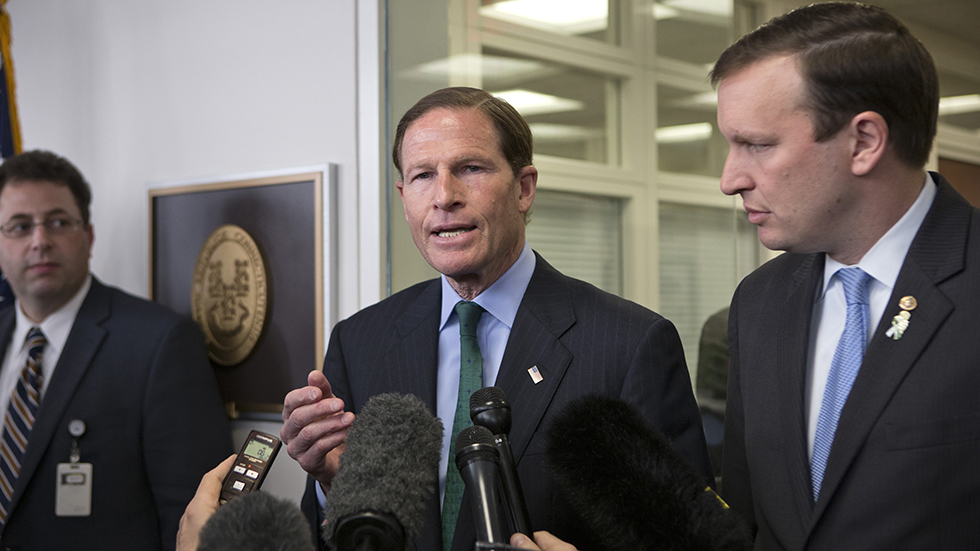
© Associated Press / J. Scott Applewhite | Sens. Chris Murphy (D-Conn.) and Richard Blumenthal (D-Conn.), seen in 2013, have worked together on proposed gun legislation for a decade.
On Sunday in Texas, Biden says he hopes to bring a “little comfort to a community in shock.”
It remains to be seen what else Biden can do. As The Hill’s Morgan Chalfant and Brett Samuels write, the president has nearly exhausted his options to confront gun violence through executive action. However, gun control advocates and allies are urging him to bolster enforcement of existing laws or treat incidents as a federal public health concern.
“This should be an all-government, all-hands-on-deck approach to solve this issue, and that includes the health agencies,” Kris Brown, president of the Brady Campaign, told The Hill.
Ultimately, though, what Biden can do pales in comparison to what can be done on Capitol Hill.
■ The New York Times: Senators grasp for a bipartisan gun deal, facing long odds.
■ Politico: “He can’t just be the ‘eulogizer in chief’”: Frustration grows over Biden’s Texas response.
■ Niall Stanage: The Memo: “Gated political thinking” thwarts progress on guns.
■ The Dallas Morning News: Texas Gov. Greg Abbott (R) decided not to attend the National Rifle Association convention in Houston and instead will be in Uvalde today. The governor recorded a video message for the NRA gathering.
Texas law enforcement officials face questions about whether police waited too long to respond after the gunman entered the elementary school unchallenged by security and spent an hour inside (The Washington Post). It was unclear on Thursday whether the rampage went on long enough on Tuesday that witnesses gathered at the scene had protested that police needed to enter the school and even agitated to do so themselves.
“We have not verified if that’s a true statement or not or whether it’s just rumor out there,” said Victor Escalon, a regional director of the Texas Department of Public Safety (The Hill).
Related Articles
▪ CNBC: Rep. Joaquin Castro (D-Texas) asks FBI to investigate police response timeline in Texas school shooting as controversy grows.
▪ The Hill: Senate Republicans block domestic terrorism bill.
▪ The New York Times: Other countries experienced mass shootings and had cultures of gun ownership. They changed their gun laws and their violence statistics show the results.
▪ The Hill: Five things to know about this weekend’s NRA meeting in Houston.
▪ The Hill: Education Secretary Miguel Cardona told House lawmakers on Thursday that educators “need action” on school safety and more when it comes to mass shootings.
👉 NOTE TO READERS: The Hill’s Morning Report returns Tuesday, May 31, following Memorial Day. Welcome to summer!
LEADING THE DAY
➤ POLITICS & CONGRESS
Food and Drug Administration Commissioner Robert Califf told senators on Thursday that he does not expect the nation’s infant formula shortage to be fully resolved until late July.
The FDA chief, who was appearing before the Senate Health Committee, told lawmakers that it will take weeks to get to where store shelves across the country are filled once again, but that the onslaught of production now will eventually result in a surplus.
“My expectation is that within two months we should be beyond normal, and with a plethora,” Califf said. “It’s going to be gradual improvement up to probably somewhere around two months until the shelves are replete again.”
Califf added that a separate discussion about the creation of a government national stockpile of formula “as a backup” to guard against future disruptions should be discussed (The Hill).
■ The Associated Press`: Baby formula shortage highlights racial disparities.
■ CNN: Instacart: Baby formula searches surging as store shelves remain empty.
■ The Washington Post: Parents trying to find baby formula are getting scammed.
On the political side, former President Trump and two of his adult children must testify under oath as part of the New York attorney general’s investigation into his business practices, a state appeals court ruled Thursday.
A four-judge panel for the appellate division of the state’s high court unanimously ruled against Trump’s appeal, dismissing the former president’s arguments that the subpoena is part of a politically motivated investigation. The ruling also means that Donald Trump Jr., and Ivanka Trump must also testify, as both stepped down from the family business in 2017.
“The existence of a criminal investigation does not preclude civil discovery of related facts, at which a party may exercise the privilege against self-incrimination,” the panel wrote (The Associated Press).
“Appellants have not identified any similarly implicated corporation that was not investigated or any executives of such a corporation who were not deposed.” the ruling continued. “Therefore, appellants have failed to demonstrate that they were treated differently from any similarly situated persons” (The Hill).
On Capitol Hill, Rep. Elise Stefanik (R-N.Y.), who has seen her star grow in Trump’s orbit, is leaning against a bid for House majority whip if Republicans retake the majority in the lower chamber in November, according to the Washington Examiner.
If Stefanik passes on becoming the top GOP vote counter, Reps. Drew Ferguson (R-Ga.), the House GOP’s chief deputy whip, Jim Banks (R-Ind.), chairman of the Republican Study Committee, and Tom Emmer (R-Minn.), head of the House GOP campaign arm, are considered the leading candidates for the presumptive post.
The Hill: Trump rally for Rep. Liz Cheney’s (R-Wyo.) challenger to feature video appearances by House Minority Leader Kevin McCarthy (R-Calif.), Stefanik.
IN FOCUS/SHARP TAKES
➤ UKRAINE CRISIS
Among the many sobering warnings emanating from Ukraine is that Russia’s war could starve millions of people, or at least render some food supplies scarce.
Ukraine’s minister of agriculture warned that by midsummer the world would start to feel the squeeze on food supplies and higher grain prices caused by Russia’s blockade of Ukrainian sea exports, The New York Times reported.
Before the war, Russia and Ukraine supplied more than a quarter of the world’s wheat.
“Countries right now still have some reserves, and they are still under the general hope that somehow, this will work itself out,” the minister, Mykola Solskyi, told the Times. “But when they see in July or August that they are running out of grain, and that the prices are extremely high, then the world will start to show a lot of emotions. There will be problems because of it.”
Pouncing on the world’s worries about food, Russian President Vladimir Putin told Italian Prime Minister Mario Draghi that lifting sanctions would ease such worries — with conditions (The Associated Press).
Moscow “is ready to make a significant contribution to overcoming the food crisis through the export of grain and fertilizer on the condition that politically motivated restrictions imposed by the West are lifted,” Putin said, according to a Kremlin summary of the call.
Moscow is eager to shift blame; Ukraine cannot ship grain and other agricultural products because of Russia’s attacks and control of its ports. Britain immediately accused Russia of “trying to hold the world to ransom,” insisting there would be no sanctions relief, and a top U.S. diplomat blasted the “sheer barbarity, sadistic cruelty and lawlessness” of Russia’s invasion.
■ The New York Times: How does it end? Fissures emerge over what constitutes victory in Ukraine.
■ The Hill: U.S. fights its own secrecy laws to pursue Russian assets.
■ The Washington Post: Finnish Prime Minister Sanna Marin met in Kyiv on Thursday with Ukrainian President Volodymr Zelensky as Finland, along with Sweden, seek to join NATO.

© Associated Press / Ukrainian Presidential Press Office | Ukrainian President Volodymyr Zelensky and Finnish Prime Minister Sanna Marin in Kyiv on Thursday.
📝 Introducing NotedDC, The Hill’s curated commentary on the beat of the Beltway. Click here to subscribe to our latest newsletter.
OPINION
■ Our babies are dying. Where are the responsible adults? by Dana Milbank, columnist, The Washington Post. https://wapo.st/3a1a3SY
■ A culture that kills its children has no future, by Elizabeth Bruenig, staff writer, The Atlantic. https://bit.ly/3MS3oZX
■ The Southern Baptist moral meltdown, by David Brooks, columnist, The New York Times. https://nyti.ms/3LQuO19
WHERE AND WHEN
The House meets at 9 a.m. for a pro forma session. Lawmakers will return to work on June 7.
The Senate convenes for a pro forma session at 9:30 a.m. Senators return to Washington on June 6.
The president will address the United States Naval Academy’s graduation and commissioning ceremony for the class of 2022 at 10 a.m. Biden will depart several hours later from Annapolis, Md., for Delaware, where he will spend the weekend.
Vice President Harris has no public schedule today.
Secretary of State Antony Blinken meets at 1 p.m. with Finnish Foreign Minister Pekka Haavisto and they will take questions from the press at 2:15 p.m. at the State Department.
🖥 Hill.TV’s “Rising” program features news and interviews at http://thehill.com/hilltv, on YouTube and on Facebook at 10:30 a.m. ET. Also, check out the “Rising” podcast here.
ELSEWHERE
➤ CORONAVIRUS
The current COVID-19 variant that is sweeping the U.S. is firmly in the delta lineage, but it is perhaps its properties from the original delta strain that have helped it spread faster and evade immunity than previously dominant variations, including the original omicron variant. As The Associated Press reports, a genetic trait known as a “delta mutation,” appears to allow the virus “to escape pre-existing immunity from vaccination and prior infection, especially if you were infected in the omicron wave,” according to Wesley Long, a pathologist at Houston Methodist in Texas.
Total U.S. coronavirus deaths reported as of this morning, according to Johns Hopkins University (trackers all vary slightly): 1,004,122. Current average U.S. COVID-19 daily deaths are 305, according to the Centers for Disease Control and Prevention.
➤ ENERGY
The Biden administration on Thursday announced the first proposed wind power lease sales offshore in California, the latest in a series of sales as the administration seeks to build out renewable energy infrastructure. The lease sales, the first of its kind off the West Coast, will take place in five proposed lease areas: Two off the Northern California coast in the Humboldt Wind Energy Area, and off of central California in the Morro Bay Wind Energy Area (The Hill).
➤ RIP
Ray Liotta, known for his starring roles in “Goodfellas,” as mobster Henry Hill, and “Field of Dreams,” as Shoeless Joe Jackson, died on Thursday at age 67, reportedly in his sleep in the Dominican Republic filming a project titled “Dangerous Waters” (Deadline and CNN).

© Associated Press / Christopher Raphael, Amazon Prime Video | Actor Ray Liotta seen in a scene from “Hanna,” 2021.
THE CLOSER

© Library of Congress / Underwood & Underwood | President Theodore Roosevelt and John Muir on Glacier Point, Yosemite Valley, California, in 1903.
And finally … 👏👏👏 Bravo to this week’s Morning Report Quiz winners! With summer getaways in mind, we asked readers about former presidents, first ladies and camping.
Here’s who aced the puzzle: Ki Harvey, Amanda Fisher, Jaina Mehta, Patrick Kavanagh, Lori Benso, Daniel Bachhuber, Carl J. Horn, Bonnie LePard, Steve James, Lou Tisler and Robert Bradley.
In May 1903, former President Theodore Roosevelt’s three-day adventure camping under the stars with naturalist John Muir in Yellowstone Valley inspired Roosevelt to create Yellowstone National Park.
While campaigning for a second term during the summer of 2012, former President Obama mentioned to audiences that daughters Sasha and Malia had enjoyed a month of sports, crafts and “some ice cream” at summer camp in New Hampshire, site of the first-in-the-nation primary.
In the summer of 1995, former President Clinton and former first lady Hillary Clinton vowed to spend 17 days of vacation in the Grand Tetons. To the amazement of staff and journalists, the customarily restless duo stayed all 17 days and raved about their R&R.
As a young woman, former first lady Betty Ford worked as a dance instructor during summers at Camp Bryn Afon in Wisconsin. (The camp newsletter enthused, “There’s a step for everyone and not a wallflower in sight when the music starts to swing.”)
Stay Engaged
We want to hear from you! Email: Alexis Simendinger and Al Weaver. Follow us on Twitter (@alweaver22 & @asimendinger) and suggest this newsletter to friends!
Source: TEST FEED1
Share:
US fights its own secrecy laws to pursue Russian assets
Some of the biggest obstacles for investigators going after Russian assets amid the country’s now three-month-long invasion of Ukraine are the legal mechanisms for preserving anonymity that are built into the U.S. tax and financial code.
The most powerful of these rules is the designation known as beneficial ownership, which allows asset owners to remain unregistered on legal documents as long as they name a third party to act on their behalf.
That means beneficial ownership laws can allow billions of dollars’ worth of illicit property to remain invisible to financial investigators.
They’re also one of the main reasons the U.S. now ranks above Switzerland and the Cayman Islands as the most financially secretive country in the world, according to a list published this month by the Tax Justice Network, a U.K.-based nonprofit.
“The U.S. has climbed to the top of a global ranking of countries most complicit in helping individuals to hide their wealth from the rule of law, earning the worst rating ever recorded since the ranking began in 2009,” the group said in a statement.
The top international ranking has had an impact among financial transparency advocates in the U.S.
“While the U.S. has committed to being a leader in cracking down on global corruption, these rankings show how corrupt actors are weaponizing our financial system against democracy here and abroad,” said Ian Gary, head of the U.S. non-profit Financial Accountability and Corporate Transparency (FACT) Coalition.
Despite these hurdles, investigators from the Department of Justice-led interagency KleptoCapture task force are pressing ahead in their search for assets belonging to Russian oligarchs and decision-makers within the Kremlin.
The IRS criminal investigations division said it has initiated 19 sanctions-related criminal investigations since March.
“The agency continues to use its financial and cyber expertise to assist the tax force and our international partners with identifying assets/entities tied to individuals on the Special Designated Nationals (SDN) List, deconflicting of sanctions-related enforcement efforts and developing new sanctions-related investigations,” the division said in a statement.
This may seem like quixotic work in a country portrayed by its own Treasury chief as the money-laundering capital of the world.
“There’s a good argument that, right now, the best place to hide and launder ill-gotten gains is actually the United States,” Treasury Secretary Janet Yellen said during a State Department Summit last year. “And that’s because of the way we allow people to establish shell companies.
“Since Andrew Jackson, individual states have been free to set their own rules for incorporating companies, and since the early 20th century, some states have allowed anybody to establish a shell company without disclosing who really owns it, what we term ‘the beneficial owner,’” Yellen said.
Two states well known for their secretive ownership laws are Delaware and Nevada, where corporate lawyers can name third parties, or “nominee” entities, to own something in the eyes of the government, while the true owner stays off the books.
But that may be changing.
As part of the landmark Corporate Transparency Act of 2020 (CTA), the U.S. is now rolling out a registration database for beneficially owned companies and implementing other rules aimed at showing who owns what assets.
Transparency advocates, however, say the regulations outlined by the law are still riddled with loopholes and will remain ineffective without blunter, less nuanced language from regulators.
For example, according to the American Bar Association, it’s still unclear whether limited partnerships are included in the types of companies that need to register.
Since “the CTA’s focus is on shell companies and other entities with limited or no operations, the CTA provides numerous exceptions for entities from undergoing reporting, including those in a regulated industry (where existing regulatory regimens would already include beneficial ownership reporting), publicly traded companies, investment vehicles operated by investment advisors, nonprofits, and government entities,” Lawrence A. Goldman and David J. Marella wrote for the association.
One of these exemptions that’s of particular concern to transparency groups is referred to in regulatory language as “pooled investment vehicles,” but more commonly known as hedge funds, private equity funds and venture capital firms.
“These are vehicles that in many cases have no anti-money laundering obligations, do not make known their ownership whether to a government regulator or to the public,” FACT Coalition advocate Erica Hanichak said in an interview.
An FBI document leaked to Reuters in 2020 warned that criminals – referred to as “threat actors” – may be taking advantage of the anonymity afforded to investors by the laws around private investment funds.
“The FBI assumes AML [anti-money laundering] programs are not adequately designed to monitor and detect threat actors’ use of private investment funds to launder money. Additionally, the FBI assumes threat actors exploit this vulnerability to integrate illicit proceeds into the licit global financial system,” the leaked memo said, according to Reuters.
In March, Democratic Sens. Elizabeth Warren (Mass.) and Sheldon Whitehouse (R.I.) wrote to. Yellen and the head of the Securities and Exchange Commission to demand more transparency in the investment sector.
“The exemption for the private investment industry, which includes hedge funds and private equity firms, allows companies and their advisers to accept and manage huge sums of money without needing to know basic information about their investors or clients, undermining anticorruption, counterproliferation, and counterterrorism programs and letting criminals and sanctioned individuals like Russian oligarchs hide and grow their wealth,” they wrote.
However the CTA is hashed out into practicable rules, the current reality for investigators seeking Russian assets is still murky and hard to navigate.
“There’s been talk about the use of beneficial ownership structures and nominees,” Don Fort, former head of the IRS criminal investigation division, said in an interview about the current investigation. “It’s not easy to crack those types of financial transactions.”
FACT Coalition’s Hanichak agreed.
“Often these chains of ownership can span four or five different continents and are intentionally opaque. Having better visibility into the U.S. piece of that puzzle is incredibly important, to be able to put together the broader picture of where Russian oligarchs’ assets could be invested,” Hanichak said.
Source: TEST FEED1
Share:
Senate GOP signals an openness to talking about gun legislation
Senate Republicans are signaling an openness to talks with Democrats on gun violence in the aftermath of back-to-back mass shootings.
As pressure builds around gun reform on Capitol Hill following the shootings, Republican leaders have encouraged talks exploring a potential bipartisan course of action amid discussion on measures ranging from “red flag” legislation to background checks.
Senate Minority Leader Mitch McConnell (R-Ky.) told CNN on Thursday that he tapped Sen. John Cornyn (R-Texas), who recently returned to his home state after the recent shooting at an elementary school in Uvalde, to participate in bipartisan talks.
“What I’ve asked Senator Cornyn to do is to meet with the Democrats who are interested in getting a bipartisan solution and come up with a proposal, if possible, that’s crafted to meet this particular problem,” he said, stressing proposals directly related to the Uvalde shooting.
Other GOP leaders have also said they’re supportive of bipartisan talks, while similarly pushing back on broad proposals that stray in focus from recent gun violence.
“I think that we have to at least listen to each other and see if there’s a path forward where we might be able to find solutions that actually address the problem,” said Sen. John Thune (S.D.), the No. 2 Republican in the upper chamber.
Many Republicans were resistant to Democratic-led calls for gun reform last week, following a racist shooting at a store in a predominantly Black neighborhood in Buffalo, N.Y., that killed 10 people.
But Democrats say more Republicans are expressing interest in a possible compromise as the issue of gun violence garners more public attention in the days following the Texas shooting, which left 19 children and two teachers dead.
Sen. Richard Blumenthal (D-Conn.), who has been helping lead bipartisan talks around gun reform along with Sen. Chris Murphy (D-Conn.), estimated on Thursday that about six to twelve Republicans have “indicated serious interest,” particularly on red flag legislation.
According to Everytown for Gun Safety, a national group focused on preventing gun violence, nineteen states have implemented such laws designed to keep people at risk of harming themselves or others from temporarily accessing firearms.
There’s also interest in pursuing proposals to expand background checks, like the bipartisan legislation Sens. Joe Manchin (D-W.Va.) and Pat Toomey (R-Pa.) previously brought up years back that sought to mandate background checks for all gun commercial sales.
“That is the centerpiece as far as I’m concerned of what might be done, and frankly, there’s not much more than that – that can be done,” Toomey told The Hill on Wednesday, adding that a red flag is “possible,” but would be a “tough” lift.
Last week, Manchin also previously pointed to his and Toomey’s proposal, which also included exemptions for certain exchanges involving friends and family, as the best chance for passage in the 50-50 Senate. But he noted then that the Senate “can’t even get” that legislation, which was first introduced months after the Sandy Hook Elementary School shooting in 2012.
However, as talks have gained more steam in recent days, Manchin has appeared more optimistic about a potential compromise, telling reporters that it’s “encouraging” to see bipartisanship in current discussions.
“This feels different right now,” Manchin said on Thursday.
Sen. Tim Kaine (D-Va.) said on Thursday that recent comments from McConnell signaled “a glimmer of hope,” while noting Cornyn “was the person who helped find the last fix that we did on the background check system.”
Cornyn previously worked with Murphy on legislation aimed at strengthening reporting to the National Instant Background Check System (NICS) following another mass shooting at a Sutherland Springs, Texas, church in 2017. According to the Dallas Morning News, former President Trump signed off on the measure the following year as part of a funding bill.
Additional proposals that have come up in talks include measures to incentivize states that adopt red flag legislation.
Sen. Marco Rubio (R-Fla.), who introduced a bipartisan bill with the same aim following the Marjory Stoneman Douglas High School shooting in Parkland, Fla. in 2018, told The Hill on Thursday that he recently talked to Sen. Dick Durbin (Ill.), the No. 2 Senate Democrat, and Thune about the measure.
Thune told reporters he thinks there’s a “general feeling” among Republicans that “it’s better to incentivize [states] than to come up with a national or federal, any kind of a federal requirement. We’ll see where that goes.”
Murphy said on Thursday that he’s still “trying to game out what’s possible” in talks with Republicans, which he added will continue through the coming recess.
“I’m glad that, today, there’s a lot of potential Republican partners who want to listen, who want to engage. There’s a sense of urgency, and then we move to specifics,” he said.
But other Democrats say they aren’t holding their breath just yet on chances of a compromise.
“I’ll believe that there are Republicans in the Senate who are ready to attack gun violence head on when I see it, and not before,” Sen. Elizabeth Warren (D-Mass.) said on Thursday afternoon.
Sen. Cory Booker (D-N.J.) also sang a similar tune, noting past inaction on gun reform on a national scale following mass shootings over the years.
“The truth of the matter is, from Columbine to Parkland to Newtown, now down in Texas, we haven’t seen any change here on the federal level,” he said. “So, we’ll see.”
Source: TEST FEED1
Share:
The Memo: ‘Gated political thinking’ thwarts progress on guns
Horrific mass shootings in Texas and upstate New York within the past two weeks have fueled a new public outcry for gun reform.
But even Democrats admit that, when it comes to federal action, this time might not be different from all those that have gone before.
Measures to enact even modest gun reforms have run aground for years on Capitol Hill.
There is another push underway now, after 21 people, including 19 children, were shot dead in Uvalde, Texas, on Tuesday. The tragedy came only 10 days after 10 people were killed in a grocery store in Buffalo, N.Y.
Advocates for change note the overwhelming public support for some proposals, such as universal background checks — and the visceral horror so many Americans feel at every new mass killing.
But they aren’t sure much will change in the short term.
The gun debate “is one of the worst cases of special interest politics and, frankly, conservative political thinking and gated political thinking — and it’s keeping our system from responding to what the voters want,” said Celinda Lake, a Democratic pollster who worked with President Biden’s 2020 campaign and now conducts polling for the Democratic National Committee, among others.
Lake argued that there has been a default position whereby members of Congress believe they are culturally in sync with their constituents when they oppose gun reform measures.
But when politicians take that position, she asserted, “you’re not communicating you are in touch with voters. You’re communicating that you are a politician.”
The political reality is that the events in Texas and Buffalo do not change the legislative math — specifically, the need for 60 votes in a Senate that is split 50-50 between the parties.
Most Republicans are opposed to gun control, so the question is whether a sufficient number might break with that orthodoxy. It’s far from certain.
“It is just hard to see Democrats getting to 60. That’s a fifth of the Republicans in the Senate you have to pry off,” said Todd Belt, a professor and program director at the George Washington University’s Graduate School of Political Management.
There are some modest efforts underway to see if a bipartisan deal can be struck.
Sen. Chris Murphy (D-Ct.), a leading proponent of gun reforms, is leading a group said to comprise 10 senators, five from each party.
They are working toward some form of expanded background checks and might also be able to advance so-called ‘red flag’ laws, which enable police or family members to petition a judge to remove firearms from a person who is perceived to be at risk of committing violence.
The group includes Sens. Joe Manchin (D-W.Va.) and Pat Toomey (R-Pa.), who sponsored legislation almost a decade ago that would have strengthened background checks. Their push, sparked by the late 2012 massacre at Sandy Hook Elementary School, in which 20 young children and six adults were killed, failed.
The Manchin-Toomey proposal did, in fact, get majority support — 54 votes in favor, 46 against — but that was six votes short of the number needed for it to advance in the Senate. Manchin has in recent days reiterated his long-standing opposition to abolishing or reforming the filibuster.
“The problem of gun violence is too pressing, too great and too horrific to let a procedural tool like the filibuster stand in the ways of policies that 90 percent of Americans support,” said Christian Heyne, vice president of policy with Brady, an organization that works to reduce gun violence.
Noting that the House passed two pieces of legislation on guns last year, Heyne said, “The last place where change hasn’t taken root in the entire country is the floor of the United States Senate. That is going to be the last challenge we need to overcome.”
Meanwhile, Senate Minority Leader Mitch McConnell (R-Ky.), has been decidedly cool about any kinds of gun reform measures, even as he has expressed horror at the events in Texas.
On Thursday, McConnell said he had encouraged Sen. John Cornyn (R-Texas) to get involved in bipartisan talks. But McConnell emphasized in his remarks that he wanted any outcome to be “directly related to the facts of this awful massacre” and “crafted to meet this particular problem.”
While McConnell did not spell out exactly what he meant, those words sounded like an allusion to school security or perhaps mental health provisions — measures that Republicans are more likely to favor than gun reform.
Republicans are loath to be seen as infringing on gun rights, and also argue that restrictive gun laws will not be a panacea for shootings.
The failure to enact even incremental gun reform measures is perplexing to millions of Americans, however, especially given the apparently overwhelming public support for some proposals.
A Quinnipiac University poll last year, for example, indicated that 89 percent of Americans, including 84 percent of Republican voters, support universal background checks.
The same poll found strong support for red flag laws, with 74 percent support; and a slimmer majority, 52 percent, in favor of an assault weapons ban.
Democrats with long memories recall that their party’s support for a 1994 assault weapons ban was blamed by some for sweeping losses in that year’s midterm elections — though the causal link between the two matters is hotly disputed.
Murphy, in an interview earlier this month — after the shooting in Buffalo but before the attack on the elementary school in Uvalde — told the New York Times, “My worry is that a lot of my colleagues still believe in the mythology of 1994, when everyone thought Democrats lost Congress over the assault weapons ban. That’s not true — that’s not why Congress flipped. Ever since then, Democrats are under the illusion that it’s a losing issue for us.”
Biden noted, during his first public remarks on the Texas tragedy, that after the assault weapons ban expired in 2004, mass shootings tripled.
For the moment, the main political focus is on the more modest measures — even amid the current spate of carnage.
“Babies are dying,” Democratic strategist Donna Brazile told this column.
“This time, the deflection by Republicans accusing Democrats of trying to take away the guns of law-abiding citizens must not work. Let’s start from points of agreement on background checks, state by state red flag laws and see if we can move on to banning assault rifles for people under 18.”
For now, there’s no certainty that even those first steps will be taken.
The Memo is a reported column by Niall Stanage.
Source: TEST FEED1