

Share:
Texas mass shooting cynically exploited to advance war on public schooling
The rolling crisis that is America’s gun violence epidemic reached into yet another set of lives on Tuesday, this time in the small town of Uvalde, Texas. There, an 18-year-old gunman used his recently-purchased AR-15 to embark on a rampage that left 19 children and two teachers dead and the shooter’s grandmother seriously wounded.
Republicans from Texas Sen. Ted Cruz to Rep. Marjorie Taylor Greene quickly dismissed the idea of even talking about gun control legislation, while criticizing Democrats for, in their mind, politicizing a senseless tragedy. But one conservative writer exploited the Uvalde shooting as an opportunity to attack one of the GOP’s favorite targets: public schooling.
“Tragedies Like the Texas Shooting Make a Somber Case for Homeschooling,” reads the headline of a piece by Jordan Boyd, a writer for The Federalist. The argument is staggering in its cynicism and defeatism: an easy-to-access stream of high-powered weaponry poses a constant threat to children in schools across America. But the answer isn’t to pass legislation that improves gun safety. Boyd is proposing we shut down our schools instead.
But Boyd doesn’t want to get rid of public schools out of a desire, held by many conservatives, to end all forms of public education from the Department of Education on down. No, she’s just thinking of the children.
“Schools should be a safe place for children to learn, but saying ‘guns have no place here’ only stops good people with kids’ best interests in mind from being able to protect them,” Boyd writes. “At home, parents don’t have to worry about jumping through bureaucratic hoops to shield their kids from a bullet, the trauma of seeing their classmates slaughtered, or even terrifying shooting drills.”
Boyd’s reasoning is all wrong. When the pandemic largely shut down schools across America, our country was in the unique situation of educating most children from home. That created a treasure-trove of data. As NPR reports, accidental gunshot deaths by children handling guns at home jumped a staggering 31 percent after most schools closed.
In fact, more children died from gun violence when schools were closed than died when schools were open. Ninety-eight children died from unintentional shootings between March and December 2019. But over that same period during remote learning, 128 died from accidentally shooting themselves.
Boyd doesn’t address how reverting to homeschooling would be practical for single parents or low-income families in which both parents work full-time jobs. And since Republicans refused to extend the Child Tax Credit that slashed child poverty, fewer families than ever can leave work to educate their children personally.
Republicans don’t seem to be interested in having an honest conversation about how to support low-income families, some of whom may be interested in homeschooling their kids. They’re just desperate to distract from the direct connection between America’s ocean of guns and the now routine sight of gun-enabled mass murder in our schools and communities.
Nearly half of American families report having a gun in the home. The Uvalde shooter purchased his two AR-15 style rifles legally, following a string of successful efforts by Texas Republicans, including Gov. Greg Abbott, to strip away nearly every restriction on purchasing a gun. Whether at home or in school, our children are surrounded by a culture that has prioritized the freedom to own guns over the rights of children to remain alive.
Boyd gives away the game in the article’s last paragraph, bluntly reminding the reader that the real purpose of her article is to push “educational choice” — a phrase Americans have heard a lot from Republicans recently. That euphemism sanitizes the GOP’s years-long effort to weaken, defund and ultimately destroy public education at every level.
Democrats must realize that not only is now the time to get political, but that the fight to protect ourselves from gun violence has always been political. While some conservative Democrats bristle at pushing back against the GOP’s cynical exploitation of gun culture, Republicans are already bringing the wrecking ball to dismantle America’s public education.
Max Burns is a Democratic strategist and founder of Third Degree Strategies, a progressive communications firm. Follow him on Twitter @themaxburns.
Source: TEST FEED1
Share:
Father says he learned of daughter's death in Texas school shooting from classmate
The father of one of the young victims in the mass shooting in Uvalde, Texas, shared that he learned of his daughter’s death through one of her classmates.
In an interview with CNN’s Anderson Cooper, Angel Garza broke down while describing the moment he learned his daughter, 10-year-old Amerie Jo Garza, was dead after responding to the incident at Robb Elementary School as a med aide.
“One little girl was just covered in blood head to toe. Like, I thought she was injured. I asked her what was wrong and she said, she is OK. She was hysterical saying that they shot her best friend. They killed her best friend and she is not breathing. She was trying to call the cops and I asked the little girl the name … and she said, ‘Amerie,’ ” Angel Garza said.
He shared that Amerie had turned 10 two weeks before the school shooting.
“She received an award yesterday for honor roll just before the shooting occurred,” Garza added in an emotional interview. “She was so smart and such a good child. Amerie is known for being a hero and trying to call 911 before the shooter took her life.”
According to Garza, Amerie was trying to call police when she was shot.
“She was so scared of strangers and things like this, she would lock the door when I would step out to put gas in the car. This is literally like her worst fear. And she was just trying to help everyone,” he added.
He added that Amerie was “the sweetest little girl” who did nothing wrong.
“She listened their mom and dad. She always bred into us. She was creative. She made things for us. She never got in trouble in school. Like I just want to know what she did,” Garza said the day after the incident that claimed the lives of 19 schoolchildren and two teachers.
Amerie also has a three-year-old brother called Zayne who, according to Garza, “asks for his sister every morning when he wakes up.”
“I just want people to know that she just died trying to save her classmates.”
Source: TEST FEED1
Share:
88 percent in new poll support background checks on all gun sales
An overwhelming majority of Americans questioned in a poll conducted one day after the mass shooting at an elementary school in Texas supports background checks on all gun sales.
The survey from Morning Consult and Politico showed that 73 percent of respondents “strongly support” universal background checks and 15 percent “somewhat support” the requirement.
Only 4 percent said they “somewhat oppose” the background checks, and another 4 percent “strongly oppose” them. Five percent said they had no opinion.
Eighty-one percent also said they support making private gun sales and sales at gun shows subject to background checks.
Additionally, an overwhelming 84 percent of respondents said they would support “preventing sales of all firearms to people who have been reported as dangerous to law enforcement by a mental health provider.”
The survey also found that 79 percent strongly or somewhat support “barring gun purchases by people on the federal no-fly or watch lists.”
Seventy-five percent, meanwhile, strongly or somewhat support “creating a national database with information about each gun sale,” and 67 percent support banning assault-style weapons.
The survey included a sample of 1,920 registered voters and had a margin of error of 2 percentage points. It was conducted on Wednesday, the day after 19 children and two teachers were killed at Robb Elementary School in Uvalde, Texas.
Federal law does not require that unlicensed gun sellers operating online or at gun shows conduct background checks prior to the purchase of firearms.
A bill known as H.R. 8, known as the Bipartisan Background Checks Act, would require a background check for all gun sales. It passed in the House over a year ago, but has been stalled in the Senate.
Source: TEST FEED1
Share:
Is a durable peace between Ukraine and Russia possible?
Now that the Kremlin’s offensive has stalled and the Ukrainian armed forces appear poised to defeat Russia, various authoritative Western voices — from French President Emmanuel Macron to Italian Foreign Minister Luigi Di Maio to the New York Times — have begun calling for a negotiated end to the war.
Their intent may be laudable; their chances of success are nil. The reason is simple. Ukraine wants to survive as a nation and as a state and has no claims on Russian territory. Russia wants to destroy Ukraine as a nation and as a state and wants to seize all of Ukraine’s territory. Ukraine is playing a positive-sum game in which both sides can win. Russia is playing a zero-sum game in which Russia wins everything and Ukraine loses everything.
Unless Russian President Vladimir Putin changes Russia’s game, there is no compromise possible and, hence, no durable peace. Both sides could take a breather to regroup their forces, but a stable, long-lasting peace is possible only if Russia accepts Ukraine’s existence as both a nation and a state.
Thus far, there is no evidence of such a change of heart. Quite the contrary, Russian rhetoric and policy have become increasingly dismissive of Ukraine’s right to exist. Claims that Ukraine does not and should not exist abound; the genocidal killing of Ukrainian civilians and the destruction of Ukraine’s cultural legacy continue unabated.
Seen in this light, Italy’s recently announced four-point peace plan appears unrealistic. Although its elements are perfectly reasonable, as far as most reasonable people are concerned, the plan assumes that Putin’s Russia also could be reasonable. Russia could agree to a ceasefire and Ukraine’s neutrality (points 1 and 2 of the plan) as temporary adjustments to its strategic goal of destroying Ukraine, but it never would agree to Ukraine’s sovereignty over Crimea and the Donbas and a withdrawal of Russian troops from all of Ukraine (points 3 and 4). Ukraine, in contrast, could easily agree to all four points, at least as starting points for further negotiations.
How, then, could Russia be brought around to accepting Ukraine’s existence? There are three formidable obstacles to such a metamorphosis.
First, Putin has explicitly adopted genocide as the core of his approach to Ukraine. Given that Ukraine’s destruction is the central desideratum of Putin’s Ukraine’s policy, Russia will remain intransigent in its zero-sum approach as long as Putin remains president. To put the matter less diplomatically, Putin will have to leave office, whether by force or not, for anything to change in Russia’s Ukraine policy. Rome would do well to shelve its peace plan until that day.
To be sure, Putin’s successor also could be a hardliner. But even if he is, his line is almost certain to be softer than Putin’s, both because he will have invested less personal capital in genocide and because he may be looking for a convenient issue to enhance his own authority and distance himself from Putin’s catastrophic war. And, of course, it’s not inconceivable that, if a post-Putin power struggle were to break out, quasi-democrats might even be able to seize the government.
Second, Russia is a fascist state that needs an enemy and war to legitimize itself and retain its popularity with the population. Putin’s departure would remove the linchpin of the fascist regime and thereby fatally weaken it, but the only thing that would guarantee a withdrawal from zero-sum thinking would be regime change. Russia need not become democratic; run-of-the-mill authoritarianism would suffice to make a significant difference. Naturally, there is no hope of any kind of regime change as long as Putin remains in charge.
Finally, Russian political culture is explicitly hostile to Ukraine and Ukrainians and has been so for several centuries. The popular mindset doesn’t determine policy, but it does place constraints on what may and may not be undertaken by policymakers. Political cultures, like cultures, take time to change, and they change radically only if they experience serious traumas.
What, then, could overcome all three obstacles? Not peace plans, not vain stabs at negotiation, not concessions by Ukraine, and not ceasefires doomed to breakdown. The only thing that could change Russia quickly would be a serious defeat in the war with Ukraine. At the least, Ukraine would have to drive out Russian forces from the territories they occupied after Feb. 24. Ideally, Russia also would be driven out of Crimea and the Donbas.
If that were to happen, Putin in all likelihood would fall, the regime would collapse, and Russian political culture would begin to change from Russian supremacism toward some form of peaceful coexistence with its neighbors.
The lesson for the West is painfully obvious. If it wants real peace in Ukraine, it should keep doing everything possible not to save Putin’s face but to hand him a serious defeat.
Alexander J. Motyl is a professor of political science at Rutgers University-Newark. A specialist on Ukraine, Russia and the USSR, and on nationalism, revolutions, empires and theory, he is the author of 10 books of nonfiction, as well as “Imperial Ends: The Decay, Collapse, and Revival of Empires” and “Why Empires Reemerge: Imperial Collapse and Imperial Revival in Comparative Perspective.”
Source: TEST FEED1
Share:
Lebanon takes a first step to move forward from dysfunction
Those in Washington who have urged the U.S. to disengage from Lebanon because of its dysfunctional government and a citizenry incapable of demanding change may have found their arguments challenged by the results from Lebanon’s May 15 parliamentary elections. The Lebanese people, much to the surprise of many, apparently sought change by voting against the political status quo.
Hezbollah and its allies lost a parliamentary majority. The Free Patriotic Movement, a pro-Hezbollah, Christian party, was largely defeated by the Lebanese Forces political party, an anti-Hezbollah party that now becomes the largest Christian party in parliament. Sixteen independent candidates were joined by nine others who are critical of Lebanon’s political establishment. And although much more gender diversity is needed in the parliament, a record high of eight women were elected.
Obstacles to reforms certainly remain, but the voters have inspired a new momentum that can help steer the government away from corruption and toward a more responsive state. The verdict is still out, of course, on whether the new parliament will have the political courage and pragmatism to implement needed reforms. If there is a lesson from these elections that lawmakers should take to heart, it is that time has run out for “politics as usual.” The electoral results also highlight key areas to which U.S. lawmakers can look for constructive engagement.
It is important to remember that this was the first time the Lebanese people have voted since the October 2019 protests and the 2020 Port of Beirut explosion. A pre-election poll from Zogby Research Services showed record high levels of human suffering and an understandable desire for change. For example, essentially all of Lebanon reported being seriously impacted by shortages in fuel (97 percent), electricity (89 percent), and drinking water (74 percent), and the poverty rate is at an all-time high, exceeding 70 percent of the population.
When asked about the elections, a majority of Lebanese surveyed reported a willingness to support new political parties. They listed parliament and the traditional political parties as the institutions in which they had the least amount of trust. However, one particular challenge the opposition presented to voters is that they were unable to unite in common voting districts where their political interests intersected, forcing many voters to choose between competing lists of reformists and united lists of entrenched career politicians. Effective coalition building could have produced an even larger number of reformists in parliament.
If such squabbles cannot be overcome in the new parliament, this historic vote could render itself meaningless. The biggest threat to reform in Lebanon may be political gridlock. Reformists of all stripes must build viable coalitions to implement necessary economic and financial reforms in order to receive help from the International Monetary Fund, or make crucial leadership decisions in choosing a speaker of the parliament, who must be of the Shiite religion; a prime minister, who must be of the Sunni religion; and a president of the pepublic, who must be a Maronite Catholic. These tests will require deal-making, compromise and coalition building that will test all members of parliament, especially those who campaigned on reform.
While there were reports of voting irregularities, threats against voters, and a hostile press environment, the Biden administration and Congress were firm and helpful in promoting free, fair and on-time elections in Lebanon. America’s continuing support is needed to strengthen democracy within Lebanon and protect its vital interests on the eastern Mediterranean. A strong civil society, stable economy and a free media are pivotal to these objectives. U.S. programs to support economic reform and democratic and corruption-free institutions should be implemented. U.S. lawmakers should take note that the U.S.-supported Lebanese Armed Forces (LAF) were deployed throughout the country on election day to maintain relative calm.
The message the Lebanese people have conveyed is clearly one of determination. The U.S. has a partner in a reform-minded Lebanese citizenry. It must capitalize on this by increasing support for the LAF and investments in Lebanon’s democratic future. Lebanese lawmakers must also do their job; the clock is ticking for them to build coalitions, rebuild public trust and govern in a manner that moves their country forward.
Edward M. Gabriel is the former U.S. ambassador to the Kingdom of Morocco (1997-2001). Currently, he is the president and CEO of the American Task Force on Lebanon, a leadership organization of Americans of Lebanese descent.
Source: TEST FEED1
Share:
The Hill's Morning Report — Will Congress act on guns?
Grief consumed Texas and the country on Wednesday following a gunman’s spree that killed 19 schoolchildren and two teachers in the town of Uvalde on Tuesday. In Washington, lawmakers debated legislating to strengthen gun background checks, “red flag” laws and other steps to respond to Americans’ fury and impatience.
President Biden said Wednesday he will travel to the 16,000-person town “in the coming days” in an attempt to comfort residents as he pleaded with lawmakers to take action on gun control measures in the near future.
“We must ask when in God’s name will we do what needs to be done to, if not completely stop, fundamentally change the amount of the carnage that goes on in this country,” Biden said at the White House before signing an executive order on policing.
“The Second Amendment is not absolute. … You couldn’t own a cannon. You couldn’t own certain kinds of weapons. There’s always been limitations,” Biden added(CBS News).
The president’s remarks came as the gun debate intensified on Capitol Hill despite the possibility that nothing will ultimately overcome the 60-vote threshold in the upper chamber, a story that has played out repeatedly over the past decade. As The Hill’s Alexander Bolton notes, the leading proposal is a bill to deal with “red flag” laws with the intention to keep firearms out of the hands of potentially dangerous people.
House Majority Leader Steny Hoyer (D-Md.) announced that the House will vote after the Memorial Day recess on a bill that would nationalize those laws. The legislation would also empower courts to bar individuals from buying or possessing firearms if a judge deems them to be a threat to themselves or others (The Hill).
Across the Capitol, Senate Majority Leader Charles Schumer (D-N.Y.) said on Wednesday that senators would have the chance to vote on amendments on gun measures if the Senate GOP agrees to debate on the Domestic Terrorism Prevention Act that is set for a vote this week. However, that possibility is exceedingly remote, as Republicans have vowed to block the bill, which garnered only one House Republican vote (The Hill).
The New York Democrat’s remarks came a day after he told lawmakers that he was not planning to bring any gun-related legislation to the floor and would, instead, wait for a possible bipartisan compromise proposal that could garner the requisite 60 votes (The Hill). Among those expected to hold discussions are Sen. Chris Murphy (D-Conn.),Sen. Susan Collins (R-Maine), a centrist, and Sen. Pat Toomey (R-Pa.), who is retiring.
■ Emily Brooks and Mike Lillis, The Hill: Here are the gun bills stalled in Congress.
■ Dan Balz: America’s new norm: “Why are we willing to live with this carnage?”
■ Politico: Biden’s presidency has been colored by crises. It now faces the grimmest one yet.
■ The New York Times: A timeline of failed attempts to address U.S. gun violence.

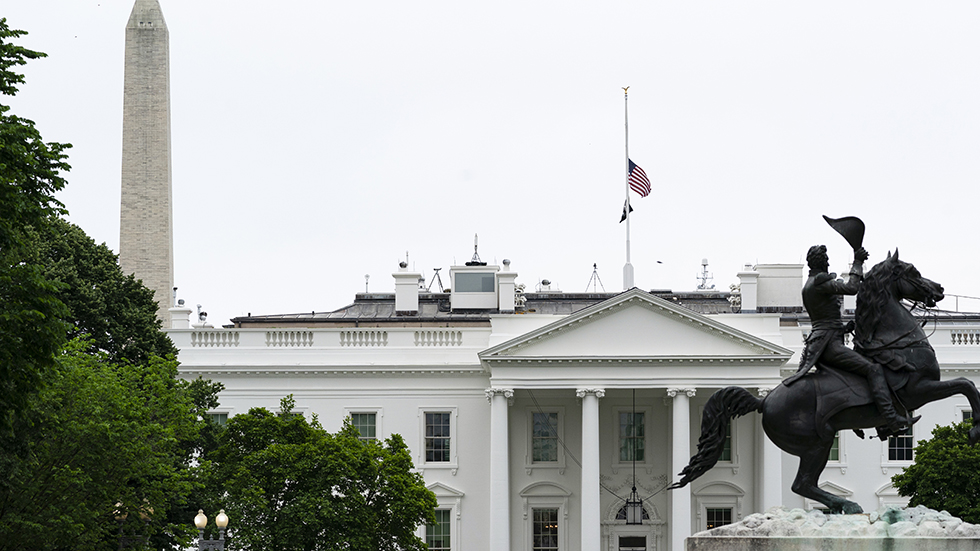
© Associated Press / Alex Brandon | Flags fly over the White House at half-staff on Wednesday.
In Texas, state and local officials offered information on Wednesday about the Uvalde shootings, the victims and survivors, and the 18-year-old gunman’s movements up to the moment law enforcement killed him while he was described as armed and barricaded inside a fourth grade classroom.
Lots of information. Few answers. Fewer recommendations.
Texas Gov. Greg Abbott (R), during a midday news conference near the now flower-draped Robb Elementary School, said “there was no meaningful forewarning of this crime,” adding that the suspect, Salvador Ramos, allegedly shot his grandmother in the face prior to his rampage and posted messages to Facebook 30 minutes before he reached the school. The messages said, “I’m going to shoot my grandmother,” “I shot my grandmother” and “I’m going to shoot an elementary school.” The grandmother remained hospitalized on Wednesday, according to reports.
NBC News: Abbott said the young gunman had “a mental health challenge,” adding that Texas needed to “do a better job with mental health.” In April, the governor cut $211 million from the state department that oversees mental health programs. And Texas ranked last out of all 50 states and the District of Columbia for overall access to mental health care, according to a 2021 State of Mental Health in America report.
Abbott, whose job approval was 47 percent last month, described the murders of 21 people and injuries to 17 others as “intolerable” and “unacceptable” without proposing specific action. As he spoke, Democratic gubernatorial candidate Beto O’Rourke, a 2020 presidential primary candidate, disrupted the news conference to challenge Abbott’s rhetoric, which prompted Uvalde’s mayor to denounce O’Rourke’s behavior as “sick” and “out of line.” O’Rourke was escorted out by security (The Hill and The Dallas Morning News).
Abbott — an ardent Second Amendment defender with an A+ rating from the National Rifle Association (NRA) who says gun control measures are not the answer to mass shootings — added heat to the south Texas swelter by comparing his state to Chicago and its murder rate.
“There are, quote, ‘real’ gun laws in Chicago,” Abbott said. “There are more people who are shot every weekend in Chicago than there are in schools in Texas” (CBS News Chicago).
The NRA will hold its annual convention in Houston this weekend, a point of controversy in some parts of Texas because of the elementary school massacre. Sen. Ted Cruz (R-Texas), whose Tuesday comments about the right to bear arms invited Democratic criticism, confirmed he will appear. Former President Trump is also expected to speak (The Hill).
Related Articles
▪ The New York Times: After Texas shooting, Cruz digs in against gun control.
▪ CNN exclusive, by Annie Grayer: The House sergeant-at-arms believes lawmakers should not be allowed to carry guns inside the Capitol.
▪ The Hill and Politico: Mass shootings focused attention on Wednesday on Democrats’ push to confirm Biden’s nominee to head the Bureau of Alcohol, Tobacco, Firearms and Explosives (ATF). ATF has not had a Senate-confirmed leader in seven years.
▪ The Texas Tribune: Texas governor attended a political fundraising event 300 miles away from the site of Tuesday’s school shooting just hours after the murders.
▪ The New York Times: Uvalde gunman, 18, had no history of mental health problems, according to Texas authorities.
Virtual Event Invite
As a valued subscriber to our newsletters, you’re invited to become a Hill Insider and unlock exclusive benefits, including original content, invitations to special events like Q&As with The Hill’s journalists and early access to new digital features.
Join now — it’s free! — and we’ll automatically sign you up for the next event in our monthly Insider series: Battle for Control of the Senate, Thursday, June 2 at 12 p.m. ET. Sign up here.
LEADING THE DAY
➤ POLITICS & PRIMARIES
The Keystone State battle between Mehmet Oz and David McCormick is officially going to a recount, the Pennsylvania secretary of state’s office announced on Wednesday.
Leigh Chapman, Pennsylvania’s acting secretary of state, officially announced the development as the latest vote count shows Oz leading McCormick 917 votes (0.1 percentage points). A recount is put into motion if two candidates are separated by 0.5 percentage points or fewer, according to state law.
The recount is set to start on Friday and be completed by June 7, with results set to be released one day later.
The recount comes amid a legal battle between the two sides. McCormick’s team is suing for the state to count ballots that were not dated, as is typically required, but that were received on or before Election Day. Oz has argued those ballots should be rejected, with the Republican Party of Pennsylvania and the Republican National Committee supporting him (The Hill).
■ Niall Stanage: The Memo: Winners and losers from Tuesday’s primaries.
■ Politico: How Georgia Secretary of State Brad Raffensperger (R) went from Trump outcast to MAGA vanquisher.
■ The Washington Post: Georgia Gov. Brian Kemp (R) and Stacey Abrams are in a rematch. A lot has changed since 2018.
■ CNN: Moderate-turned-MAGA Rep. Elise Stefanik’s (R-N.Y.) stock is rising in Trump world.
■ Aaron Blake, The Washington Post: Former Sen. David Perdue’s (R-Ga.) historically bad comeback attempt.

© Associated Press / Matt Slocum | Election worker in Chester County, Pa., counts ballots, May 19.
On the Democratic side, Speaker Nancy Pelosi (D-Calif.) and House Majority Whip James Clyburn (D-S.C.) are the prime targets of a flood of progressive criticism after Rep. Henry Cuellar (D) is expected to narrowly emerge over Jessica Cisneros in Texas’s 28th District.
Cuellar defeated Cisneros by only 177 votes on Tuesday, and did so with the support of the two Democratic leaders as they both recorded robocalls on his behalf in the final days of the campaign. The series of events has angered top progressives who believe Cisneros would have won without their influence.
“On the day of a mass shooting and weeks after news of Roe, Democratic Party leadership rallied for a pro-NRA, anti-choice incumbent under investigation in a close primary. Robocalls, fundraisers, all of it,” Rep. Alexandria Ocasio-Cortez (D-N.Y.) tweeted (The Hill).
Cuellar is the last remaining pro-life member of the House Democratic Caucus and is part of the dwindling group of centrist House Democrats. The race in November is considered a toss-up.
IN FOCUS/SHARP TAKES
➤ UKRAINE CRISIS
Into month four of a devastating war in Ukraine, the death toll is unfathomable, the destruction after shelling and shooting is apocalyptic in many regions, and some countries that want to push Russia back inside its own borders and help Ukrainians rebuild are sounding fatigued and impatient.
The New York Times: The European Union’s proposed oil embargo with Russia is stuck in a standoff, edging after a month from surprising Western unity to “no way” when it comes to Hungary.
International deliberations about sanctions, more weaponry and economic and other aid are in a slow-motion loop, returning to talk of diplomacy and negotiations and edging closer to where some world capitals lingered before Russia invaded Ukraine in February.
Reuters: Ukrainian President Volodymyr Zelensky on Wednesday savaged suggestions that Kyiv give up territory and making concessions to end the war with Russia, saying the idea smacked of attempts to appease Nazi Germany in 1938.
Russian President Vladimir Putin wants to slowly expand Moscow’s control in eastern Ukraine, and on Wednesday, he fast-tracked Russian citizenship for residents in parts of southern Ukraine largely held by his forces, while lawmakers in Moscow passed a bill to strengthen the stretched Russian army, The Associated Press reports. Putin’s decree applying to the Kherson and Zaporizhzhia regions could allow Russia to strengthen its hold on territory that lies between eastern Ukraine, where Moscow-backed separatists occupy some areas, and the Crimean Peninsula, which Russia seized in 2014.
Reuters reports that in the European Union, cracks are widening over Ukraine as Italy and Hungary urge a truce.
The scars of war, deprivation and uncertainty in Ukraine are everywhere, reports The Associated Press.
The Associated Press: NATO member Turkey says it remains opposed to applications by Finland and Sweden to join the Western military alliance. Why? Because of perceived support of the Kurdistan Workers’ Party, or PKK, and other entities that Turkey views as security threats.
Reuters: Russia has raised the stakes for multinational companies leaving the country. The government is advancing a new law to allow it to take control of the local businesses of western companies that decide to exit because of Russia’s invasion of Ukraine.
➤ CORONAVIRUS
If you’re an adult of any age, but particularly an older adult, scientists have assembled some downbeat news about long COVID: Coronavirus vaccines that help prevent initial infections and serious illnesses provide some protection against long COVID but, mounting research shows, not as much as scientists had first hoped. And up to a year after an initial coronavirus infection, 1 in 4 adults aged 65 and older had at least one potential long COVID health problem, according to the Centers for Disease Control and Prevention (The Associated Press).
Long COVID refers to any of more than two dozen symptoms that linger, recur or first appear at least one month after a coronavirus infection. There are therapies and workouts, but there is no known cure.
It’s yet another reminder that medical strides when it comes to COVID-19, its evolving variants, inflammation and cellular changes after infection, the limits of vaccines, and the future of treatments have yet to be nailed down.
In China, the country’s pursuit of “zero COVID” means regular testing (The New York Times). The endeavor is massive: 99 million residents of central Henan province will be required to take PCR tests every other day by June. In the eastern province of Zhejiang, drivers are tested at highway exits before they can enter. Beijing, which has a small outbreak, is among the cities now requiring a test to get on the subway or enter any public place.
🦠 Rep. Liz Cheney (R-Wyo.) announced that she tested positive for COVID-19 on Wednesday with mild symptoms. “I continue to pray for the people of Uvalde, TX, especially the mothers and fathers who have lost their little children in this horrific attack,” she added.
Total U.S. coronavirus deaths reported as of this morning, according to Johns Hopkins University (trackers all vary slightly): 1,002,783. Current average U.S. COVID-19 daily deaths are 288, according to the Centers for Disease Control and Prevention.
📝 Introducing NotedDC, The Hill’s curated commentary on the beat of the Beltway. Click here to subscribe to our latest newsletter.
OPINION
■ The shame of the Texas school massacre, by the Bloomberg Opinion editorial board. https://bloom.bg/3lKQIIE
■ Uvalde, Texas, suffers, yet the political charade goes on, by the San Antonio Express-News editorial board. https://bit.ly/3LMNGOE
WHERE AND WHEN
The House meets on Friday at 9 a.m. for a pro forma session.
The Senate convenes at 10 a.m. and will resume consideration of the motion to proceed to the Domestic Terrorism Prevention Act.
The president and Vice President Harris will receive the President’s Daily Brief at 1:45 p.m. in the Oval Office.
The Labor Department will report at 8:30 a.m. on filings for unemployment benefits in the week ending May 21.
The White House daily briefing is scheduled at 3 p.m.
🖥 Hill.TV’s “Rising” program features news and interviews at http://thehill.com/hilltv, on YouTube and on Facebook at 10:30 a.m. ET. Also, check out the “Rising” podcast here.
ELSEWHERE
➤ STATE WATCH
West Virginia Attorney General Patrick Morrisey (R) on Wednesday announced a $161.5 million settlement between the state and two drug companies over their role in the opioid epidemic. Morrisey’s office described the deal with Teva and Allergan as “record-breaking,” saying it was the highest per capita settlement in the U.S. The news comes as a trial over a lawsuit alleging the companies helped fuel the epidemic was concluding (The Hill). … States are divided on gun control, even as mass shootings rise. The majority have taken no action on gun control in recent years. That’s because they are either controlled politically by Republicans who oppose gun restrictions or are politically divided, which results in stalemate on gun proposals (The Associated Press). … Oklahoma Gov. Greg Stitt (R) on Wednesday signed one of the nation’s strictest abortion laws. In a rebuke of Roe v. Wade, the state’s law bans termination of pregnancy from the stage of “fertilization” and allows private citizens to sue abortion providers who “knowingly” perform or induce an abortion “on a pregnant woman” (CNN).

© Associated Press / Richard Drew | Teva logo, 2019.
➤ TECH
Twitter agreed to pay $150 million to end a privacy lawsuit brought by the Federal Trade Commission and Justice Department. The settlement, made public Wednesday, concerns allegations that the platform improperly collected user data between 2014 and 2019. Twitter asked for phone numbers and email addresses from users to secure their accounts and allowed advertisers to subsequently use that information in targeted ads, according to the complaint (The Hill).
THE CLOSER

© Associated Press / Doug Mills | Clintons on vacation, 1995.
Try our Morning Report Quiz
And finally … It’s Thursday, which means it’s time for this week’s Morning Report Quiz! Inspired by the summer months ahead, we’re eager for some smart guesses about the history of former presidents, first ladies and some camping.
Email your responses to asimendinger@thehill.com and/or aweaver@thehill.com, and please add “Quiz” to subject lines. Winners who submit correct answers will enjoy some richly deserved newsletter fame on Friday.
In May 1903, former President Theodore Roosevelt’s three-day adventure camping under the stars with naturalist John Muir in Yellowstone Valley inspired Roosevelt to create what?
- White House conifer garden
- Yellowstone National Park
- Portrait of Muir to hang in Roosevelt’s White House quarters
- New railroad route to northwest Wyoming
While campaigning for a second term during the summer of 2012, former President Obama mentioned to audiences that daughters Sasha and Malia had enjoyed a month of sports, crafts and “some ice cream” at summer camp in which politically noteworthy state?
- New Hampshire
- Hawaii
- South Dakota
- Louisiana
In the summer of 1995, former President Clinton and former first lady Hillary Clinton vowed to spend 17 days of leisurely vacation in the wilderness-peaceful Grand Tetons to enjoy horseback riding, hikes, rafting and a little golf. How long did they stay?
- They changed their minds and went to Martha’s Vineyard
- One week
- 10 days
- 17 days
Which former first lady as a young woman was a dance instructor during summers at Camp Bryn Afon in Wisconsin?
- Mamie Eisenhower
- Pat Nixon
- Betty Ford
- Laura Bush
Stay Engaged
We want to hear from you! Email: Alexis Simendinger and Al Weaver. Follow us on Twitter (@alweaver22 & @asimendinger) and suggest this newsletter to friends!
Source: TEST FEED1
Share:
Democratic discontent brews with Federal Reserve
Discontent with the Federal Reserve is brewing among Democrats, even those who voted earlier this month to confirm Fed chairman Jerome Powell for another 4-year term.
With inflation at 40-year highs and the prospect of a recession looming large over midterm elections later this year, Democrats are worried the economy could cost them their majorities.
And the feeling in the party is that if the Fed had acted quicker, Democrats might not face such tough headwinds.
Specifically, Democrats say the Fed started raising interests too late following the onset of the pandemic, missing an opportunity to curb the inflation that’s weighing on Democratic hopes for reelection.
“I recall urging the Fed late last fall that they would start needing to ratchet these rates up. I wish they would have done earlier,” said Sen. Mark Warner (D-Va.).
Sen. Richard Blumenthal (D-Conn.) voiced similar consternation.
“The Federal Reserve is not clairvoyant, nor is its judgment foolproof. It might have acted earlier,” he said. “Hopefully now its actions will have a very effective impact in stopping inflation.”
If Warner and Blumenthal’s criticisms of the Fed seems measured, there is a logical explanation.
Both voted to confirm Powell to another term in an 80-19 vote on May 12 after President Biden nominated the Republican to a second term.
Only five Democrats and Independent Sen. Bernie Sanders (Vt.), who caucuses with Democrats, voted against Powell. The other “no” votes were Republicans.
That makes it tougher for Democrats to criticize Powell and the Fed.
The idea that the Fed acted too late to raise interest rates to lower inflation has support among a chorus of economists, who say it was overly stimulative and too focused on propping up demand deep into the pandemic even as deeper issues affecting supply chains went unaddressed.
Starting in March of 2020, as the economy locked down with the coronavirus, the Fed dropped interest rates to 0.05 percent while purchasing securities that would end up more than doubling its balance sheet. These stimulative measures continued as the federal government undertook its own fiscal stimulus programs, with $1,200 checks going out under the Trump administration and $1,400 checks going out under the Biden administration.
Republicans have blamed those checks for making inflation worse. The GOP expects it will ride high inflation to ballot box victories in November that could deliver Republican-majority chambers of Congress.
The GOP argument is getting some backing from economists who see the stimulus from Congress, the administration and the Fed as having had a snowball effect upon inflation.
“In 2021, there had already been a huge stimulus package, and Biden added another $2 trillion, or to be precise, $1.9 trillion or 8 percent of GDP. Powell should have been beginning to put on the brakes, if not in March of 2021 when Biden introduced that package, then at least a few months later,” Desmond Lachman, an economist with the right-leaning American Enterprise Institute, a Washington think tank, said in an interview.
“Instead, he kept interest rates at zero and kept flooding the market with liquidity, so he set us up and played a big role in getting the high inflation.”
To bring inflation down, the Fed increased interest rates earlier this month by half a percent, or 50 basis points, to 0.83 percent, saying it “anticipates that ongoing increases in the target range will be appropriate.”
The interest rate hikes have hit stock markets hard, with some either in or near bear territory that represents a 20 percent fall from peaks.
The deeper worry is that the rising interest rates could lead to a recession, though a number of economists think that is unlikely until at least 2023. The Fed is hoping it can tame inflation without triggering a recession.
Not all Democrats have been behind Powell. Sens. Jon Ossoff (Ga.), Ed Markey (Mass.), Jeff Merkley (Ore.), Elizabeth Warren (Mass.) and Bob Menendez (N.J.) joined Sanders in opposing his confirmation, despite the nomination of their party’s president.
“I like and respect Chairman Powell. But 8.3 percent inflation is hurting my constituents a year after the Fed predicted inflation was ‘transitory,’” Ossoff said earlier this month.
“The Fed persisted in massive quantitative easing even after it was clear inflation was worse than forecast,” he said. “These are policy errors that have worsened inflation and hurt low-income people the most. I recognize that Chairman Powell has a difficult job in challenging times, and I sincerely hope for his success in his second term.”
There are also Democrats who appear willing to give Powell the benefit of the doubt.
Some view the global economic picture as a product of the pandemic and beyond the remit of any one central bank or lawmaking body.
“Let’s be honest, it was a unique situation, the American economy and many others around the world basically shut down because of the pandemic,” Sen. Dick Durbin (D-Ill.) said.
“And you saw retrenching of consumer demand, and now the opposite is the case,” he added. “People are more optimistic, consuming more, and their consumption is outpacing production, and that leads to inflation. So it’s great to have so many people at work and low unemployment, but it just feeds the fires of inflation. It’s a tough situation, fairly unique in our history.”
Source: TEST FEED1
Share:
North Dakota governor spends against members of own party in primaries
North Dakota Gov. Doug Burgum (R) is digging into his own pockets to fund a handful of Republican candidates running for state legislative seats this year in an effort to reshape the politics of one of the most conservative states in the country.
Burgum, serving his second term, has contributed nearly $1 million to a political action committee run by a former top staffer that is said to be spending big on key legislative races across the state ahead of next month’s primary elections. In a state where Democrats are an afterthought, Burgum allies say putting a thumb on the scale in legislative races is the most effective way he can spend.
“The mission of the PAC is to elect conservative Republicans who share the governor’s vision to move North Dakota forward,” said Levi Bachmeier, Burgum’s former policy director who now heads the Dakota Leadership PAC. “We don’t have a highly robust Democratic Party in most parts of the state. So this is just to bring transparency to our party primaries.”
Bachmeier declined to discuss the races in which the PAC is involved, and campaign filings do not yet disclose how the group has spent its money.
But much of the spending appears to be aimed at a conservative faction of state legislators who call themselves the Bastiat Caucus — named for the 19th century French economist and parliamentarian Frederic Bastiat — who have become a thorn in Burgum’s side.
“The establishment has gone after aggressively this conservative group. They’ve branded and labeled this conservative group extremists, so now we’re not conservatives, we’re ultra-conservative,” said Gary Emineth, a former chairman of the North Dakota Republican Party. “It’s unprecedented at this level to have an executive spend his money to knock off legislators.”
Emineth said Burgum’s PAC has targeted “at least a dozen races” in this year’s GOP primary.
Observers say the schism within the North Dakota Republican ranks has emerged along with the dual rises of Burgum and former President Trump, who both won election as outsider candidates in 2016. Both were multi-millionaire businessmen before they entered politics, and both defeated far more established politicians; Burgum beat out then-Attorney General Wayne Stenehjem (R) by a 20-point margin to win the Republican nomination in 2016.
But their similarities largely ended in their approach to governing, if not in their conservatism.
“The Trump movement has sparked a big divide in the party between the populist culture warriors and traditional Republicans,” said Rob Port, author of the Say Anything Blog that covers North Dakota politics.
“Trump is one factor. It does have a lot to do with that, even with folks that have gotten involved since the 2020 election. But it’s much bigger than that,” said Jared Hendrix, a district Republican Party chairman who is aligned with members of the Bastiat caucus. “Burgum took a big-city approach to North Dakota politics that we haven’t seen in a long time. To his credit, he’s got money, he hires the professionals, he does the polling, he does what he needs to to get elected.”
Hendrix said though Republicans hold an overwhelming supermajority in the legislature, the more-conservative faction has felt stymied in recent years.
“We have a 7-1 Republican majority legislature. Last session, they shot down every election integrity bill, they shot down every single significant tax relief bill, in the middle of a pandemic,” he said.
Burgum, who held a senior position at Microsoft and founded several North Dakota-based investment businesses before winning election in 2016, has long funneled money to Republican causes. In 2020, he sent $3.2 million to the Dakota Leadership PAC — some of which went to a campaign to oust Rep. Jeff Delzer (R), the powerful chairman of the House Appropriations Committee, with whom he clashed over the state budget.
Delzer lost his bid for renomination. But one of the two men who beat him, David Andahl (R), died from complications of the coronavirus before Election Day. The local Republican Party returned Delzer to the legislature to fill the vacancy.
Now, Burgum advisers say he is spending his money to elect legislators who be allies Bismarck.
“Fundamentally, we believe competition is a good thing, that choice is a good thing,” Bachmeier said. “It’s not related to a particular vote or a particular issue. North Dakota’s best days are ahead of it. We’ve got a strong balance sheet.”
Plenty of governors involve themselves in races that shape the legislatures with whom they must work. But the scale of Burgum’s involvement in legislative races is unlike anything North Dakotans have seen, in a state where the average legislative district has a little over 16,000 residents.
“When you dump half a million dollars into a small district, it’s unprecedented,” Hendrix said. “He’s become his own good old boy club. He’s become the establishment.”
Source: TEST FEED1
Share:
Gun-control proposals face big hurdles in the Senate
Senate Majority Leader Charles Schumer (D-N.Y.) says he wants Republicans to work with Democrats to pass bipartisan gun control legislation — but the proposals under consideration face significant hurdles and the likelihood of success is small.
Schumer initially on Wednesday said most Republicans are so set against proposals to expand background checks or otherwise limit access to firearms that he doesn’t think it would be a productive use of Senate time to bring legislation to the floor in response to the mass shootings in Buffalo and Uvalde, Texas.
Later in the day, Schumer said he would allow votes on gun-control related amendments to a domestic terrorism bill that’s coming to the floor Thursday.
But Republicans say they will block the bill from proceeding, which means gun-control-related votes are unlikely before the Memorial Day recess.
Schumer has come under pressure from progressives to put Republicans on the record by forcing votes on expanded background checks and other reforms.
“I’m always in favor of putting people on the record. We don’t have a single Republican vote for any movement on gun safety and in the wake of what happened this week in Texas and last week in New York, I think Republicans ought to own up to their shameful, extremist position,” said Sen. Elizabeth Warren (D-Mass.), a leading progressive.
Schumer acknowledged the pressure in earlier comments on Wednesday in which he criticized GOP senators for inaction on gun control.
“There are some who want this body to quickly vote on sensible gun safety legislation …. They want to see this body to vote quickly, so the American people can know which side each senator is on,” he said. “But, sadly, this isn’t a case of the American people not knowing where their senators stand. They know.
“They know because my Republican colleagues are perfectly clear on this issue. Crystal clear. Republicans don’t pretend that they support sensible gun safety legislation,” he added.
The two leading proposals now under discussion are expanded background checks and so-called red-flag procedures to take guns away from people deemed dangerous to themselves or others.
Sen. Joe Manchin (D-W.Va.), a key centrist, told reporters Wednesday that he sees red-flag legislation as an issue that could attract bipartisan support.
“We talked about the red flag. It’s worked. It’s works in states such as Florida. It’s been very effective,” he said.
He also cited expanded background checks as “something that doesn’t infringe” on gun owners’ rights.
Bolder ideas to ban assault-style rifles — something President Biden endorsed last week — or to prohibit high-capacity magazines aren’t getting any serious discussion.
Sen. Dianne Feinstein (D-Calif.) on Tuesday said she hadn’t made a decision about whether to push for a vote on her signature issue, a ban on assault-style weapons, which she got enacted into law from 1994 to 2004.
Feinstein introduced a new assault weapons ban in March of last year.
A House-passed bill to expand the period for reviewing firearm sales to 10 days, a response to the 2015 shooting of a Charleston church, has been largely ignored.
The relatively mainstream idea of expanding background checks, which several senators pointed to on Wednesday as one of the most likely reforms, still faces a tough path in the Senate.
Manchin said last year that he didn’t support a House-passed bill to require background checks for all firearm sales.
Instead, Manchin last week pitched the bill he negotiated in 2013 with Sen. Pat Toomey (R-Pa.) and with input from the National Rifle Association to expand background checks but exempt sales and transfers between friends and families.
But Sen. Chris Murphy (D-Conn.), a leading Senate gun-control advocate, on Tuesday rejected Manchin-Toomey — as originally drafted — as insufficient.
“Manchin-Toomey is not just a background checks bill. It’s got lots of sweeteners in it designed to get the NRA’s support,” he said.
“You can’t do Manchin-Toomey but you could do a commercial background checks bill. That’s something that would get bipartisan support,” he added.
Toomey told The Hill last week that he did not see a clear legislative path for Manchin-Toomey.
“I still support the policy. The political path forward is not obvious to me,” he said.
Toomey is one of only two Republicans currently in the Senate who voted for Manchin-Toomey when lawmakers considered in 2013 in the aftermath of the mass shooting at Sandy Hook Elementary School. Sen. Susan Collins (R-Maine) cast the other yes vote.
So far, however, no other Republican has stepped forward to endorse expanded background-check requirements.
Red-flag legislation is emerging as a more promising option given long-standing partisan disagreements over expanding background checks.
Sens. Marco Rubio (R-Fla.), Rick Scott (R-Fla.), Jack Reed (D-R.I.) and Angus King (I-Maine) introduced legislation last year to direct Department of Justice funds to encourage states to set up procedures similar to Florida’s to prevent individuals who pose a threat to the community from purchasing firearms.
And Sen. Richard Blumenthal (D-Conn.) also has a bill with Sen. Lindsey Graham (R-S.C.), though they haven’t yet introduced it this Congress, to encourage states to set up red-flag laws.
But some Republicans such as Sens. Thom Tillis (R-N.C.) and Mike Rounds (R-S.D.), who usually fall within the group of possible GOP “yes” votes when a bipartisan bill is seeking 60 votes to overcome a filibuster, both raised concerns over red-flag legislation.
“I have a concern with existing red-flag laws. If I’m not mistaken, New York has one and it didn’t stop the tragedy in Buffalo,” Tillis said.
Tillis said Schumer’s decision to put the two House-passed bills to expand background checks on the Senate calendar would chill the negotiations.
“It’s going to be very difficult to even have anybody enter a room when you have leader Schumer laying two bills coming from the House because that sounds like a political stunt and less of a sincere interest in having a conversation and an outcome,” Tillis said.
“I would not support a federal mandate for red flag. I do believe you can create a framework that would encourage [state] legislators to consider it,” he said.
Source: TEST FEED1