

Share:
The Hill's Morning Report — Will GOP primaries offer clues about 2024?
Former President Trump’s power within the Republican Party will get its latest examination tonight as voters head to the polls in four states, including Georgia, where Gov. Brian Kemp (R) is on the verge of handing the ex-president his biggest loss of 2022 so far.
Since the 2020 election, few on the right have drawn Trump’s ire like Kemp. Trump recruited David Perdue (R-Ga.), a former senator and once a supporter of the governor, to primary Kemp. The incumbent, however, is projected to win handily.
Two polls released in the closing days show Kemp leading by 30 and 14 points, respectively, with each putting him above the 50 percent bar to avoid a runoff next month. Putting a cherry on the sundae for the sitting governor, former Vice President Mike Pence made an election eve stop on his behalf in suburban Atlanta, saying that he backed Kemp “before it was cool.”
“I’m here because Brian Kemp is the only candidate in tomorrow’s primary who has already defeated Stacey Abrams, whether she knows it or not,” Pence told rally attendees, referring to Abrams’s refusal to accept the election results of their gubernatorial election four years ago (The Atlanta Journal-Constitution).
A resounding Kemp win would serve as a 100 mph brushback pitch in the direction of Trump’s ability to swing elections single-handedly. As The Hill’s Niall Stanage writes in his latest Memo, the former president still has enormous influence with his base, but the primary contests have shown that he cannot simply anoint his preferred candidate and assume they will win.
For example, Mehmet Oz is clinging to a lead of 987 votes in the Pennsylvania Senate GOP race, while the Republican governor’s machine pushed state Sen. Jim Pillen (R) to victory in the Nebraska gubernatorial contest two weeks ago over Trump’s preferred candidate, Charles Herbster.
“A Kemp win shows candidates there’s more to winning than relying solely on Trump’s endorsement or microphone,” one GOP strategist involved in the midterms told the Morning Report. “Primary voters are more sophisticated than pundits give them credit for; the substance a candidate offers matters to them most. A focus on fighting today’s war on inflation, illegal immigration, and crime goes much further than fighting the last war.”
■ The Atlanta Journal-Constitution: Georgia governor’s race sharpens rivalry between Trump, Pence.
■ The New York Times: Perdue makes racist remarks about Abrams as he ends a lackluster campaign.
■ The Hill: Five things to watch in the Georgia, Alabama primaries.
■ The New York Times: Pence, tiptoeing away from Trump, lays groundwork for 2024 run.
Trump’s night could get exponentially worse in Alabama, where Rep. Mo Brooks (R) may rise from the ashes of the 45th president’s decision to withdraw his endorsement and make it into a runoff next month.
Brooks, who is facing off against Katie Britt, the former chief of staff for retiring Sen. Richard Shelby (R-Ala.), and Army veteran and businessman Mike Durant, has found life in recent weeks as his two rivals have targeted each other to the tune of more than $4 million, allowing him to gain traction. A top supporter of Trump’s claims of election fraud in the 2020 election, Brooks has also received air support from the Club for Growth, with Sens. Ted Cruz (R-Texas) and Rand Paul (R-Ky.) appearing on his behalf in the final days.
According to the latest poll, Britt and Brooks are slight favorites to emerge to next month’s runoff, with Durant trailing close behind.
■ The Washington Post: Forsaken by Trump, Brooks finds a second wind in Alabama senate race.
■ The Wall Street Journal: Alabama Gov. Kay Ivey (R) looks to fend off primary challengers as she defends her COVID-19 policies.
■ Emily Brooks, The Hill: Rep. Marjorie Taylor Greene’s (R-Ga.) popularity faces test in first reelection primary.
Across the aisle, Texas is the site of a proxy war between centrists and progressives as Rep. Henry Cuellar (D) seeks to stave off a challenge from Jessica Cisneros for the second cycle in a row. As The Hill’s Hanna Trudo previews, Cuellar, the lone Democrat opposed to abortion rights remaining in the lower chamber, is among the preeminent targets of the left wing, which is under pressure to build on recent momentum gained in recent weeks.
For centrists, anxiety is on the rise over the possibility of losing swing districts. Spooked by President Biden’s low approval ratings, moderates are arguing that nominating a progressive will only make the climb more arduous for the party to hold seats in what is expected to be a tough midterm cycle.
Related Articles
■ The Associated Press: Trump’s bid to reshape GOP faces biggest hurdles in Georgia.
■ The Texas Tribune: End of the Bush era? Democratic men in trouble? Five things to watch during Texas’ primary runoffs.
■ The Associated Press: Seven years later, still no trial for Texas Attorney General Ken Paxton (R), who faces George P. Bush tonight.
■ The Hill: David McCormick’s campaign files lawsuit to count mail-in ballots with undated envelopes.
■ The Associated Press: Sen. John Boozman (R-Ark.) fending off rivals in GOP primary.
■ Reid Wilson, The Hill: Abortion providers in blue states are preparing for a massive influx of patients if and when the Supreme Court finalizes its decision overturning Roe v. Wade.
Virtual Event Invite
Antibiotic Resistance: A Looming Public Health Crisis — Today at 1 p.m. ET
Antibiotic-resistant pathogens result in millions of infections and thousands of deaths every year. What threats do antibiotic-resistant superbugs pose for the future, and how has COVID-19 informed our approach to pandemic preparedness? Sen. Michael Bennet (D-Colo.), Rep. Drew Ferguson (R-Ga.), HHS Asst. Sec. Dawn O’Connell and more join The Hill to discuss tackling the growing threat of antibiotic resistance. RSVP now.
LEADING THE DAY
➤ CONGRESS
Senate Majority Leader Charles Schumer (D-N.Y.) is leading negotiations with West Virginia centrist Democrat Sen. Joe Manchin about the policy ingredients that could fit in a budget reconciliation measure of unknown size after Democrats’ failure to come together last year. There had been a loose deadline of Memorial Day, reports The Hill’s Alexander Bolton. That holiday target will come and go in limbo.
The House Ethics Committee is rarely idle. Members are looking into the promotion of cryptocurrency by Rep. Madison Cawthorn (N.C.), who recently lost his GOP primary. The investigation focuses on whether “he may have had an undisclosed financial interest, and engaged in an improper relationship with an individual employed on his congressional staff” (Washington Examiner, The News & Observer and The Hill). … Members of the Ethics panel are also looking closely at Reps. Ronny Jackson (R-Texas) for alleged campaign finance violations and Alex Mooney (R-W.Va.) (The New York Times). Mooney allegedly enlisted staff to plan a trip to Aruba on official time, using federal resources and dollars, according to the Office of Congressional Ethics.
To stave off a possible premium increase this fall for health coverage under the Affordable Care Act, vulnerable House Democrats are urging congressional action to extend enhanced ObamaCare assistance made available last year (The Hill).
■ Rebecca Beitsch, The Hill: House Republicans threaten to release Jan. 5 footage taken by Capitol Policy the day before the attack on the Capitol — but obtaining it will cost them.
■ The Hill: Legal and ethics experts say a decades-old law, the Hatch Act, that bars federal officials from most electioneering provides an opening to prosecution of Trump for his role in attempts to overturn the 2020 election.

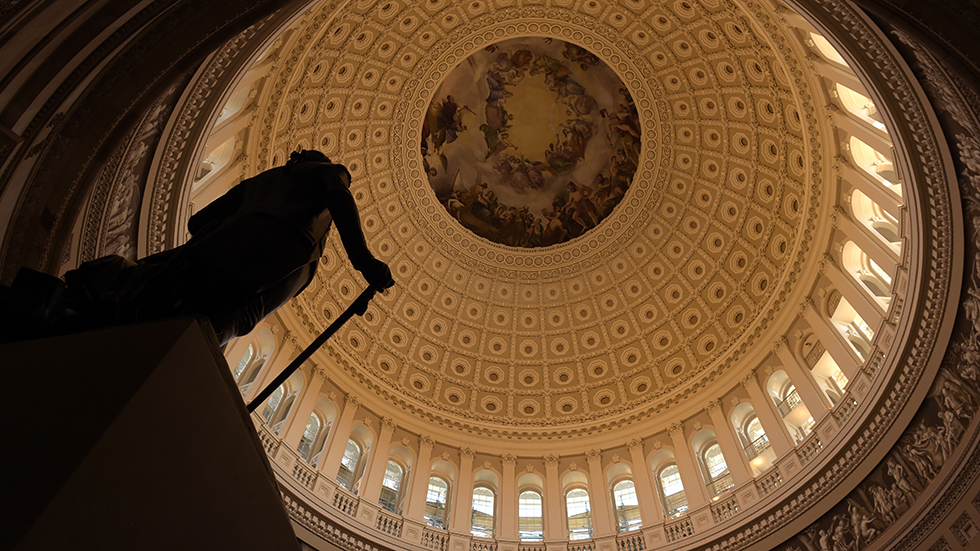
© Associated Press / Susan Walsh | Inside of U.S. Capitol dome, 2016.
IN FOCUS/SHARP TAKES
➤ UKRAINE CRISIS
Ukrainian President Volodymyr Zelensky on Monday warned the U.S. and, specifically, supporters of the “America First” agenda that defeating Russia now should be a priority, as a fallen Ukraine could lead to Moscow targeting the Baltic states and NATO regions.
Zelensky, speaking to Axios in a remote interview at the world economic forum in Davos, Switzerland, noted that an invasion of a Baltic nation — including Estonia, Lithuania and Latvia, which are all NATO members — would trigger the requirement for U.S. troops to enter the region.
“We do not know where they will stop,” Zelensky said of the Russians, adding that the atrocities committed in Bucha and Mariupol are making it “more and more difficult” to meet with Russian President Vladimir Putin.
“This is really the moment when it is decided whether brute force will rule the world,” Zelensky said. “If so, there is no need for further meetings in Davos” (CNBC).
■ Reuters: Russia launches assault to encircle Ukraine troops in east.
■ The Wall Street Journal: Ukraine’s forces sink Russian river crossings, inflicting heavy damage.
■ The Washington Post: European oil embargo breakthrough may come “within days,” German minister says.
■ The Wall Street Journal: Russian oligarch Roman Abramovich’s offshore wealth is focus of new probe.
📝 Introducing NotedDC, The Hill’s curated commentary on the beat of the Beltway. Click here to subscribe to our latest newsletter.
OPINION
■ Executive privilege for ex-presidents? Not this time, by Mark J. Rozell and Mitchel A. Sollenberger, opinion contributors, The Hill. https://bit.ly/3LH12Md
■ Putin rules Russia like an asylum, by Farida Rustamova, opinion contributor, The New York Times. https://nyti.ms/38DiR1r
WHERE AND WHEN
The House meets at 10 a.m. for a pro forma session.
The Senate convenes at 10 a.m. and will resume consideration of Stephanie Davis to be a circuit judge for the 6th Circuit Court of Appeals.
The president on Tuesday wrapped up his itinerary in Tokyo. At this hour, he has completed his second in-person Quad summit at the Kantei Palace, greeted U.S. Embassy staff, and departed for Washington (with a fueling stopover in Alaska). He returns to Washington tonight.
Vice President Harris will ceremonially swear in Alina Romanowski to be U.S. ambassador to Iraq at 2:50 p.m. in her ceremonial office. She will do the same at 3:15 p.m. with Deborah Lipstadt to be U.S. special envoy to monitor and combat antisemitism with the rank of ambassador. Harris at 7:20 p.m. will address the Asian Pacific American Institute for Congressional Studies awards dinner at the Renaissance Hotel in Washington, D.C.
Blinken, who today was in Tokyo with the president before Biden’s departure, met with Australian Foreign Minister Penny Wong.
Treasury Secretary Janet Yellen today will swear in Joshua Frost as assistant secretary for financial markets.
🖥 Hill.TV’s “Rising” program features news and interviews at http://thehill.com/hilltv, on YouTube and on Facebook at 10:30 a.m. ET. Also, check out the “Rising” podcast here.
ELSEWHERE

© Associated Press / Zhang Xiaoyu, pool photo | President Biden on Tuesday in Tokyo with host Japanese Prime Minister Fumio Kishida, Prime Minister Narendra Modi of India, Australian Prime Minister Anthony Albanese (to Biden’s right).
➤ BIDEN, CHINA & INTERNATIONAL
Biden in Tokyo on Tuesday met with fellow “quad” leaders from Japan, India and Australia’s new prime minister and encouraged the democratic world to continue to support Ukraine against Russia’s aggression (The Associated Press).
“We’re navigating a dark hour in our shared history,” he said. “The Russian brutal and unprovoked war against Ukraine has triggered a humanitarian catastrophe and innocent civilians have been killed in the streets and millions of refugees are internally displaced as well as in exile.”
Biden’s entreaties appeared aimed in part at India’s Prime Minister Narendra Modi, seated near him, who has adopted a neutral stance with the Kremlin while India continues to do business with Russia, including supplying weapons. Modi made no mention of Ukraine.
“The world has to deal with it and we are,” Biden admonished. The United States has praised Japan, Singapore and South Korea, among other Asian partners, for their willingness to sanction Russia and impose export bans while offering humanitarian and military assistance to Kyiv.
CNN: During the Quad summit in Tokyo, Biden’s comments to reporters on Monday about a U.S. commitment to defend Taiwan militarily became an explicit warning to Beijing. The president later clarified that nothing had changed about U.S. policy toward Taiwan despite shock waves in Washington and China as the White House worked to clarify what the president meant. “I stated that when I made my statement,” Biden said.
Related Articles
■ Reuters: Newly elected Australian Prime Minister Anthony Albanese met in Tokyo with Biden and recalled a colorful first trip to the U.S.
■ The Associated Press: Australia’s new prime minister makes a whirlwind world debut.
■ Politico: Secretary of State Antony Blinken on Thursday to unveil U.S. strategy toward China.
■ The New York Times: Internal debate about tariffs reveals Biden’s difficulties on China trade.
■ Foreign Policy analysis: Is Biden missing a chance to engage China?
■ The Economist: Foreign investors are fleeing China.
Iranian President Ebrahim Raisi on Monday said his country will avenge the death of Revolutionary Guards Col. Sayad Khodai a day after the elite corps officer was shot five times outside his home and killed by two people on a motorcycle in a rare assassination in Tehran. There was no immediate claim of responsibility for the daylight attack (Reuters and Politico).
➤ PANDEMIC & POX
💉 Pfizer and BioNTech announced on Monday they plan to submit data to the Food and Drug Administration for three doses of their COVID-19 vaccine for children at least 6 months old up to children under 5 years old. They report at least 80 percent effectiveness of the vaccine for the youngest children, who have to date not been eligible for doses (Politico).
In the age category of 5- to 11-year-olds, fewer than 30 percent of children have been fully vaccinated in the U.S. and about 36 percent have received one dose, according to the Centers for Disease Control and Prevention. To date, 90 percent of children hospitalized with COVID-19 in this country were unvaccinated.

© Associated Press / Mary Altaffer | New York on Monday.
Last year, Biden ordered that all federal employees be vaccinated against COVID-19 and a federal appeals court eventually supported that mandate. However, opponents of the requirement on Saturday filed a petition asking that the decision be vacated and that the full 17-member appeals court hear new arguments in the case (The Associated Press).
😷 Masks are back in schools in Philadelphia because COVID-19 infections are on the rise. Students and teachers on Monday were required to wear masks in schools after the city’s school district returned to an indoor mask mandate amid a rise in newly reported COVID-19 cases (The Wall Street Journal).
🦠 Sen. Jeff Merkley (D-Ore.), who said he is vaccinated and boosted, announced on Twitter on Monday that he has a confirmed case of COVID-19 with mild symptoms. He encouraged Americans ahead of the Memorial Day weekend to “take steps to make sure the virus is not an uninvited guest.”
Total U.S. coronavirus deaths reported as of this morning, according to Johns Hopkins University (trackers all vary slightly): 1,002,377. Current average U.S. COVID-19 daily deaths are 281, according to the Centers for Disease Control and Prevention.
How did monkeypox, a treatable infection, spread to at least 12 countries with at least 131 confirmed cases outside of Africa as of this morning? Likely because of sexual activity at recent raves in Spain and Belgium, according to the World Health Organization. Health officials say most of the known cases in Europe have been among men who have sex with men, but anyone can be infected through close contact with a sick person, their clothing or bedsheets. Scientists say it will be difficult to determine whether the spread is being driven by sex or merely close contact (The Associated Press). Risk of additional transmission is considered high.
■ NBC News: Cases of suspected monkeypox in the U.S. (one each in Massachusetts, New York City and Florida and two in Utah) are being investigated by the Centers for Disease Control and Prevention, which said on Monday there is no evidence the disease has become more infectious. The cases of suspected transmission are in men and related to travel, according to the CDC.
■ The Hill: Here are the signs and symptoms of monkeypox.
■ The Wall Street Journal: The smallpox vaccine has entered wider production amid the outbreak of monkeypox.
➤ SUPREME COURT
Justices on Monday declined to take up a case brought by several former national security officials arguing the government’s prepublication review prerequisites for books violate their First Amendment rights. The court upheld a 4th Circuit Court of Appeals decision, which sided with the government to maintain its right to review the manuscripts by former officials once they departed the intelligence community. The case was brought on behalf of five former national security officials, who said they waited months for their books to be reviewed, only to be told they had to redact major portions (The Hill).
THE CLOSER

© Associated Press / Katie Vasquez | Planned auction today of a dress worn by Judy Garland in “The Wizard of Oz,” to benefit Catholic University, is on hold in court as ownership gets sorted out.
And finally … We have a follow-up to some news we flagged last month. Who owns Judy Garland’s “The Wizard of Oz” dress, which was to be auctioned today to benefit Catholic University but is instead the subject of litigation in a New York court?
On Monday, a U.S. district judge halted the university’s much-publicized plans today to auction a dress worn by Garland in her role as Dorothy in the 1939 movie. The temporary injunction will provide time to figure out whether the university or a niece of the university’s former drama department director, the Rev. Gilbert Hartke, owns the cinematic garb. Hartke received the dress as a gift from actress and Garland friend Mercedes McCambridge in the 1970s. Through her attorney, Hartke’s niece argues her uncle, not the university, was the original owner and that she, as his heir, owns the costume.
The judge’s order prevents the gingham frock, estimated to fetch more than $1 million, from being sold until the case is resolved (WTOP).
Stay Engaged
We want to hear from you! Email: Alexis Simendinger and Al Weaver. Follow us on Twitter (@alweaver22 & @asimendinger) and suggest this newsletter to friends!
Source: TEST FEED1
Share:
House GOP campaign arm launches ad campaign aimed at new parents over formula shortage
The National Republican Congressional Campaign Committee (NRCC) is targeting new parents with a five-figure ad campaign hitting Democrats over their handling of the baby formula shortage in the U.S.
The twenty-second spot ties House Democrats to President Biden’s handling of the issue, accusing them both of “failing to fix the crisis” while a baby is heard crying continuously through the ad.
“It’s outrageous that Democrats managed the supply chain so poorly that there is a nationwide baby formula shortage,” said NRCC communications director Michael McAdams. “Democrats are too incompetent to govern.”
The Hill was the first outlet to report on the ad campaign.
The NRCC’s campaign is the latest move in the political blame game over the country’s baby formula shortage. Last week, the Democratic Congressional Campaign Committee hit House Republicans for voting against legislation that would allocate $28 million to boost resources at the Food and Drug Administration to help alleviate the baby formula shortage.
The legislation, known as the Infant Formula Supply Appropriations Act, passed along a 231 to 192 vote mostly along party lines. Twelve Republicans voted to support it, while four Republicans and one Democratic lawmaker did not participate in the vote.
“If Republicans had it their way the formula shortage would continue so they could cynically exploit recalls for political gain and racial divide,” said DCCC spokesperson Chris Taylor. “Democrats worked to deliver solutions, but when given the opportunity to solve problems Republicans abandoned the American people.”
House Republicans argued the legislation would not have helped put formula back on store shelves.
The baby formula shortage was caused by a combination of supply chain snarls and Abbott, a major manufacturer of formula, recalling and temporarily closing a manufacturing plant because of safety issues.
On Sunday, the first plane carrying roughly 78,000 pounds of baby formula arrived in the U.S. from Germany. Additional planes carrying baby formula are expected in the coming days. The Biden administration as dubbed the effort “Operation Fly Formula.”
Source: TEST FEED1
Share:
Five things to watch in the Georgia, Alabama primaries
Republicans are gearing up for a handful of hotly contested primaries on Tuesday in Georgia, where GOP voters appear poised to buck former President Donald Trump and his endorsed candidate in the state’s primary for governor.
But Tuesday’s primaries – which will additionally take place in Alabama and Arkansas, along with a key runoff in Texas – also carries stakes for progressives and Republicans who broke with Trump over his false claim that the 2020 election was stolen from him.
Here are five things to watch in the May 24 primaries.
Can Trump evade a tough night in Georgia?
Donald Trump appears on track for a loss in Georgia’s GOP gubernatorial primary between Gov. Brian Kemp and former Sen. David Perdue (R-Ga.). The former president is backing Perdue in the race, but polling shows Kemp leading in the contest by wide, double-digit margins.
With that, the question is whether other candidates Trump has endorsed can give him something to brag about.
Trump is backing Rep. Jody Hice’s (R-Ga.) primary challenge to Georgia Secretary of State Brad Raffensperger as part of his bid to install loyalists in election administration rolls. While Raffensperger isn’t backing down, polling shows a much tighter race.
An Atlanta Journal-Constitution survey released last month showed Raffensperger and Hice statistically tied at 28 percent and 26 percent support respectively.
Trump has also endorsed several other candidates in Georgia. He’s backing Patrick Witt for insurance commissioner; John Gordon for attorney general; and Vernon Jones in the GOP primary in the state’s 10th congressional district.
Of course, there’s one win that Trump can count on Tuesday: former NFL star Herschel Walker, who’s seen as the heavy favorite to clinch the GOP nod to take on Sen. Raphael Warnock (D-Ga.) this fall.
Do voters stick with Trump on election fraud claims?
Trump’s effort to reshape election offices nationwide will see its first major test on Tuesday in the GOP primary for Georgia secretary of state.
Raffensperger made an enemy of the former president in the aftermath of the 2020 presidential election when he rebuffed Trump’s pleas to help overturn President Biden’s victory in Georgia. He’s since endorsed Hice, who has repeatedly echoed Trump’s baseless claim that widespread voter fraud robbed him of reelection two years ago.
While the state’s primary between Kemp and Perdue has largely been predicated on the same issue – Trump’s false claims of election fraud – a win in the secretary of state’s race would put the former president on track to install a loyalist at the top rung of Georgia’s elections system.
Exactly how the race will shake out remains murky. Nevertheless, it stands as a test of just how willing Republican voters are to give Trump influence over how Georgia’s elections are run.
Do Democrats turn out in force?
After Kemp signed a far-reaching bill last year imposing new limits on early voting, Democrats and civil rights activists lashed out by accusing Republicans of seeking to suppress the vote especially among core Democratic constituencies – especially people of color.
So far, those fears haven’t materialized at the polls. Early voting is at a record high in Georgia this year. As of Friday, more than 857,000 Georgians had cast their ballots early, including about 483,000 Republicans and nearly 369,000 Democrats.
Of course, there are other reasons to believe that Democratic turnout on Primary Day itself might not reach the same height as GOP turnout.
For one, Democrats have fewer competitive primaries at the top of the ticket this year; Democrat Stacey Abrams isn’t facing a challenger in the state’s gubernatorial primary, while Sen. Raphael Warnock (D-Ga.) is up against only nominal opposition in his nominating contest.
But early polling shows Republicans with an enthusiasm advantage in this year’s midterms as the party looks to recapture control of the House and Senate. If Democrats turn out in force in Georgia on Tuesday, however, it could be an early sign that the party’s voters are willing to buck that trend.
Can the left keep its winning streak going?
The Democratic Party’s left flank is coming off of big wins after last week’s primaries.
Pennsylvania Lt. Gov. John Fetterman easily won his state’s Democratic Senate primary, while state Rep. Summer Lee dispatched a moderate challenger in the primary in Pennsylvania’s 12th congressional district. Meanwhile, in Oregon, progressive candidate Jamie McLeod-Skinner appears on track to oust moderate Rep. Kurt Schrader (D-Ore.) in the state’s 5th District.
Progressives will face their latest test on Tuesday when Jessica Cisneros goes up against Rep. Henry Cuellar (D-Texas) in a closely watched runoff election in Texas’s 28th district.
Cuellar, one of the few remaining anti-abortion Democrats, has been among progressives’ top targets, and the left’s opposition to him has only intensified since the leak of a draft ruling indicating that the Supreme Court may be poised to overturn Roe v. Wade.
Cisneros came just over 1,000 votes short of defeating Cuellar outright in a March primary. Since then, progressives have rushed to boost her ahead of the runoff, with Sen. Bernie Sanders (I-Vt.) stumping for her in Texas on Friday.
If Cisneros pulls off a win on Tuesday, it would give progressives another high-profile victory as they look to bounce back from disappointing defeats earlier this year.
The Democratic Party’s left wing will also see a smaller test of its influence on Tuesday in Georgia, where Reps. Lucy McBath (D-Ga.) and Carolyn Bourdeaux (D-Ga) are facing off in an incumbent vs. incumbent primary.
While McBath isn’t seen as a conventional left-wing candidate, she has the backing of top progressives like Sen. Elizabeth Warren (D-Mass.).
Does Mo Brooks outperform expectations?
Rep. Mo Brooks (D-Ala.) became the early favorite to win the GOP Senate nomination in Alabama after Trump endorsed him last year. But he failed for months to gain traction among voters and suffered a further blow when Trump announced in March that he was rescinding his support for Brooks.
Recent polling, however, suggests that Brooks may be making a comeback, with surveys showing him statistically deadlocked for first place in a hotly contested three-way primary that also includes former Army pilot Mike Durant and former Senate aide Katie Britt.
Of course, even if Brooks finishes in first place in Tuesday’s primary for the GOP nod to succeed retiring Sen. Richard Shelby (R-Ala.), it appears unlikely that he’ll win the nomination outright.
A candidate must win more than 50 percent of the vote to clinch the nomination. If no candidate manages to hit that margin on Tuesday, the race will head to runoff in June.
Still, advancing to a runoff would be a big win for Brooks after losing Trump’s endorsement earlier this year.
Source: TEST FEED1
Share:
Ethics law offers possible path for Trump prosecution
As federal investigators weigh the potential criminality of former President Trump’s efforts to overturn the 2020 election, legal experts say a decades-old ethics law — one routinely violated by members of Trump’s inner circle — could provide them a glide path to prosecution.
The Hatch Act prohibits electioneering by executive branch officials, including the promotion of the president’s political interests, during the course of their formal duties.
The law was regularly flouted by the Trump administration while in office, a trend that continued throughout the two months between the presidential election and the Jan. 6 attack on the U.S. Capitol.
While the ethics law has been used almost entirely administratively since it was passed in the 1930s, experts say a rarely used criminal provision of the law could be a novel and relatively straightforward strategy to ensure consequences for Trump in what is sure to be a challenging atmosphere.
Norm Eisen, who served as special counsel to Democrats during the first impeachment of Trump, called the actions leading up to Jan. 6 part of a “disturbing and endemic pattern of conduct by Trump enablers in the White House that implicates the Hatch Act including criminal aspects.”
“This is no exception. It may be the culmination and the worst example,” he said of events and statements around the Capitol riot.
“The problem is that criminal prosecution is really unusual. But everything that happened at the end of the Trump White House was also unusually wrong, and I think it is already the subject of criminal review. So given that context I think it is quite likely that prosecutors will take a fresh look at the Hatch Act among other potential remedies that have been more extensively discussed publicly.”
Much of the discussion over possible charges for Trump have focused on weighty crimes that carry heavier penalties, eyeing statutes that bar interfering with or delaying an official proceeding, or conspiracy to defraud the United States.
But the sister statute for the Hatch Act, which bars coercing federal employees into political activity, carries a three-year prison sentence and could include a fine.
While the Hatch Act is typically thought of as applying ahead of elections, an opinion from the Office of the Special Counsel (OSC) issued the day after the 2020 election notes that an individual doesn’t cease to be a candidate until the Jan. 6 certification of the election results.
Some actions from Trump and his associates after the election — from a call to Georgia’s secretary of state to a pressure campaign at the Department of Justice to investigate alleged election fraud — offered early signs the Hatch Act may have been violated.
But depositions with Trump staff and text messages from his chief of staff Mark Meadows released in the last month show the extent to which the White House was the locus for coordinated efforts between the campaign, lawmakers, and DOJ.
Indeed, the House committee investigating the Jan. 6 attack on the Capitol has used Meadows’s campaign activities – noting his “unofficial role in the Trump campaign” and calling him a “functionary” – as justification for fighting his claims his testimony should be protected by executive privilege.
“The administrative version of the Hatch Act and the criminal version of the Hatch Act exists to make sure that there there’s clear guidance and a clear prohibition on officials using their government jobs to help facilitate any candidate for elective office winning or holding on to their power,” said Donald Sherman, chief counsel at Citizens for Responsibility and Ethics in Washington.
“And it seems quite clear from the facts available, that that was not just something that Mark Meadows did, but it was his primary focus as White House chief of staff in the days and weeks after the 2020 election,” he added.
“I mean, to call it a textbook case of a Hatch Act violation is a bit too on the nose. I think it’s far beyond what Congress or OSC or really anyone could have envisioned in terms of the worst case scenario of an abuse of this principle.”
The Jan. 6 committee is still grappling with whether to make a criminal referral for prosecution of Trump and others in his circle as part of its final work product capping its investigation.
But it is preparing its own legislative proposals as part of a broader effort to ensure that Jan. 6 — the attack as well as the misuse of power — never happens again.
“You know what’s hiding in plain sight? In so much of the evidence that’s come out from a whole bunch of different sources is that there were government officials deeply involved in Donald Trump’s campaign, and so at the simplest level this is a Hatch Act issue spotter,” Rep. Jamie Raskin (D-Md.), one of the committee’s members, told The Hill.
“You can just identify so many cases where government officials were involved in re-election activity and political activity that went beyond re-election to arguable illegality.”
Good governance advocates have for years lamented the relative toothlessness of the Hatch Act. The president is exempt while in office, and other high-ranking officials are largely immune once they leave their posts. The only repercussions — at least administratively — are largely employment-related, like a reduction in salary grade or other demotions geared toward reprimanding rank-and-file employees. High ranking officials can, however, be barred from future federal service.
“That’s kind of one of the general flaws in all of this,” Delaney Marsco, senior legal counsel for ethics at the Campaign Legal Center, told The Hill.
“Unless the president asks, their superior asks, it’s very hard to get any accountability for these types of violations. And once they leave office, it’s pretty much non-existent.”
The Office of the Special Counsel (OSC), which oversees Hatch Act violations, wrote in its report documenting Trump administration violations of the law that its “enforcement tools are limited with respect to Senate-confirmed presidential appointees and White House commissioned officers.”
And on the criminal front, it’s not clear that the Justice Department would consider such a charge, though its recent request to the Jan. 6 committee to review some of its depositions suggests they could be weighing some sort of criminal charges against those in Trump’s orbit.
The OSC report noted flagrant Hatch Act abuses by 11 Trump officials while in office, including Meadows and others who have been interviewed by the committee: former Press Secretary Kayleigh McEnany and advisors Jared Kushner and Stephen Miller. The report, however, landed in November last year, well after the team had left office.
Since then, depositions released by the committee in court cases walk through the extent of Meadow’s actions for the campaign: He was on Trump’s call with Georgia’s secretary of state and visited the state during its election audit. He was the coordinator of calls between lawmakers and the Trump legal team – at one point Rep. Marjorie Taylor Greene (R-Ga.) begged him for more time with Rudy Giuliani. And he was also involved in Trump’s pressure campaign at DOJ.
“While [Meadows] is on the federal payroll, yes, he’s chief of staff to the president, but he’s not chief of staff to the president’s campaign, he’s chief of staff to the White House. And he seems to have completely lost that distinction,” said Kathleen Clark, a law professor at Washington University specializing in government ethics.
She said the lack of repercussions for holding the Republican National Convention at the White House – something she called a “Hatch Act crime spree” – was a green light to those in Trump’s orbit to push things further.
“When you don’t enforce a law, when you don’t prosecute or take accountability when people violate a law, you’re giving them permission to violate it in the future. Draw a straight line from the Hatch Act violations at the RNC at the White House, right up through the post election violations,” Clark said.
Still, not all are sure Meadows himself violated the law, or that his violations can be proven in a court of law.
“If Meadows as chief of staff in the White House was putting any pressure on any federal employee to engage in partisan political activity, which I believe would include trying to reverse the election result, he is in violation of the criminal statute,” Richard Painter, chief ethics lawyer for the George W. Bush White House, told The Hill.
Painter filed a complaint with DOJ while Trump was in office alleging he violated the criminal statute, asking for an investigation into him and his aides.
“If I had enough evidence to feel that that complaint was justified in October 2020, whatever happened after the election was far worse,” he said.
But he said a conviction against someone like Meadows can be “a mess.” It would have to go beyond demonstrating the extent he organized meetings – even using White House phones is usually considered “de minimus” – and would need to show Meadows coerced others into helping the campaign.
“They’re allowed to engage in [their] personal capacity in political activity. And they’re allowed to do it in the White House,” he said. “Meadows can play politics one minute then do official work the next. You got to really take one hat off and put on the other.”
“If he sought to coerce a federal employee, including a staff member to a senator or representatives or a staff member of the Justice Department or the attorney general or anything like that, he would have committed a criminal offense,” Painter added.
An attorney for Meadows declined to comment.
But recent court filings in his battle with the committee lists a slew of examples in which former chiefs of staff “engaged in efforts related to their president’s election efforts.”
“While the Congressional defendants contend, without citing any factual support, that White House chiefs of staff do not get involved with an incumbent president’s reelection campaign, common sense and facts…are to the contrary. The breadth of the chief of staff’s duties necessarily includes activities relevant to the president’s reelection,” Meadows attorney George Terwilliger wrote in a Friday brief.
Meadows has in the past brushed aside concerns he had violated the law.
“Nobody outside of the Beltway really cares,” he said in 2020 of the Hatch Act.
That’s precisely why some see action – either from DOJ or from the committee – as a necessity.
“It’s not small potatoes because it goes to the heart of what our government is supposed to be – that it’s not just for the benefit of the office holders,” Clark said.
“Executive branch officials swear an oath, and it ain’t an oath to the president. It’s an oath to the Constitution.”
Source: TEST FEED1
Share:
Blue state abortion providers plan for cascade of red state patients
Abortion providers and reproductive rights advocates in Democratic-controlled states are preparing for a wave of patients traveling from conservative neighbors when the U.S. Supreme Court releases an opinion that is expected to strike down the federal right to an abortion enshrined half a century ago by Roe v. Wade.
In interviews, those providers say they have already seen an increased number of patients traveling across state lines since Republican-controlled legislatures passed new limits on abortion access. But they say those figures will surge when the high court’s decision allows so-called trigger laws barring abortion to take effect.
“Our own data models predict in the first year after Roe is overturned, we’re expecting to see over 14,000 additional patients to turn to Illinois,” said Bonyen Lee-Gilmore, vice president of strategy and communication at Planned Parenthood of the St. Louis Region and Southwest Missouri. “We’re now trying to figure out how to have the manpower, enough hands to help the patients that are going to be turning to us soon.”
Lee-Gilmore’s chapter of Planned Parenthood includes clinics in southern Illinois, a Democratic-controlled state that is surrounded by several other states in which abortion would become illegal or severely restricted if Roe falls.
The draft opinion leaked last month would, if it stands, create a patchwork nation of states where abortions are either protected under state law or completely banned. Women living in parts of Montana would have to travel to Washington, Minnesota or Colorado to receive an abortion. Women who live on the Gulf Coast would have to travel to North Carolina, Illinois, New Mexico or Kansas to seek care.
Today, the clinics in the St. Louis region perform between 6,000 and 7,000 abortions a year. That number could jump to 20,000 if the Supreme Court’s leaked opinion becomes official, Lee-Gilmore said. To handle the increase, one Planned Parenthood clinic is in the process of adding another 18,000 square feet of medical space.
In Colorado and New Mexico, Planned Parenthood chapters began experiencing an influx of patients seeking abortions last year, when Texas Gov. Greg Abbott (R) signed legislation that barred many abortions. Now, with the possibility of abortion banned or curtailed in Oklahoma, Arizona, Utah, Wyoming and Nebraska, those clinics are considering what they need to do to increase capacity.
“All options are on the table,” said Neta Meltzer, who handles communications for Planned Parenthood of the Rocky Mountains. “Does that look like hiring more providers? Does that look like opening new locations? Does that mean expanding hours?”
Building capacity is both a physical challenge and a human resources issue, Meltzer and Lee-Gilmore said. Conscious that appointment spaces will be snapped up, abortion clinics and their allies in both regions are seeking new doctors, nurses and physician assistants to accommodate more patients.
“Capacity is gong to be a challenge for the foreseeable future. Not just for us but for providers all across critical access states,” Lee-Gilmore said. “There has to be someone on the other end that catches those patients. So we have to think about the system holistically.”
Other groups are beefing up the number of volunteers they are recruiting to handle the non-medical parts of the expected surge. Karen Middleton, who heads Cobalt Advocates, an abortion resources provider in Colorado, said her group was building its list of volunteers who could drive patients from Denver’s airport to a clinic.
“People are opening their checkbooks. Folks are very concerned and we are seeing an influx of resources across the network of organizations that provide abortion care,” Middleton said. “We’re going to do everything we can in our power to coordinate and provide collaboration for the people who can provide abortions in the state of Colorado.”
While conservative states have spent years passing new abortion restrictions — in many cases with the aim of knocking down the precedents established by Roe v. Wade and Planned Parenthood v. Casey — liberal states have raced in recent years to codify abortion rights, or to expand access.
Colorado Gov. Jared Polis (D) last month signed a measure enshrining the right to an abortion in state law. Illinois Gov. J.B. Pritzker’s (D) administration has advanced rules that allow more clinicians to perform procedures. Twenty-two states now have some form of protections written into state law.
Those measures, abortion advocates say, are a sign of the preparations they have made in recent years as the Supreme Court’s conservative wing has grown, both in number and influence. After former President Trump nominated Justices Neil Gorsuch, Brett Kavanaugh and Amy Coney Barrett to the bench, abortion rights supporters say they knew Roe’s days were numbered.
“We’ve been working for a few years to be ready for this,” Middleton said. “We didn’t think it would happen so soon.”
Source: TEST FEED1
Share:
Greene’s popularity faces test in first reelection primary
Firebrand Rep. Marjorie Taylor Greene (R-Ga.) heads to her first reelection primary on Tuesday in a good position to win the GOP nomination for her seat despite becoming perhaps the most controversial, bombastic, and criticized Republican in the House.
Greene faces five GOP challengers in her primary, the best-funded of which is political newcomer Jennifer Strahan, owner of a healthcare consulting business.
Strahan has raised around $400,000 for her campaign, but also has the backing of outside PACS. The Republican Jewish Coalition PAC supports Strahan, and the Value In Electing Women (VIEW) PAC has spent nearly $200,000 in support of her candidacy.
“We’ve heard a lot of talk, and our district has nothing to show for it,” Strahan said in a debate earlier this month. “We need a representative who works effectively with colleagues, and navigates the legislative process to push Georgia priorities forward while protecting our Constitutional freedoms.”
Strahan’s website highlights Russian state media using Greene’s arguments against funding Ukraine’s efforts against Russia’s invasion, echoing Russian arguments when she worried that U.S.-funded equipment might be obtained by Nazis in Ukraine.
Greene has been the subject of a constant stream of criticism and outrage since her election in 2020.
She was stripped of her committee assignments soon after being sworn into office over social media posts about conspiracy theories and liking a Facebook comment that called for the assassination of House Speaker Nancy Pelosi (D-Calif.). Her personal Twitter account was permanently banned after she repeatedly violated the platform’s policy on misinformation relating to COVID-19, though her official congressional account remains active.
In a 2018 Facebook post, which has since been deleted, Greene suggested that the wealthy Jewish Rothschild family profited from California’s wildfires and mentioned claims of “lasers or blue beams of light causing the fires,” prompting accusations of promoting antisemitic conspiracy theories. In the halls of Congress, Greene has gotten into confrontations with Democratic members of Congress, including Rep. Alexandria Ocasio-Cortez, and earlier this year spoke at a white nationalist conference (Greene said she did not know about the group’s views and was hoping to reach young conservatives).
But Greene, who has the backing of former President Donald Trump, has also cultivated a loyal national following among the GOP base.
“Wherever she goes, there are people who cheer her on,” Audrey Haynes, a political science professor at the University of Georgia, said of Greene’s loyal following. “Yet there are also those who believe she has made the district, and particularly Republicans in the district, into a joke, and has little influence in the House.”
But unlike fellow firebrand Rep. Madison Cawthorn (R-N.C.), who was defeated in a May 17 primary after a series of scandals that centered more on his personal actions than his policy positions, Greene has not been politically punished or abandoned by top Republicans and is in a much better financial position than Cawthorn was in his primary.
Greene moved to run in Georgia’s northwestern 14th Congressional District after former GOP Rep. Tom Graves announced that he would retire from Congress after more than a decade, leaving the seat open. She defeated neurosurgeon John Cowan 57 percent to 43 percent in a 2020 GOP primary runoff, and sailed to election with nearly 75 percent of the vote after her Democratic opponent dropped out of the race.
The 2020 GOP primary field for the district was larger than this year, but with five candidates potentially splitting the vote, there is a chance that Greene gets under 50 percent support and heads to a June 21 primary runoff.
A January poll commissioned by “a group of Georgia Republicans who want to show that there is a viable, conservative alternative to” Greene, Jewish Insider reported, found that potential GOP primary voters in the district were swayed against Greene after being exposed to her controversial statements. The poll showed 60 percent support for Greene and 30 percent support for Strahan initially, and then tied at 41 percent after being read the statements.
Additional polling in the district is sparse, though, and Greene remains a political force and a fundraising powerhouse.
Greene has raised more than $9.2 million, spent more than $6.6 million and had $3 million in the bank as of May 4. In 2021, she was the 8th top-raising House candidate, according to FEC data. The four other GOP candidates running against Greene have not cracked six figures in campaign fundraising.
“As one campaign operative has suggested, some days it is really hard to know which way the wind is blowing. But if money is generating the breeze, then Greene is likely to take the primary win. She has so much money to spend compared to all the other candidates combined. And she relishes the fight,” Haynes said.
A number of PACs have lined up to oppose Greene, including the Lincoln Project; VoteVets, which endorsed one of Greene’s Democratic opponents; and Really American PAC. But all of their spending combined, much of which was on digital ads and ad production, is just a fraction of what Greene has spent.
Tuesday’s primary will also determine her Democratic challenger. Three candidates are aiming to go up against Greene in the general election despite the ruby-red nature of the district. Several election analysts rate Georgia’s 14th District as solidly Republican.
The most prominent of Greene’s challengers is veteran Marcus Flowers, whose fundraising prowess rivals Greene’s. He has raised more than $8.1 million and spent more than $7.4 million in his campaign against Greene so far.
Small business owner Holly McCormack, while behind Flowers in fundraising, is also vastly exceeding the typical fundraising haul for a challenger with little chance of unseating an incumbent. She has raised more than $1.8 million and spent more than $1.7 million.
Former Rome, Ga., City Commissioner Wendy Davis is also vying to be the Democratic nominee against Greene, and brought in a respectable $490,233 for her campaign as of May 4.
Source: TEST FEED1
Share:
Democrats set to blow through key date for moving Biden’s agenda
Democrats are set to blow through the soft Memorial Day deadline for reaching a deal with Sen. Joe Manchin (D-W.Va.) on a slimmed-down budget reconciliation bill to raise taxes, fight climate change and lower the cost of prescription drugs.
Senate Democratic sources say there’s no chance of getting a deal this week but they argue that doesn’t necessarily mean the negotiations over a long-awaited budget reconciliation package are doomed.
Some optimistic Democratic aides note that neither Senate Majority Leader Charles Schumer (D-N.Y.) nor Manchin has identified the Memorial Day recess as a drop-dead deadline.
Instead, Democrats are once again pushing back the target date for getting a deal with Manchin. They now point to the start of the August recess as the new deadline, arguing that gives them most of August to draft legislation and the month of September to pass it on the floor.
Such a timetable seems difficult to say the least.
Passing major legislation in September of an election year is extremely difficult, and high inflation has been the main reason for Manchin’s opposition to the package. The nation’s concerns about inflation have only grown in recent weeks.
Pushing the deadline back, however, shows that some Democrats are refusing to publicly throw in the towel on the package. There are a few reasons for this, including the fact that the rules for preventing the GOP from filibustering the package expire at the end of the fiscal year, Sept. 30.
“We hear it’s really a Schumer conversation and there’s progress but until we actually see there’s been an agreement and an initial on the agreement and we’re going to put it on the floor, I’m going to be skeptical,” said a Democratic senator, characterizing conversations with fellow Senate Democrats on the state on the negotiations.
The lawmaker said Schumer has taken the lead in the talks because senior White House officials damaged their relationships with Manchin when negotiations broke down in December. Manchin was furious that the White House leaked that he opposed a one-year extension of the expanded child tax credit, a popular provision among many Democratic lawmakers who wanted it to be in the package.
“The administration is not getting it done. Their relationships are too damaged. Only through Schumer is it going to get done but it’s not like it’s easy. I give it a 50-50 possibility of a modest bill getting done,” said the Democratic senator.
Manchin was in Davos, Switzerland on Monday for the World Economic Forum. Speaking at a panel session with Sen. Chris Coons (D-Del.), Manchin predicted that Congress would be able to pass meaningful legislation by the midterms.
“There’s a responsibility and opportunity we can do something,” he said.
Manchin told reporters last week that all fifty Senate Democrats should be able to agree on a reconciliation package that lowers the price of prescription drugs. He has previously said the package should include proposals to reduce the deficit and fight climate change.
Rank-and-file Democratic senators say they’ve been kept largely in the dark about Schumer’s negotiations with Manchin.
“You’re not going to hear anything, I don’t think, out of anyone but Schumer and Manchin, just the two of them,” said Sen. Ben Cardin (D-Md.). “I’ve been involved in previous discussions but at this point we’ve really delegated everything to Sen. Schumer in his conversation with Sen. Manchin.
Cardin said Schumer told colleagues that if there is to be a deal with Manchin, “it needs to be done soon.”
“We thought this work period,” Cardin said, referring to the five-week stretch that ends this Thursday or Friday.
Some Democrats still think Memorial Day is a key date and holding out hope for an agreement, at least in principle, by the end of this week.
Sen. Tammy Duckworth (D-Ill.), who presided over a pro-forma session of the Senate ON Monday, said she shared Sen Tim Kaine’s (D-Va.) view that it was important to get a handshake deal by Memorial Day.
“That’s the ideal and that’s what we would like,” she said. “That’s what we would want to have.”
Asked about the chances of passing any kind of reconciliation package, Duckworth said “I think 50-50 right now,” predicting that constituents are going to ramp up pressure on senators to get something done.
“As folks go home and see where the lay of the land is, hopefully that’s going to light a fire under them,” she said.
A group of 26 vulnerable House Democrats led by Rep. Lauren Underwood (D-Ill.) warned Schumer and Speaker Nancy Pelosi (D-Calif.) in a letter Monday that if Congress doesn’t pass a new round of health insurance subsidies though the budget reconciliation package, constituents will see their premiums go up right before the midterm election.
“We cannot afford to backslide on this progress. Our constituents cannot afford to go back to paying upward of 20 percent — or more — of their household income on health care premiums,” the group warned.
Schumer has kept the number of negotiators small and the talks quiet, a pivot from the fall when Democrats set high expectation for passing Build Back Better by Christmas.
White House chief of staff Ron Klain conceded in January that too much of last year’s negotiations with Manchin played out in public view.
“One lesson we learned in the first year is, I think, the less we talk about our negotiations with specific senators and congressmen, the better we are, so I’m going to say our talks with Sen. Manchin will proceed directly and privately,” Klain told the Wall Street Journal in an interview.
A Democratic strategist who has closely followed the talks predicted there’s no chance of a deal by the weekend.
The strategist said there’s “zero” chance of getting a deal with Manchin the next few weeks but predicted something could get done by the Aug. recess.
The source also said that rumors about a falling out between Manchin and senior White House advisor Steve Ricchetti during last year’s negotiations are overblown.
“Manchin and Steve Ricchetti are fine but I do think there will be fewer people in the room,” the source said.
The sentiment that no deal will emerge in the next few weeks was echoed Monday by Senate Democratic aides.
“It all suggests it’s going nowhere fast,” said one Democratic aide.
Some Democrats, however, think the lack of details from the talks between Schumer and Manchin are a reason to be hopeful. These optimists point out that when two opposing sides in a policy negotiation stay quiet, it’s often a sign they’re resolving disagreements.
“I think it’s a good sign that there’s obviously some talks and it’s very quiet. I think public negotiations have been very damaging to this process. If something’s going to get done, Schumer, Manchin and Biden are going to figure it out. And I wouldn’t even put a timeline on it,” said Jim Kessler, a former Schumer aide who now serves as executive vice president for policy at Third Way, a centrist Democratic think tank.
Source: TEST FEED1
Share:
Air pollution linked to more severe COVID-19: study
Several common air pollutants are linked to more severe outcomes following a coronavirus infection, a new study has found.
Individuals who lived in areas of Ontario, Canada with higher levels of three common air pollutants — fine particulate matter, nitrogen dioxide and ground-level ozone — were at increased risk of being admitted to the intensive care unit, according to the authors, who published their findings on Tuesday in the Canadian Medical Association Journal.
Chronic exposure to ozone specifically carried an elevated risk of death from COVID-19, the scientists determined.
To draw these conclusions, researchers from the Canadian government’s Health Canada analyzed data on all 151,105 people ages 20 years and older who had confirmed coronavirus infections in 2020 in Ontario.
Information about fine particulate matter, nitrogen dioxide and ground-level ozone was readily available to the researchers, as these substances are all regularly monitored by the Canadian government, the authors noted.
These pollutants are emitted from a variety of different sources, including fuel combustion and reactions of volatile organic compounds or other chemicals.
The scientists calculated each infected individual’s long-term exposure to the three air pollutants based on their residence from 2015-2019, according to the study.
The authors excluded infected individuals living in long-term care facilities and adjusted for date of diagnosis, sex, age, essential worker status, socioeconomics, healthcare access and other factors.
Long-term exposure to air pollution, the authors explained, could increase the risk of developing severe COVID-19 by several different mechanisms. For example, air pollutants can reduce immune responses and antimicrobial activities in the lungs, thereby boosting viral loads, according to the authors.
These substances can also cause chronic inflammation and the over expression of a specific receptor protein that enables the entry of coronavirus into human cells, the researchers added.
“Given the ongoing pandemic, our findings that underscore the link between chronic exposure to air pollution and more severe COVID-19 could have important implications for public health and health systems,” the authors stated.
Source: TEST FEED1
Share:
McCormick campaign files lawsuit to count mail-in ballots with undated envelopes
Pennsylvania Senate candidate David McCormick’s campaign is pushing for additional ballots to be counted in the state’s GOP primary results, according to a lawsuit filed Monday.
The lawsuit pushes for counting mail-in and absentee ballots missing a date on their envelope to be included in the election result.
“These ballots were indisputably submitted on time—they were date-stamped upon receipt—and no fraud or irregularity has been alleged,” according to the complaint, which was obtained by Politico.
“The Boards’ only basis for disenfranchising these voters is a technical error that is immaterial under both state and federal law,” it added.
Just last week, a federal 3rd Circuit Court of Appeals ruled that undated ballots in a county judgeship election from last year should be counted, a decision cited in McCormick’s Monday complaint.
The Hill has reached out to the McCormick campaign for comment.
The push comes after the election last week was declared too close to call, prompting a recount in the race between McCormick and Trump-endorsed, celebrity doctor Mehmet Oz.
Pennsylvania law requires an automatic recount if candidates’ votes are within a 0.5 percent margin, and Oz led McCormick by less than 1,000 votes as of Monday.
As a result of that recount, voters may have to wait until June 8 to learn the outcome of the election.
Meanwhile, Trump has urged Oz to declare victory in the election as votes were still being counted, saying it would make it “much harder for them to cheat with the ballots that they ‘just happened to find.’”
Source: TEST FEED1