White House effort to stave off fall COVID surge with new boosters faces uphill battle

The White House is rushing ahead to roll out a new COVID-19 booster shot campaign in early September, but is facing an uphill battle to ensure it is successful.  

The vaccines being used in the campaign are the first ones that have been manufactured to specifically target the subvariants of omicron that are currently causing the most infections, and administration officials have indicated they’re preparing to start offering the shots shortly after Labor Day.

Immunity from the initial round of vaccines is waning and health officials said they want to ensure the public is protected as much as possible against another wave of infections in the fall and winter. Right now, close to 450 Americans are dying every day from the virus, and there’s concern the numbers could rise as people move indoors.

Both Pfizer and Moderna have asked the Food and Drug Administration (FDA) for emergency use authorization for booster shots that target the omicron BA.4 and BA.5 subvariants. Pfizer’s vaccine will be for everyone aged 12 and older, while Moderna’s will be meant just for adults aged 18 and older.

Administration officials say these new vaccines will be key to controlling a potential fall surge, but they will need to convince an increasingly checked-out public to get the shots.

White House COVID-19 response coordinator Ashish Jha has been front and center trying to promote the reformulated boosters, saying recently that “all the data suggests [they] should be highly effective against the new variants.”

“The big picture bottom line is these are substantial upgrades in our vaccines in terms of their ability to prevent infection, to prevent transmission. Certainly to prevent serious illness. And so it’s going to be really important that people this fall and winter get the new shot.” Jha said during a U.S. Chamber of Commerce event on Aug. 16. 

During an interview with the radio program “Conversations on Health Care,” Centers for Disease Control and Prevention (CDC) Director Rochelle Walensky said the administration wants to provide people with the broadest possible protection.

“So the strategy now is to tailor vaccine for giving us the largest breadth of response, ideally one that would have less waning over time,” Walensky said. “I believe it is best to use a vaccine that is tailored for the variant that we have right now.”

But despite the administration’s optimism, the effort is likely to face major hurdles. Chief among them is a lack of interest from the public. Only about two-thirds of the U.S. population have been vaccinated with a primary COVID-19 vaccine series, while less than half of that group has received even a first booster.  

The vaccination rate among children is even lower. According to the CDC, less than 4 percent of eligible kids under the age of 2 have received at least one dose, and only 6 percent of kids between the ages of 2 and 4 have received a single dose. 

Rupali Limaye, a vaccine expert at the Johns Hopkins Bloomberg School of Public Health, said she doesn’t expect the retooled boosters will do much to convince the under-vaccinated population to get another shot. 

The same people who rushed to get the initial vaccine series and then the first round of boosters will be the ones to receive the omicron-specific shots, she said, and mixed messages from health officials are partly to blame. 

The most recent update to the CDC’s guidance emphasized living with the virus, and downplayed many of its previously recommended mitigation strategies. That doesn’t necessarily mesh with the idea that the public urgently needs to get an updated vaccine.

“I think for the most part, the majority of the public has sort of moved on, if you will. And the messaging has been that this is going to now be with us,” Limaye said. “Why do I need a new vaccine related to a virus that essentially my government has told me is no longer an issue?”

Rather than a broad rollout of the updated vaccines for the general public, Limaye and other scientists have suggested a more targeted approach, tailoring vaccine recommendations to the elderly and immunocompromised. 

John Moore, a virologist at Weill Cornell Medicine, said it’s not clear how much extra protection the new shots would provide against infection, but predicted they won’t be much better than the first round of boosters.

The protection is likely “somewhere between mediocre and reasonable. I mean, we just don’t know,” Moore said. “A booster will give some additional protection against infection for, you know, a few months before it wanes again.”

Moore said it’s important that health officials provide the public with realistic messaging, and don’t oversell the benefits of the shots.

“It’s not like they’re a magic bullet that gives you super strong protection,” Moore said. “If the public thinks they’re getting something that is really, really against infection, then they might change their behavior and increase the risk of exposure. That’s counterproductive.” 

The other concern among some scientists is that the government is moving too quickly to authorize the vaccines. Neither Moderna nor Pfizer has clinical trial data for the vaccine. Instead, their requests are based on data from a booster targeting an earlier version of omicron, as well as preclinical data from mice.

But health officials maintain they don’t need additional data, because vaccine manufacturers are essentially making a minor update to the existing vaccine, which has an established track record of success.

“There’s always a question here of being too slow versus too fast, and I think one of the challenges is if we wait for those data to emerge in human data, not just mice data, in human data, we will be using what I would consider to be a potentially outdated vaccine,” Walensky said. “I believe it is best to use a vaccine that is tailored for the variant that we have right now.”

Source: TEST FEED1
The tragedy of Novak Djokovic

He’s arguably the world’s greatest tennis player and belongs squarely in the greatest-of-all-time conversation. But tennis fans won’t see him on one of its biggest stages at the U.S. Open because of the federal government’s rule against allowing unvaccinated non-U.S. citizens into the United States.

“Sadly, I will not be able to travel to NY this time for US Open,” Djokovic wrote on Twitter. “Good luck to my fellow players! I’ll keep in good shape and positive spirit and wait for an opportunity to compete again.”  

The 35-year-old Serbian is one month removed from capturing Wimbledon in London again. He’s now won 21 Grand Slam singles titles, one fewer than the great Rafael Nadal. Nadal may very well extend that lead with Djokovic unable to play. Regardless of whether a Djokovic-Nadal matchup would have taken place, not having the world’s best player in New York competing against anyone is robbing tennis fans.

And it’s all for nothing.

Djokovic isn’t vaccinated against COVID-19. His body, his choice. He could easily get the jabs and be done with it, but he’s steadfastly sticking to his principles. If this is about the science and data and protecting others from the virus, how does getting the vaccine stop the spread of the virus? Because more and more, we’re seeing triple-vaccinated people contracting coronavirus. President Joe Biden and First Lady Jill Biden even got it twice in the span of less than two weeks despite being fully vaxxed up.

But don’t take my word for it. Here’s what the Centers for Disease Control and Prevention (CDC) Director Rochelle Walensky said recently about vaccines preventing transmission.

“Our vaccines are working exceptionally well. …What they can’t do anymore is prevent transmission.”

Consider also that Djokovic already hadCOVID in June 2020 and December 2021 and therefore has naturally acquired immunity. Several respected studies have suggested that natural immunity is also effective at preventing major illness from the virus. 
 
In other words, Djokovic, relatively young and in top health, has little risk from COVID, because his body has produced naturally what a vaccine would otherwise provide. 

And if this is about public health and safety, someone really needs to explain why Djokovic, nowhere near anyone on a court, cannot play while more than 23,000 fans fill Arthur Ashe Stadium without masks and without showing the same vaccination card Djokovic is required to present before entering the country.

“At this time, ticket holders will not be required to show proof of COVID vaccination for admission into the US Open,” the event’s official website states.

And while we’re at it, why was he allowed to play in last year’s U.S. Open unvaccinated but not in 2022 under the same status?

When it comes to healthy athletes and vaccine mandates, it’s all become very arbitrary. Take a nationally televised NBA game from earlier this year featuring the New York Knicks at the Brooklyn Nets.

Kyrie Irving, the Nets unvaccinated star point guard, wasn’t allowed to play for the home team due to New York’s COVID laws at the time. But there was Irving, plain-clothed and sitting courtside, mingling with fans and cheering his team on, without a mask, and even greeting players during timeouts with high fives and chest bumps.

Can you believe this? Irving was allowed to sit in the stands with no mask. He could touch his teammates and talk to people in the stands at close range. But playing was deemed a health risk.

Oh, and here’s the best part: New York’s rules allowed unvaccinated players from other states to play.

Tennis icon and broadcaster John McEnroe called the Djokovic decision “a joke.” 

“I don’t think it’s fair,” the always candid McEnroe told reporters on Thursday. “I think it’s a joke. I would have had the vaccine and gone and played, but he’s got very strong beliefs and you have to respect that.”

“At this point, in the pandemic, we’re 2½ years in, I think people in all parts of the world know more about it, and the idea that he can’t travel here to play, to me is a joke,” he added.

A Djokovic-less Open comes as the U.S. government is allowing millions of migrants to enter the country regardless of vaccination status. Those entering illegally are coming in from poorer countries, where vaccines are less common.

Of course, our government does not require those entering illegally to show a vaccination card. But if you’re Novak Djokovic, it’s an absolute necessity.

Tennis fans will be robbed this week. Novak Djokovic, who had been ranked #1 for 373 consecutive weeks (a record), will sit and watch someone else win a title he’s captured three times.

We will someday look back on the COVID era with such shame — shame for what our leaders did in preventing our children from going to school and requiring that they wear masks for years.

The same illogic applies to those who believe keeping Novak Djokovic out of the country and out of the Open is a good idea. 

Joe Concha is a media and politics columnist.

Source: TEST FEED1

US warships sail through Taiwan Strait for first time since Pelosi visit

The U.S. Navy sailed two warships through the Taiwan Strait on Sunday, marking the first transit since Speaker Nancy Pelosi’s (D-Calif.) visit to Taiwan earlier this month. 

The U.S. 7th Fleet said that the USS Antietam and USS Chancellorsville conducted a “routine” transit.

“These ships transited through a corridor in the Strait that is beyond the territorial sea of any coastal State,” officials said, adding that the movement of the guided-missile cruisers shows that the U.S. is committed “to a free and open Indo-Pacific.” 

“The [ships’] transit through the Taiwan Strait demonstrates the United States’ commitment to a free and open Indo-Pacific,” officials said. “The United States military flies, sails, and operates anywhere international law allows.”

Pelosi’s trip to Taiwan marked the first time a high-ranking U.S. official visited the country in 25 years. 

Her visit angered Chinese officials, who warned the Speaker against making the trip.

Beijing, which views Taiwan as part of China’s territory, has stepped up its military and domestic pressure against Taiwan in recent months. 

In its own statement, the Chinese military’s Eastern Theater Command said it would monitor the two U.S. warships, adding that it would be “ready to thwart any ​​provocation,” according to CNN.

Source: TEST FEED1

Black Americans feel disproportionate pain from high interest rates

The federal government’s efforts to stanch inflation are disproportionately impacting Black Americans. 

The Federal Reserve has hiked interest rates in the hopes of cooling off a red-hot economy, but its actions are hitting Black Americans — who have historically been squeezed out of home ownership and affordable loans — the hardest.

Fed interest rate hikes are meant to slow consumer and business spending by making debt more expensive, including mortgages. Mortgage rates rise as the Fed hikes its baseline interest rate higher, making monthly home payments more expensive for anyone seeking a new home or those who purchased one with an adjustable interest rate loan.

“African Americans have the lowest homeownership rates among the four major racial groups in the country,” Romie Tribble, professor of economics at Spelman College and secretary of the National Economic Association, told The Hill. 

Just 45.3 percent of Black households owned their homes during the second quarter of 2022, according to the Census Bureau, compared to 74.6 percent of white households, 61.1 percent of Asian households and 48.3 percent of Hispanic households.

“It’s now going to be more difficult for them to acquire and to also keep a home,” Tribble said.

Black Americans have long faced higher barriers to homeownership than their white counterparts, which is one of several forces behind a steep racial wealth gap. 

During the post-World War II economic boom, racist lending practices and bans on home sales to non-white families locked millions of minority families out of the housing market. 

While Congress passed laws intended to halt discriminatory lending practices during the 1970s, discrimination in the housing market still persists. And the racial wealth gap created in part by housing discrimination has left Black families with fewer resources to help achieve homeownership.

For many Black homeowners, interest rates are already often higher than their white counterparts regardless of income, according to a 2021 Harvard University study. This is, in part, because Black homeowners are seen as a bigger financial risk than white homeowners. 

Combined with the short supply of housing around the country, Tribble said, these concerns all exacerbate housing inequities. 

While higher interest rates are likely to take a steeper toll on Black Americans, the decades of near-zero rates meant to help low and middle-income households shore up their finances were not as helpful for them, experts say.

The Fed slashed its baseline interest rate range to near-zero levels in the wake of 2007-08 financial crisis to help keep money flowing through the economy. The central bank held rates near zero until 2015 and only hiked them gradually in the years that followed.

Ultra-low Fed interest rates in the wake of both the Great Recession and the COVID-19 recession helped fuel record-breaking home prices as households with means to keep up enjoyed low mortgage rates. Homeowners were also able to refinance their mortgages at lower rates, giving them more money to save up for the next home purchase.

But those super low rates did little to help Black Americans without homes and others on the margins of the housing market, all while pushing home prices even higher.

“The Fed through that period argued that ultra-low interest rates supported household wealth by virtue of allowing people with homes to reduce their cost of housing with refinancing and therefore improve their wealth position. But that turned out not to be anywhere near as true for low and moderate income people, particularly minorities,” said Karen Shaw Petrou, author of “Engine of Inequality: The Fed and the Future of Wealth in America.”

“We’ve now had 22 years … of policies that make it harder for lower and moderate income households, especially those of color, to be homeowners. “

But even for those who don’t have mortgage payments, high interest rates have led to the continued practice of banks offering predatory credit lines for Black Americans. 

Many African Americans don’t participate in the stock market, said Sharif Muhammad, CEO of Unlimited Financial Group Inc. and board member of the Association of African American Financial Advisor, meaning whatever cash they do have doesn’t have high growth prospects during a normal rate of inflation.

“But now when we’re in this hyperinflationary environment, purchase power is even more profound,” said Muhammad. 

But a lack of financial literacy leads to consumers spending more — and buying on credit more, too.

The problem is, Muhammad said, banks are capitalizing on that lack of knowledge by providing credit to unsuspecting African American communities who then “use it as an extension of their purchase power rather than seeing it as an actual borrowing of money.” 

And when the interest rates hit, Muhammad said, it becomes a “double whammy.”

“Your money is not growing because you’re keeping it in a savings account or cash and not properly investing it,” he explained, “and then you’re out there spending money using credit cards that are growing at almost usury level rates and compounding on a daily basis.”

The impact of these high interest rates seep outside the home, too, and into businesses. 

For many small business owners, the pandemic deeply affected their ability to stay afloat, and Black-owned businesses suffered the most. 

Now, even as the country moves into post-pandemic times, the struggle to recover persists. 

On average, Black-owned businesses already pay 1.4 percent more in interest than white-owned businesses, according to the U.S. Department of Commerce’s Minority Business Development Agency. 

With interest rate increases, the cost of borrowing goes up as well. Most of these small businesses operate with “working capital,” or capital accessible to banks, said Tribble. 

“For a small restaurant, rising interest rates in working capital means either ‘I’m going to have to cut back on employees or I’m going have to cut back on the hours that I’m open,’” said Tribble.

Which in turn exacerbates racial disparities in unemployment.

Black Americans face higher unemployment than whites at every level of education, according to the Associated Press. And despite the seemingly good job market, Muhammad points out the jobs numbers are a “lagging indicator” that won’t accurately reflect job retention until the next month.

Still, Tribble advises Black Americans to try to hold on to their jobs. 

“I know that prices are really difficult,” he said. “I know that people in the low income category are having to make hard choices. The limited money and limited funds that we have, we’ve just got to use them more efficiently than ever before.”

Muhammad also had advice: “get aggressive” paying down debt. He also added that now could be a good time to take advantage of investment opportunities and meeting with experts. 

For those who may be bracing for a potential layoff, he said, this will allow them to ensure they have a “rainy-day war chest.”

“Sit down with an advisor to really look at your tax situation and see if there’s anything in the provisions for the new tax laws that you’re not currently taking advantage of,” he advised. 

Source: TEST FEED1

White House faces legal questions with student loan forgiveness plan

The White House has stepped into tricky legal territory with a plan to erase $10,000 in federal student loan debt for millions of borrowers. 

The plan is expected to face legal challenges, which would cause uncertainty for borrowers who stand to benefit from the new policy. 

At the same time, there are also expected to be challenges for those planning to sue the administration over the plan.

Demonstrating standing in the case in particular is seen as a hurdle, leading some to doubt a future challenge will be successful.

The Biden administration relied on the 2003 Heroes Act enacted following the Sept. 11 terror attacks to underpin its plan. It argues that because of the COVID-19 emergency, the law gives the Education Department the authority to both suspend loan repayments through Dec. 31 and cancel loan debt for many borrowers.

Groups like the centrist Democratic think tank Third Way have opposed Biden’s plan in part due to the threat of legal challenges. 

“We’re very concerned that it is going to get held up in court and leave borrowers in limbo,” said Lanae Erickson, senior vice president for social policy, education and politics at Third Way. 

There has been discussion for months about the administration’s legal authority to cancel student loan debt, as progressives increased pressure on Biden to take action. The initial expectation was that the Biden administration would use the Higher Education Act to justify executive action on student loans. 

Biden on Wednesday announced plans to cancel up to $10,000 in federal student loan debt for borrowers making under $125,000 per year, and up to $20,000 for Pell Grant recipients. The Justice Department’s Office of Legal Counsel released a memo outlining the legal justification. 

The Heroes Act was passed in 2003 with bipartisan support and gives the Education secretary the authority to waive debt obligations amid a war or national emergency. The law was passed with veterans fighting in Iraq and Afghanistan in mind, but the administration believes the coronavirus pandemic is covered by the law because it was declared a national emergency.

“They very clearly narrowed their decision to this very specific national emergency hook,” said Dalié Jiménez, a law professor at University of California Irvine. “I think they did that probably to avoid a legal challenge or prevent it as much as possible.” 

“It’s strategically a much better thing to do, and I think it narrows the possibility of successful challenges considerably,” Jiménez said. 

Erickson, however, argued that there remains a “very high likelihood” that the action will ultimately be struck down. 

“It is still very vague congressional language and I don’t think Congress thought when it was passing Heroes that it was giving the department the authority to wipe out student debt,” she said. 

When White House press secretary Karine Jean-Pierre was asked Thursday if the administration is prepared for potential legal challenges, she declined to get into what she called a hypothetical scenario.

Bharat Ramamurti, deputy director of the National Economic Council, said Friday that Biden did not want to move forward with loan forgiveness unless he was certain he was on firm legal footing.

“Of course people can challenge actions in court, it happens all the time,” Ramamurti said. “It’s going to be up to the courts to decide whether those are valid claims or not. But we believe we’re on very strong legal ground.”

There are questions about who could demonstrate standing in a case. 

“It’s an obvious standing hurdle. It seems plausible to me that some plaintiffs could overcome it,” said Richard Re, University of Virginia law professor. “If someone can show that this measure will cost them something financially, that would probably be the strongest way to have a challenge be heard on the merits.” 

Re and others have suggested that loan servicers could potentially sue to stop the loan forgiveness. Erickson said that borrowers who fall just outside the income bracket for the loan forgiveness — such as those who make $126,000 per year — may also be able to sue. 

Should they retake control of the House of Representatives in the upcoming midterm elections, Republicans could also file a lawsuit against the student loan forgiveness plan as early as January, she said, like the suit then-House Speaker John Boehner (R-Ohio) filed over the Affordable Care Act in 2014. 

Conservative critics of Biden’s announcement acknowledge there is uncertainty over who would have standing to bring a lawsuit in this case, but they largely agreed that the policy itself is unconstitutional and contradictory.

Critics pointed to comments last July from House Speaker Nancy Pelosi (D-Calif.) when she cast doubt on the president’s authority to unilaterally wipe out student loan debt.

“People think that the president of the United States has the power for debt forgiveness. He does not. He can postpone, he can delay, but he does not have that power. That has to be an act of Congress,” Pelosi said.

Akash Chougule, vice president of government affairs at Americans for Prosperity, argued using the Heroes Act to justify the measure is a “misreading of the executive branch’s authority,” noting that a former Obama administration counsel for the Education Department determined in a memo earlier this year that the executive branch likely does not have the power to cancel student debt.

Chougule also suggested the administration was hypocritical in describing the COVID-19 pandemic as an emergency that necessitated the loan forgiveness since the White House moved to lift the Title 42 immigration policy on the grounds that the pandemic was no longer an emergency that required the rapid expulsion of migrants.

“The difficulty, I think, is I don’t know who has standing to sue,” said Neal McCluskey, a policy analyst at the CATO Institute. “So, the most direct harm it seems to me is on taxpayers because they’re not getting repaid and they have to cover government spending.”

Alex Gangitano contributed. 

Source: TEST FEED1

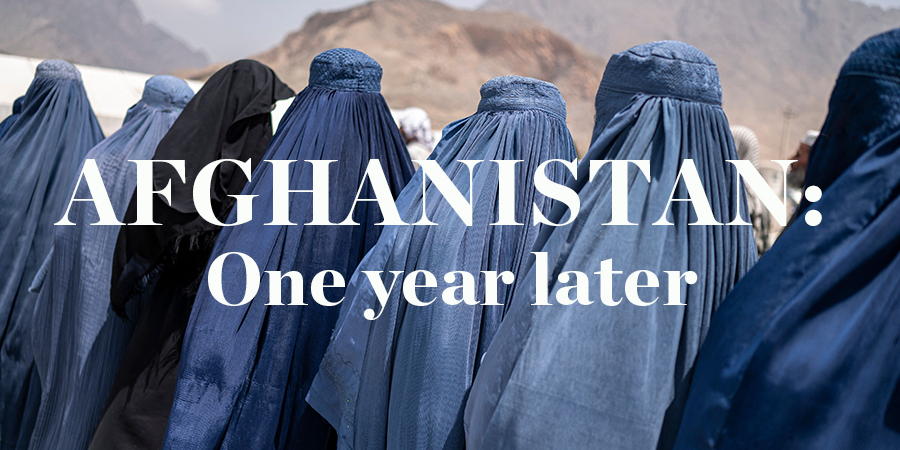
Fears over Afghanistan threat simmer, despite White House assurances

Getty Images

When the United States pulled its troops from Afghanistan in a chaotic dash, the Biden administration and its critics traded fire over whether America could keep its borders safe from terrorist threats without boots on the ground. 

A year later, that debate is still raging.

While the Biden administration has pointed to key wins from afar — in particular a Kabul drone strike earlier this month that killed longtime al Qaeda leader Ayman al-Zawahiri — former and current defense officials and experts harbor doubts that the U.S. is safe from future threats with its troops gone from the region.

“It means that we are going to have to be very vigilant about the potential for terrorism to raise its ugly head out of Afghanistan again,” former Defense Secretary Leon Panetta told The Hill. 

That isn’t easy when the U.S. doesn’t have a presence in a country, he said. 

“I think there’s a lot we don’t know about what’s going on in Afghanistan.”

Colin Clarke, research director at global security firm the Soufan Group.

While the al-Zawahiri strike showed the U.S. can still hit at terrorists, the leader’s presence in Afghanistan also proved a long-held concern that the Taliban would provide safe haven for extremist organizations, as it did leading up to the attacks of Sept. 11, 2001. 

And without eyes and ears on the ground, it’s difficult to discern the extent to which al Qaeda could regrow in Afghanistan and be able to conduct operations outside of the country, Clarke said.

Al-Zawahiri’s Kabul location was “just further proof of what myself and most counterterrorism experts have been saying since last year — which is it’s wishful thinking at best and naivete at worst to think that the Taliban and al Qaeda are going to break in any meaningful way. It’s just not going to happen,” Clarke added. 

In this photograph taken on July 31, 2022, smoke rises from a house following a US drone strike in the Sherpur area of Kabul. President Biden later announced that Al-Qaeda chief Ayman al-Zawahiri had been killed by a drone strike in Kabul. Getty Images/AFP

The administration has been grilled in Congress for its failure to foresee the Taliban’s rapid takeover after the U.S. exit, and the bungled handling of the withdrawal of some 120,000 Afghans — during which 13 American service members and more than 170 Afghan civilians were killed in a suicide bombing at Kabul’s airport. Friday marked the one-year anniversary of the deadly attack, which also wounded at least 150 others. 

Last week, Republicans on the House Foreign Affairs Committee released a 121-page report that investigated the U.S. effort, blaming the Biden administration for having no solid plan in place once all U.S. troops left Afghanistan.  

“The choices made in the corridors of power in D.C. led to tragic yet avoidable outcomes: 13 dead service members, American lives still at great risk, increased threats to our homeland security, tarnished standing abroad for years to come, and emboldened enemies across the globe,” Republicans said in the report. 

The White House, in turn, issued a memo brushing aside the GOP investigation, accusing it of advocating “for endless war and for sending even more American troops to Afghanistan.” 

The administration further argued its decision strengthened national security and did not compromise America’s ability to extinguish terrorist threats.  

The memo pointed to U.S. intelligence assessments that found al Qaeda has not reinstated itself in Afghanistan, with “less than a dozen” operatives in the country, and only al-Zawahiri so far attempting to restart operations there. 

The terrorist group “does not have a capability to launch attacks against the U.S. or its interests abroad from Afghanistan,” and “neither the few remaining [al Qaeda] core members nor its regional affiliate are plotting to attack the Homeland,” White House National Security Council spokeswoman Adrienne Watson wrote in the memo. 

But Dustin Carmack, the former chief of staff to ex-Director of National Intelligence John Ratcliffe, said that al-Zawahiri’s occupancy in Kabul appeared to highlight Washington’s dearth of intelligence capabilities now that U.S. forces are gone.

“We are flying blind to a large extent,” said Carmack, now with the Heritage Foundation.

“We still have a lot of capabilities, a lot of ability to go after folks but … how we left Afghanistan and just the way in which we removed any kind of contingencies of elements to be able to go execute proper [counterterrorism] strategies, it’s just an alarming failure because we’re going to be dealing with this for a long time.”

And Clarke said it’s likely a matter of time before al Qaeda could launch an attack against the West. While it’s unlikely the group would be able to pull off anything on the scale of 9/11, there is the possibility of smaller but deadly attacks. He pointed to the al Qaeda-directed commuter train bombings in March 2004 in Madrid that killed 193 people and the July 7, 2005, London transportation bombings that killed 52 people. 

“These attacks against soft targets — transportation, infrastructure, things like that — I think are certainly within al Qaeda’s capability set or skill set in the next year to 18 months. And that’s a significant possibility. It’s a real threat,” he said. 

President Joe Biden speaks before signing the “PACT Act of 2022” during a ceremony in the East Room of the White House. Associated Press-Evan Vucci

The White House’s confidence is also not shared by some former military leaders that oversaw the region firsthand.  

Two former heads of U.S. Central Command (Centcom) — retired Gen. Frank McKenzie and retired Gen. Joseph Votel — have publicly argued that the U.S. is less safe now than it was a year ago. 

“I do not believe we are safer as a result of our withdrawal from Afghanistan,” the recently retired McKenzie, head of Centcom from 2019 to 2022, told Voice of America on Monday

His predecessor Votel, leader of Centcom from 2016 to 2019, told the outlet that there remains “a lot that we don’t know about the organizations, the terrorist organizations that are left on the ground.” 

“I don’t think we’re more stable or more safe,” Votel added. “I think Afghanistan is more unstable and, as a result, that this region is more unstable.” 

Both McKenzie and Votel had also recommended the president keep a U.S. troop presence in Afghanistan. 

“I just don’t buy the idea that we had to pull everybody out,” Votel said, noting that he feared the “forever war” narrative pushed by the past two administrations “overtook smart, strategic decisionmaking.”  

Even with the White House pointing to its recent win with the al-Zawahri strike, the government remains wary when it comes to the region, and particularly the Taliban.   

The administration last week ruled out releasing $3.5 billion held in the U.S. back to Afghanistan’s central bank, citing the al Qaeda leader’s former presence in Kabul. The al Qaeda leader was killed on the balcony of a house tied to the Taliban. 

“We do not have confidence that that institution has the safeguards and monitoring in place to manage assets responsibly,” Thomas West, the American government’s special representative for Afghanistan, said in a statement first reported by The Wall Street Journal.  

“And needless to say, the Taliban’s sheltering of Al Qaeda leader Ayman al-Zawahri reinforces deep concerns we have regarding diversion of funds to terrorist groups.” 

Votel had also recommended the president keep a U.S. troop presence in Afghanistan. Associated Press-Evan Vucci

Beyond fears over al Qaeda, concerns also remain as to the Taliban’s ability to keep at bay the Afghan branch of the Islamic State, known as ISIS-K. Before and after U.S. troops left Afghanistan, the terrorist group staged numerous bombings, assassinations and suicide attacks that the Taliban has been unable to combat. 

U.S. defense and intelligence officials have voiced fears that left unchecked, such groups, including al Qaeda and ISIS-K, may soon develop capabilities to launch attacks across borders. 

Shortly after the U.S. withdrawal from Afghanistan, Joint Chiefs of Staff Chairman Gen. Mark Milley in September told lawmakers that the extremist organizations could build up a capability to attack the United States in one to three year’s time.  

That assessment appeared to be supported by Centcom head Gen. Michael Kurilla, who in June said U.S. intelligence confirmed that terrorist groups have begun to build training camps inside Afghanistan. 

Carmack, meanwhile, said Milley’s predicted timeline could likely be sped up.

“I think they’re being a little almost rosy in their thoughts, because when these guys have the ability to kind of grow and just run around Kabul and start being able to communicate globally again — at least more than what they were doing maybe a few years ago — they will be seeking new targets,” he said.

Source: TEST FEED1

Republican Senators challenge immigration rule change on terrorist support

Ten Republican Senators sent a letter to members of the Biden administration this week demanding an explanation for a rule change that will allow some individuals who have materially supported terrorist organizations to immigrate to the U.S.

“We write because the American people deserve an explanation regarding the broad, open-ended nature of this authority for exempting individuals who would otherwise be barred from immigration to the United States for supporting a terrorist organization,” Sen. Bill Hagerty (Tenn.) and his colleagues wrote wrote in the letter addressed to Secretary of Homeland Security Alejandro Mayorkas and Secretary of State Antony Blinken.

The June 8 determination by the Departments of Homeland Security and State announced that people who have provided “insignificant” or “limited” material support to terrorist organizations in the past will no longer be barred from immigration.

The Secretaries of the two departments have authority to exempt some from federal prohibitions on the immigration of people linked to terrorist activity.

However, according to the letter, “Usually, such an exemption is limited to specific groups or conflicts for obvious reasons.”

The Senators took issue with the generality of the rule change, which according to the DHS was intended to help “vulnerable Afghans,” saying that its lack of limits to “certain conflicts, terrorist organizations, geographic regions, or time periods” is dangerous.

The letter sought answers to eight questions concerning the determination, including about whom it had already allowed into the country, why the language was general rather than specific to Afghans and whether it would apply to people at the Southern border or affiliated with the Iranian Revolutionary Guard Corps.

Sens. Rick Scott (Fla.), Kevin Cramer (N.D.), Ted Cruz (Texas), Marco Rubio (Fla.), Joni Ernst (Iowa), Roger Marshall (Kansas), Tommy Tuberville (Alabama), John Hoeven (N.D.), and Steve Daines (Montana) joined Hagerty in signing the letter.

Source: TEST FEED1

Mississippi governor declares state of emergency over expected river flooding

Mississippi Governor Tate Reeves declared a state of emergency on Saturday for areas of the state affected by river flooding.

“I encourage individuals in the flood zones to be cautious, take appropriate precautions, and evacuate if necessary,” Reeves wrote in the declaration.

While some flooding has occurred, more is expected to occur this week, though earlier than originally predicted.

Reeves said that the Pearl River, located in central Mississippi near other flooding, “is expected to crest on Monday…at 36 feet.”

“The time is now to start making preparations to protect you and your family,” wrote Reeves.

The governor said that his emergency declaration would allow state agencies, including the Mississippi Emergency Management Agency (MEMA), to assist with the flooding and its aftermath.

MEMA and the Reeves administration have worked together to deploy sandbags and prepare search and rescue teams, according to the emergency announcement.

Reeves added that MEMA is continually monitoring flood levels using drones and other instruments.

Floods swept across the southwest U.S. last week as the National Weather Service warned of a potential tropical cyclone.

Similar trends of unstable weather have appeared in other areas of the country and throughout the southern state of Mississippi.

Source: TEST FEED1

Judge announces intent to appoint special master to review Mar-a-Lago documents

A Florida judge filed an order Saturday noting that the court plans to appoint a special master to oversee judicial interactions with plaintiff former President Trump.

“The Court hereby provides notice of its preliminary intent to appoint a special master in this case,” wrote District Judge Aileen Cannon, who was nominated by Trump during his time as president.

The order fulfills earlier requests by Trump for the court to appoint a special master to review Mar-a-Lago documents before the FBI is able to review them.

Trump filed a lawsuit on Monday to block the FBI from reviewing the documents that it seized in its raid of his home earlier this month.

Cannon declared that a hearing on the motion to appoint a special master will take place on Thursday, after the defense lawyers file their response.

She also required that Trump respond to the response of the defense before the hearing next week.

The motion in the Southern District of Florida follows the release on Friday of a partially redacted affidavit filed by the FBI to obtain a search warrant for Trump’s Mar-a-Lago resort.

The affidavit states that the search was justified because of evidence of potential obstruction.

Trump was found to be holding some top-secret classified documents at his home, despite being asked beforehand to return all classified information to the White House.

Source: TEST FEED1

Haines says intelligence officials to assess national security risks from Mar-a-Lago documents: reports

Intelligence officials in the Biden administration will review the national security risk posed by top-secret documents held at the Mar-a-Lago home of former President Donald Trump.

Director of National Intelligence Avril Haines sent a letter to two Democratic representatives on Friday, obtained by Politico, noting that intelligence would assess the risk resulting from potential disclosure of the classified information in the documents.

“The Department of Justice (DOJ) and the Office of the Director of National Intelligence (ODNI) are working together to facilitate a classification review of relevant materials, including those recovered during the search,” wrote Haines to House Oversight Committee Chair Carolyn Maloney (D-N.Y.) and House Intelligence Committee Chair Adam Schiff (D-Calif.).

The letter was written shortly after the release of a redacted version of the search affidavit filed by the Federal Bureau of Investigations before officers raided Trump’s Mar-a-Lago in search of documents that had been kept illegally by the former president.

The affidavit stated that reports indicated there could be “evidence of obstruction” at Mar-a-Lago, justifying a search.

Haines told Maloney and Schiff that intelligence officials’ assessment of national security risk would not “unduly interfere with DOJ’s ongoing criminal investigation.”

“We are pleased that in response to our inquiry, Director Haines has confirmed that the Intelligence Community and Department of Justice are assessing the damage caused by the improper storage of classified documents at Mar-a-Lago,” the two lawmakers told Politico on Saturday.

“It is critical that the IC move swiftly to assess and, if necessary, to mitigate the damage done — a process that should proceed in parallel with DOJ’s criminal investigation.”

Source: TEST FEED1