The liberal media has characterized the Supreme Court’s decision allowing President Biden to terminate the “Remain in Mexico” policy as a win for the president.
Not so fast. In reality, the court has handed the struggling president yet another political hot potato. Already there are a record number of people traveling north to cross into the U.S. illegally; this decision will likely increase the flow, causing headaches for an overwhelmed border patrol, and for the White House.
A recent Economist poll shows Biden’s approval on immigration at 32 percent; chaos at the border is not popular.
Biden’s approach so far has been to ignore the problem, despite pleas from border states, which absorb the brunt of the influx. Now, however, after the horrific deaths of 53 migrants left to die inside a scorching truck, Democrats and their allies in the liberal media are finally paying attention. It’s about time.
Senate Majority Whip Dick Durbin (D-Ill.) has called the slaughter a “Uvalde moment,” likening the impact of those deaths to the galvanizing murders of 19 school children last month in Uvalde, Texas. That terrible event led to the first gun reform laws being passed in decades.
Similarly inspired, Durbin and Sen. Thom Tillis (R-N.C.) are reportedly in talks aimed at reaching a broad compromise on immigration.
This could throw Biden a lifeline. Were the president to encourage Democrats in Congress to propose sensible immigration reforms, he might actually improve his standing.
The odds are long.
Over many years, repeated efforts to agree on common sense immigration rules that might stem the flow of people coming across our border illegally – now at over 200,000 per month – have flopped. Democrats welcome the flood of mostly Hispanic people entering our country, convinced that they will ultimately become voters for their party. That was not always the case.
Majority Leader Chuck Schumer (D-N.Y.) declared in 2009 to the Migration Policy Institute, “Illegal immigration is wrong, and a primary goal of comprehensive immigration reform must be to dramatically curtail future illegal immigration.” Today, for Schumer and other Democrats, “border security” is a non-starter.
At the other end of the spectrum, Republicans think illegal immigration is a running sore, undermining the rule of law. They argue that you cannot have a secure country without a secure border.
Neither side has put forward a workable compromise in decades.
Biden took office determined to undo everything President Trump had accomplished, including his success in driving down the number of people attempting to enter the U.S. illegally. Trump’s “Remain in Mexico” policy helped; the numbers were not large, but news percolated south that the welcome mat had been removed.
On entering the Oval Office, Biden ordered the end of that approach but was initially blocked by the courts. Nonetheless, the president’s campaign promised to end detention of migrant families, to stop building the border wall and generally to be more welcoming to those seeking asylum; those signals encouraged the caravans to start making their way north.
The costs of Biden’s “see no evil” attitude are evident. The deadly drug fentanyl, imported across our southern border, has become the number one cause of death among young people; 80,000 Americans died from fentanyl poisoning just last year. Fentanyl used to come from China; smugglers have now teamed up with Mexican drug cartels, which are reaping billions from easy access to U.S. buyers.
Meanwhile, the cartels are also earning a fortune from their smuggling operations. At the same time, an overwhelmed border patrol apprehended 50 people on the terror watch list last year; who knows how many slipped through undetected?
This is unacceptable. The administration’s point person on immigration, Alejandro Mayorkas, lied when he told Congress that our border was “closed.” What he presumably meant was that the subject is closed — not just within the White House, which has studiously refused to discuss the disaster at the border, but also among Democrats generally.
Which is why Durbin’s sudden awakening is welcome, as would be some reasonable new immigration rules. For instance:
Finish Trump’s wall. Where the terrain makes a wall impractical, use drones or other technology to make illegal entry difficult. In that 2009 address, Schumer also said: “Operational control of our borders – through significant additional increases in infrastructure, technology and border personnel – must be achieved.” He was right; for any compromise in Congress, we must have a secure border.
The majority of people in the U.S. did not illegally enter our nation via the border but overstayed their visas. It is essential that Congress implement the use of E-Verify, a free government-provided service that would prevent undocumented people from working. If immigrants cannot earn a living, they will go home.
Ditch the diversity visa program. The vast majority of Americans oppose the approach, which randomly selects 50,000 people to enter the U.S. each year. Like other nations, we should have criteria to determine who is welcome to become U.S. citizens.
Resolve the ongoing DACA dysfunction by granting young people who have grown up in the U.S. a path to citizenship. President Obama created hope among these people but left them in limbo; it is time to resolve the terrible uncertainty around their status.
Give people who are today living in the U.S. illegally a one-time chance to attain legal status. The millions living in the shadows would not become citizens, ever; they have lost that right. This is not “amnesty.” But allow them to become registered legal aliens, whereby they could work and pay taxes.
Rewriting our dysfunctional and unpopular immigration laws seems a heavy lift for a president unable to inspire even his own party.
But if Biden could lead Congress to common sense reforms, he might go down as a president that did something right. At this point, that seems a long shot.
Liz Peek is a former partner of major bracket Wall Street firm Wertheim & Company. Follow her on Twitter @lizpeek.
The DC Health Department ended its COVID-19 contract tracing program on Thursday, laying off 131 workers employed by the program.
“The COVID-19 Contact Trace Force has been instrumental in helping slow the spread of COVID-19 in the District of Columbia,” DC Health told The Hill. “However with COVID infection levels coming down and easier access to at-home testing kits, the COVID-19 Contact Trace Force is no longer as effective or vital a tool as it was during the peak of the pandemic.”
The District of Columbia government currently considers COVID-19 infection levels in the area “low,” the most recent weekly case rate coming in at 195.9 for the week of June 19 to 25 and the most recent hospital admission rate at 0.4 percent.
DC Health emphasized that its department gave advance notice of the end of the trace force and aided its employees in finding new roles.
“DC Health provided contact tracers with opportunities to learn more about new positions and even a career fair,” a spokesperson told The Hill, adding that many will continue to work in DC government and disease investigation.
The DC government will continue operating its mobile contact tracing system despite the closure of its overall contact tracing program, allowing DC residents to opt in for notifications about potential exposure to COVID-19.
“The DC CAN digital exposure notification system for mobile devices will remain in place and fully supported, and DC Health will continue to monitor the spread of diseases in the community, including COVID-19, and provide consultative services to high-risk facilities,” wrote the department.
Florida’s Parental Rights in Education law – known to its critics as the “Don’t Say Gay” law – will officially take effect today.
The measure has already had a chilling effect on public school educators, who in some cases have been instructed to remove LGBTQ+ Pride flags and photographs of same-sex partners from their classrooms to avoid violating the law.
Republican lawmakers have from the start argued that the measure’s only intent is to empower parents. Democrats and LGBTQ+ advocacy groups say the now-law is intentionally vague and represents a huge step backward for equality.
In early January, an eleventh-hour proposal filed in the Florida House of Representatives caught the eye of Rep. Carlos Guillermo Smith, a Democrat representing Orange County. The bill didn’t seem particularly insidious; it aimed to advance the involvement of parents in their children’s schooling – something education advocates had been endorsing for years.
But then Smith read something that made his breath catch. The measure, officially titled the Parental Rights in Education bill, would prohibit, in certain grade levels, “classroom discussion about sexual orientation or gender identity.”
Smith, who in 2016 became the state’s first openly gay Latino lawmaker, said he wasn’t exactly surprised that the bill had been introduced. It was just one of a number of bills that had been pre-filed before the legislature met on Jan. 11 that in some way targeted the LGBTQ+ community.
Our country is in a historic fight against the coronavirus. Add Changing America to your Facebook or Twitter feed to stay on top of the news.
Smith says those facts have been largely ignored by conservative lawmakers in Florida, who make up the majority of both the House and the Senate. They also have control of the governor’s office.
“There’s no acknowledgment whatsoever from Republicans in Tallahassee or Governor DeSantis that LGBTQ students are vulnerable and at risk,” Smith told Changing America in an interview.
Under the measure, which was signed into law in March by Florida’s Republican governor Ron DeSantis, public primary school teachers are prohibited from engaging in classroom instruction related to sexual orientation or gender identity.
The law officially takes effect Friday.
Public school educators through high school under the law are not able to address either topic in a manner that is not “age-appropriate or developmentally appropriate” for their students.
In House and Senate hearings through early March, Republican lawmakers backing the measure evaded questioning that would have clarified what is meant by “classroom instruction,” leaving it up to the interpretation of school districts.
Florida’s Department of Education will have until next summer to develop new rules that define that and other parts of the law, such as “age-appropriate and developmentally appropriate” instruction.
The department did not respond to multiple requests for comment.
Smith said he believes the measure is intentionally broad so as to chill the speech of public school teachers fearful that they may unintentionally violate the law.
Should that happen, parents may choose to take legal action against school districts, as is their right under the measure.
“When we talk about the culture of fear that this bill has created and the chilling effect, we’re talking about the fact that educators and school districts are scared to approach anything related to LGBTQ people or issues out of fear of lawsuits and professional ruin,” Smith said.
“The real enforcement mechanism for this law is not oversight from the state department of education,” he said. “It’s litigation.”
Already, reports have surfaced detailing Florida school districts’ attempts to get ahead of potential lawsuits – through which parents may be awarded damages – by rolling out new policies that limit the ways in which LGBTQ+ issues and identities may be talked about in class.
Andrew Spar, the president of the Florida Education Association (FEA), told Changing America that that isn’t a sign of increased anti-LGBTQ+ hate in schools – it’s a signal that educators and other school officials are afraid of losing their jobs.
“That’s why we may see some districts overreact by being extra cautious and just banning any conversations” about LGBTQ+ topics, he said.
Spar said a number of teachers have already approached the FEA about a series of trainings that have taken place in some school districts. During those trainings, teachers said, they were instructed to remove LGBTQ+ Pride flags, safe space stickers and photos of same-sex partners from their classrooms in the lead-up to Friday.
From the beginning, Spar said, an overwhelming majority of Florida’s teachers have opposed the new law, mostly because they believe it will keep them from protecting their students from anti-LGBTQ+ rhetoric and help perpetuate harmful stereotypes about LGBTQ+ people.
Teachers have also argued that the legislation solves a problem that does not exist in Florida.
Currently, sex education in Florida does not begin until the fifth grade, Spar said, when health instructors are required to give a one-time lesson on bodily changes that students may be experiencing because of puberty.
Lessons about sexual orientation or gender identity are not part of the curriculum, he said.
But conservative lawmakers have argued to the contrary, claiming that both topics are being pushed in an inappropriate manner on children in classrooms across the state.
In emailed comments to Changing America, the bill’s sponsor, Rep. Joe Harding (R), said the measure had successfully prevented “far-left school districts from trying to sexualize our children.”
“Florida is no longer just the freest state in the country, it is now the most pro-parent state as well,” he said.
In March, Harding during a television interview with ABC-affiliate WPLG in Miami said he had introduced the bill because he had been notified of multiple instances where educators of students as young as kindergarten were teaching lessons about “gender theory and gender identity.”
“The reason that the bill exists is because we have specific examples where this type of instruction has happened in Florida schools,” he said at the time.
Harding added that the legislation’s primary purpose is – and has always been – to empower parents and give them a greater say in the education of their children. He said Democrats calling the measure the “Don’t Say Gay” bill were lying to children and using them as “political pawns” to further an agenda.
LGBTQ+ advocacy groups, meanwhile, have accused Harding and other Florida Republicans of doing the same thing.
“The country is tired of watching you use the lives of our children for personal political power,” Joni Madison, the interim president of the Human Rights Campaign, said Thursday in a statement directed at conservative politicians in Florida and other states where similar measures have been introduced.
“We’ve always understood what we’re up against in the state of Florida,” Brandon Wolf, the press secretary of the organization Equality Florida, told Changing America. “We know these lawmakers, we know the rightward shift that has happened under Governor Ron DeSantis.”
The law is also personal for Wolf, a queer man who survived the Pulse Nightclub shooting in Orlando in 2016. His two best friends, Drew and Juan, were among the 49 people killed that night.
“It feels very ominous that in a state that saw the deadliest attack on LGBTQ people in this nation’s history … that we would be having conversations about erasing our history, our lives, our lived experiences from classrooms,” he said.
Wolf said he’s recently felt a renewed vigilance when it comes to his personal safety – a vigilance he has not felt since the days immediately following the Pulse attack.
President Volodymyr Zelensky and his Ukrainian warriors have unleashed a “Red Dawn”-like response against Russian troop advances in nearly every part of the country. Russian tanks — the much-heralded T-72, T-80 and T-90 — are no match for the Javelin, Next-generation Light Anti-tank Weapon (NLAW), Baykar Bayraktar TB2 and Switchblade drones. Their turrets litter the Ukraine landscape. Neither composite armor, explosive reactive armor, nor countermeasure suites have been effective against the modern weapon systems designed to destroy them.
These defensive weapons, supplied by the United States and NATO, are dramatically altering the battlefield and providing a much-needed shot in the arm to a president in Kyiv unwilling to “take a ride.” Ukraine has marginalized the once vaunted Russian War Machine. As the combat continues, the Ukraine Defense Ministry recently reported they have inflicted 34,430 casualties, and destroyed 1,504 tanks, 3632 armored personnel carriers, 756 artillery pieces, 240 Multiple Launch Rocket Systems, 216 aircraft and 183 helicopters.
The Greek philosopher Heraclitus of Ephesus introduced us to the reality that “change is the only constant.” That applies to warfare as well, from tactics and strategy to weapons systems and protective equipment. When change fundamentally reshapes how we fight, it is known as RMA — a hypothesis in military theory about the future of warfare, often connected to technological and organizational recommendations for military reform.
Broadly stated, RMA claims in certain periods of the history, there were new military doctrines, strategies, tactics and technologies that led to irrecoverable changes in the conduct of warfare. Furthermore, those changes compel an accelerated adaptation of novel battlefield doctrines and strategies. Examples include the machine gun from World War I, Blitzkrieg from World War II, long-range precision missile fires from Desert Storm, and communications and network-centric warfare.
The war in Ukraine is continually introducing high-tech weapon systems to the battlefield that are fundamentally marginalizing armor — tanks and armored personnel carriers — by utilizing centuries-old tactics that have fundamentally marginalized, while ingeniously also exploiting, the manner in which the Russian military employs them. Russian President Vladimir Putin exposed himself to this possible RMA moment by fighting a war using WWII tactics with modern-day armor; the Ukrainian military is winning by destroying them wholesale with modern weapon systems using infantry tactics as old as the French and Indian War.
In Ukrainian hands, $175,000 Raytheon FGM-148 Javelins and their “fire and forget” technology are acting as long-range snipers, while the $40,000 UK Thales NLAW are serving as close-in brass knuckles. Both have easily destroyed Russian armor, including Russia’s $2.8 million T-72 tanks by homing in on their manned turrets from the topside — structurally their weakest defensive armor link. Turkish Bayraktar TB2 drones, pricier at $5 million each, provide 24-hour air cover and have been highly effective at destroying a variety of Russian armor, command posts, surface-to-air missile (SAM) batteries, and multiple rocket launchers. Perhaps the most revolutionary are the U.S. AeroVironment Switchblade 300s and 600s. These $6,000 loitering drones, capable of staying airborne for 30 minutes and ranging seven miles, are carried in a backpack and provide infantrymen over-the-horizon intelligence. They also are kinetic and can destroy Russian armor and artillery.
But, are we witnessing RMA? Yes, but it’s a culmination of bad Russian strategy, the Kremlin’s overreliance on antiquated tactics, poor training, abysmal execution, and Ukraine’s adaptation to asymmetric armor tactics. Poor operations security contributed as well. The modern-day tank has lost its “fear factor”; its presence makes everything around it vulnerable.
It is certainly akin to long-range precision fires and network-centric warfare. These new weapon systems provide stand-off precision fires on smaller, more lethal platforms and the ability for soldiers on the ground to geo-locate and target enemy forces using social media and cell towers. The infantryman can now deliver accurate, lethal fires, unseen, miles away from the target — a modern-day bogeyman to the Russian soldier. The WWII saying that “loose lips sink ships” is still relevant, but in 2022, “social media posts” sideline tanks and general officers — bad operations security still has deadly consequences.
The Javelin anti-tank missile and Switchblade drone have exposed weaknesses in armor, and not just Russian tanks and APCs. Air Defense security from drone strikes has taken on increased significance, as does enhanced armor protection on the top of tanks and APCs. Armor is vulnerable, and it’s much harder to hide on today’s battlefield. Much as Blitzkrieg tactics defeated the Maginot line, the principles of speed and security will be needed to overcome advances in today’s weapons technology.
Asymmetric weapons systems employed during the Ukraine war have diminished the mobility and intimidation factor of the modern-day tank to the status of the post-WWII battleship. RMA has relegated decisive tank battles on the plains of Europe to the past – the same as aircraft carriers in WWII put an end to decisive naval armada battles envisioned by Alfred Thayer Mahan.
Now, with the introduction of U.S.-supplied High Mobility Artillery Rocket Systems (HIMARS), RMA may be on the verge of changing how artillery is employed on the battlefield. While counter-battery fires aren’t new, large lethargic artillery formations found at the regiment, division and corps levels, the staple of Russian tactics, present themselves as lucrative targets. Their prolonged exposure on the battlefield ensures their destruction. The mobility, range and accuracy of HIMARS is a game changer, and certainly will alter how Russia fights.
Revolution comes fast — hopefully, a little too fast for Putin.
Jonathan Sweet, a retired Army colonel, served 30 years as a military intelligence officer. His background includes tours of duty with the 101st Airborne Division (Air Assault) and the Intelligence and Security Command. He led the U.S. European Command Intelligence Engagement Division from 2012-14, working with NATO partners in the Black Sea and Baltics. Follow him on Twitter @JESweet2022.
Mark Toth is a retired economist, historian and entrepreneur who has worked in banking, insurance, publishing and global commerce. He is a former board member of the World Trade Center, St. Louis, and has lived in U.S. diplomatic and military communities around the world, including London, Tel Aviv, Augsburg and Nagoya. Follow him on Twitter @MCTothSTL.
President Biden on Thursday said the Supreme Court’s decision to turn abortion law over to the states was an “outrageous” move that threw more than women’s rights and medical decisions into limbo. Privacy, he argued, is a cherished constitutional shield that the conservative court could erase by nullifying other rights, including contraception and “who you can marry.”
The president called on Congress to correct the court’s ruling by passing a law that embodies the 1973 decision in Roe v. Wade to safeguard abortion and privacy as federal rights. Under pressure within his party to speak loudly and come up with an action plan, Biden urged the Senate to adopt an exception to the 60-vote filibuster threshold under these circumstances.
“I believe we have to codify Roe v. Wade in the law, and the way to do that is to make sure the Congress votes to do that,” Biden said. “And if the filibuster gets in the way, it’s like voting rights, it should be we provide an exception for this, requiring an exception to the filibuster for this action to deal with the Supreme Court decision.”
The problem for Democrats is that Congress doesn’t have the votes to codify Roe. All 50 Democrats would need to support the change, and Sens. Joe Manchin (D-W.Va.) and Kyrsten Sinema (D-Ariz.) don’t want to change the filibuster (The Hill and The New York Times).
Biden appeared to concede it will be voters, not Congress, with the power to check the Supreme Court, albeit as a potential slow-motion remedy. The president’s broad defense of privacy rights on Thursday could help shape a political narrative that appeals to some Republican women in the suburbs, independents worried about prosecutorial overreach and Big Brother, even some Catholics and Latinos.
Biden urged Americans who support abortion rights to vote against lawmakers who support the court’s ruling.
“If the polling data is correct and you think this decision by the court was an outrage or a significant mistake, vote, show up and vote,” Biden said during a news conference at the end of a NATO summit in Madrid. “Vote in the off-year and vote, vote, vote. That’s how we’ll change it.”
He said he will confer virtually today with a group of seven Democratic governors (representing Connecticut, New York, Illinois, New Mexico, California, Oregon and Washington) about efforts to protect privacy and abortion rights (The Hill). Vice President Harris, a former California attorney general and former member of the Senate Judiciary Committee, conferred with select state attorneys general more than a week ago.
“I feel extremely strongly that I’m going to do everything in my power, which I legally can do in terms of executive orders, as well as push the Congress and the public,” Biden added, dismissing criticism from within his party that the White House response to the court’s opinion has been, as one advocate described it, “milquetoast.”
“I’m the only president they’ve got,” he said with a chuckle.
▪ The Hill: Senate Democrats press the Pentagon on abortion access.
▪ The Hill: Five takeaways from Biden’s Group of Seven, NATO meetings.
Related Articles
▪ The Associated Press: A Florida judge said Thursday that he will temporarily block a state ban on abortions beyond 15 weeks of pregnancy, but his bench ruling won’t take effect before the ban becomes law today.
▪ NBC News: A Kentucky judge on Thursday temporarily blocked the state’s near-total ban on abortions, allowing pregnancy terminations to proceed. A judge will continue to hear the case next week.
▪ The Associated Press: Alabama on Thursday cited the Supreme Court’s abortion ruling to argue it can ban gender-affirming medical treatments for transgender youths. Critics of the high court’s opinion have warned that the ruling could lead to a rollback of gay marriage, contraception and parental rights.
▪ The Associated Press: Today a Connecticut law goes into effect to protect abortion providers and patients from other states’ bans on abortion. It also expands the pool of providers in the state who can perform abortions in the first 12 weeks of pregnancy using a suction procedure known as aspiration.
▪ The Associated Press: In Washington state, Gov. Jay Inslee (D) preemptively issued a directive instructing the Washington State Patrol not to cooperate “in any manner” with out-of-state abortion investigations.
▪ Reuters: The Supreme Court, with its abortion ruling last week in mind, on Thursday threw out lower court rulings that invalidated three abortion laws at the state level.
▪ The Associated Press: Eyeing last week’s high court opinion with concern about what’s to come, same-sex couples are updating legal status, wills and designations to try to protect marital status and their children.
LEADING THE DAY
➤ SUPREME COURT
Justices on the final day of the term limited the authority of the Environmental Protection Agency to curb emissions from power plants. The ruling represents a major blow to the administration and to a worldwide battle against climate change.
By a 6-3 vote, with conservatives in the majority, the court said that the Clean Air Act does not give EPA broad authority to regulate greenhouse gas emissions from power plants that contribute to global warming. Power plants account for roughly 30 percent of carbon dioxide output, the culprit in greenhouse gas that warms the planet.
Nineteen mostly Republican-led states and coal companies led the fight at the high court against broad EPA authority to regulate carbon output (The Associated Press).
Separately, the Supreme Court on Thursday ruled 5-4 in support of the Biden administration in a clash over the disputed Trump-era “Remain in Mexico” immigration policy. The justices returned the case to lower courts for additional proceedings (The Hill).
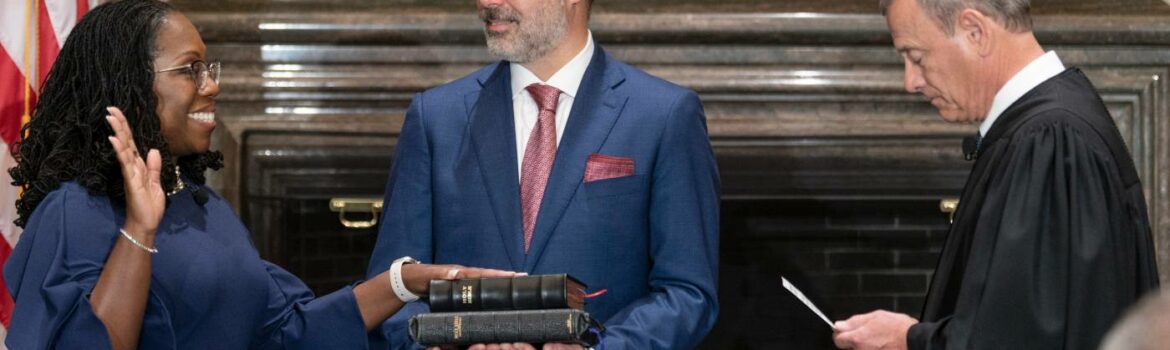
Ketanji Brown Jackson was officially sworn in as a Supreme Court justice on Thursday, cementing her as the nation’s first Black woman to serve in the position. She replaced Justice Stephen Breyer, 83, whose retirement took effect at noon on Thursday (The Hill).
Senate Minority Leader Mitch McConnell (R-Ky.) complicated the Democratic plans for July on Thursday with a threat to tank a bipartisan bill aimed at boosting U.S. competitiveness with China if the party in power moves ahead with an economic package via budget reconciliation.
McConnell issued the warning on Thursday afternoon, saying plainly that Democrats can only have one or the other, with the GOP leader effectively putting the future of the U.S. Innovation and Competitiveness Act (USICA) in limbo.
“Let me be perfectly clear: there will be no bipartisan USICA as long as Democrats are pursuing a partisan reconciliation bill,” McConnell said.
The White House and Democratic leaders responded angrily to the Kentucky Republican’s latest salvo. Biden press secretary Karine Jean-Pierre in a statement accused McConnell of protecting the pharmaceutical industry and siding with China.
“This takes loyalty to special interests over working Americans to a new and shocking height. We are not going to back down in the face of this outrageous threat,” she wrote, later echoed by the spokesmen for Senate Majority Leader Charles Schumer (D-N.Y.) and Speaker Nancy Pelosi (D-Calif.).
Passing the USICA bill was a top Democratic priority for what is expected to be an intense three-week work period before the month-long August recess. Negotiations are nearing the final stages to reconcile the bill with the House-passed America COMPETES Act. McConnell was one of 19 Senate Republicans who voted last summer for the USICA bill, which would include $50 billion to increase domestic semiconductor production and $100 billion for the National Science Foundation.
The move also throws the future of a pared-back Build Back Better bill in fresh doubt. According to Bloomberg News, Senate Democrats have discussed scaling back tax increases in any reconciliation bill in order to strike a deal with Manchin in order to get it across the finish line by the start of August.
As The Hill’s Alexander Bolton notes, the Supreme Court’s EPA ruling also heaps pressure on Democrats to push through a bill with 50 votes. Schumer on Thursday said the court’s opinion puts the onus on Congress to get something done to limit carbon emissions.
▪ Politico: Why Biden’s climate push might not be doomed.
▪ The Hill: House negotiators advance final appropriations bills.
Separately, Senate Democrats could be forced to confront yet another health issue after the July 4 recess as Sen. Patrick Leahy (D-Vt.), who is third in line for the presidency, broke his hip and underwent surgery on Thursday. He is “comfortably” recovering after a hip replacement, according to his spokesman (The Hill). According to his office, Leahy, 82, fell Wednesday evening at his home in McLean, Va. (The Associated Press).
If Leahy misses time, it would create troubles for Schumer to shepherd through nominees and other bills that require support from all 50 Senate Democrats (The Hill).
➤ UKRAINE CRISIS
Biden on Thursday hailed the work of NATO as the alliance is set for expansion in Scandinavia in response to Russia’s invasion of Ukraine and the U.S. prepares to send more in military aid to the war-torn nation.
The president argued on Thursday that the invasion has strengthened the sprawling alliance, especially as Sweden and Finland took a step closer to joining. He also maintained that Ukraine will not fall to the Russians, going so far as to promise it will not happen.
“Putin thought he could break the transatlantic alliance,” Biden told reporters. “He tried to weaken us. He expected our resolve to fracture. But he’s getting exactly what he did not want. He wanted the Finland-ization of NATO. He got the NATO-ization of Finland.”
“We are going to stick with Ukraine, and all of the alliance is going to stick with Ukraine as long as it takes to, in fact, make sure that they are not defeated,” Biden said, adding that another $800 million in military assistance will go to Ukraine. “[Russia] cannot, in fact, defeat Ukraine and move beyond Ukraine. This is a critical, critical position for the world” (Politico).
Russian President Vladimir Putin on Thursday issued his own warning to the two Nordic nations, saying that while he has no problem with them joining, Moscow will respond if there is a NATO military buildup in the region (Insider).
Earlier in the week, NATO Secretary General Jens Stoltenberg revealed that the alliance is ramping up the number of troops set for rapid deployment from 40,000 to 300,000 (CNBC).
▪ The New York Times: Ukraine drives Russian forces from Snake Island, a setback for Moscow.
▪ Reuters: Former Russian President Dmitry Medvedev says sanctions could be justification for war.
▪ The Wall Street Journal: Russian missiles kill 18 in residential area in Odessa region, Ukraine says.
▪ The New York Times: Patient and confident, Putin shifts out of wartime crisis mode.
Meanwhile, WNBA star Brittney Griner arrived in a Moscow court today to begin her trial on drug charges after being imprisoned without bail since February. Legal experts said her trial was all but certain to end in a conviction despite the insistence in the United States that she be released. The State Department and the White House have protested her treatment, now officially categorized as “wrongful detention,” during a fraught period for U.S.-Russian relations (The New York Times).
“Brittney has been classified as wrongfully detained since April 29, which means that the U.S. government has determined she is being used as a political pawn and as a result, is engaging in negotiations for her release, regardless of the legal process,” Griner’s agent, Lindsay Kagawa Colas, said Wednesday. “As such, our expectation — Brittney’s family included — remains that President Biden get a deal done to bring her home.”
The New York Times: Russia hints at linking Griner’s case to Viktor Bout, a Russian arms dealer serving a 25-year prison sentence in the United States. He is known as the “Merchant of Death.” Because of the disparity between the alleged charges against Griner — possession of vape cartridges containing cannabis oil) and Bout’s crimes of selling arms to those intent on killing Americans — the Biden administration, reluctant to create an incentive for the arrest or abduction of Americans abroad, may be hard-pressed to justify a swap with Bout.
■ Is Biden handling Putin better than he’s handling Trump? by Susan B. Glasser, staff writer, The New Yorker. https://bit.ly/3OWfuBQ
■ 🚴 He’s the best cyclist in the world. He’s only getting better, by Jason Gay, columnist, The Wall Street Journal. https://on.wsj.com/3yuhKLt
WHERE AND WHEN
🇺🇸 A programming note: The Morning Report wishes readers a happyFourth of July holiday. Find The Hill’s Tipsheet early next week, and our newsletter returns bright and early to inboxes on Wednesday.
The House will meet at 10 a.m. for a pro forma session and will resume votes on July 12.
TheSenate convenes at 8:30 a.m. for a pro forma session. Senators will return to Washington on July 11 following the July 4 recess.
The president receives the President’s Daily Brief at 9:45 a.m. Biden will consult virtually with a group of seven Democratic governors at 1 p.m. about the repercussions of the Supreme Court decision overturning Roe v. Wade. The president will depart the White House for Camp David at 2:30 p.m.
The vice president is in Los Angeles and has no events scheduled.
First lady Jill Biden arrives at 12:30 p.m. in Richmond, Va., and will visit and deliver remarks at a Richmond and Henrico County Health District’s vaccination clinic. She will urge parents and guardians to vaccinate their children younger than 5 against COVID-19.
Chinese President Xi Jinping on Thursday left the safe confines of the mainland, arriving in Hong Kong for the first in-person travel he’s made in 29 months to survey part of a tightly scripted, two-day anniversary celebration aimed at reinforcing his authority over the city (The New York Times).
During a Friday keynote address, Xi asserted that true democracy in Hong Kong began with the handover. “After its return to the motherland, Hong Kong compatriots became masters of their own affairs, Hong Kong people administered Hong Kong with a high degree of autonomy, and that was the beginning of true democracy in Hong Kong,” Xi said (CNN).
Xi declared that Hong Kong had “put an end to chaos and violence,” and was ready to “break new ground and take a new leap forward” in the next five years. He said the city of more than 7 million people must be governed by “patriots,” shorthand for those loyal to the ruling Communist Party.
His visit marked exactly two years after Beijing imposed a sweeping national-security law on Hong Kong, paving the way for authorities to end a wave of dissent that had drawn millions of people onto the streets and alarmed the Communist Party leadership with what they saw as a direct challenge to their authority (The Wall Street Journal).
The Hill’s Laura Kelly reports on why Hong Kong matters to the U.S., noting the Western campaign to support its independence faces a grim future on the 25th anniversary of its handover from the United Kingdom back to the Chinese Communist Party.
Pfizer on Thursday announced that it submitted an application to receive full approval from the Food and Drug Administration for Paxlovid, its COVID-19 antiviral, for use in high-risk individuals. The agency greenlighted it for emergency use in December to treat mild-to-moderate COVID-19 in adults and children over the age of 12 who are at a high risk of developing severe symptoms (The Hill).
The World Health Organization on Thursday reported that COVID-19 cases are rising nearly everywhere in the world. The largest weekly rise in new COVID-19 cases was seen in the Middle East, where they increased by 47 percent, according to the report released late Wednesday. Infections rose by about 32 percent in Europe and Southeast Asia, and by about 14 percent in the Americas, WHO said (The Associated Press).
Total U.S. coronavirusdeaths reported as of this morning, according to Johns Hopkins University (trackers all vary slightly): 1,017,266. Current average U.S. COVID-19 daily deaths are 317, according to theCenters for Disease Control and Prevention.
➤ ECONOMY
The Commerce Department reported on Thursday that a key inflation gauge remained high at 6.3 percent in May, year over year. The report also said that consumer spending rose at a sluggish 0.2 percent rate from April to May. Consumer spending is beginning to weaken in the face of high inflation, which some analysts believe could be a favorable omen for the Federal Reserve’s goal to tame rising prices without triggering a recession. The Fed meets again on July 26-27.
“It should really come as no surprise that U.S. consumers are paring their spending due to the high costs of, well, almost everything,”Jennifer Lee, senior economist at BMO Capital Markets, wrote in a research note. After adjusting for inflation, she noted, consumer spending actually fell 0.4 percent from April to May (The Associated Press).
U.S. employers say they see signs of a cooling market for job hunters (Reuters).
Retailers, manufacturers and farmers hope for a quick resolution to a labor dispute with port workers that could lead to significant supply chain disruptions. Both sides in the clash say they will not allow work stoppages. Today is the contract deadline. Businesses say they worry that the risk of walkouts climbs if labor talks drag on (The Hill).
Cities and states can now apply for federal grants over a span of five years to rectify harm caused by roadways that were placed primarily through lower-income and Black communities after the 1950s commitment to the interstate highway system.
Transportation Secretary Pete Buttigiegon Thursday launched a $1 billion first-of-its-kind pilot program aimed at helping reconnect cities and neighborhoods racially segregated or divided by road projects. Proponents of the administration’s effort say the grant funds under the infrastructure law are far less than the $20 billion Biden initially proposed (The Associated Press). Some conservative officials, including Florida Gov. Ron DeSantis (R), a possible 2024 presidential contender, have derided the effort as the “woke-ification” of federal policy.
And finally … 👏👏👏 Congratulations to our Morning Report Quiz winners!
With Tuesday’s Jan. 6 congressional testimony in mind, we sought some smart guesses about thehistory of presidential transport, especially around Washington, D.C.
In our winner’s circle this week: Pam Manges, Mary Anne McEnery, Paul Harris, Patrick Kavanagh, Ki Harvey, Lou Tisler, Luther Berg, Terry Pflaumer, Jack Barshay, Robert Bradley, Jose Ramos, Stanley Wasser, Amanda Fisher, Lesa Davis, Len Jones, Joe Erdmann, Jaina Mehta, Candi Cee and Steve James.
They knew that the gleaming black limousine that serves as a fortified security bunker to drive presidents around is known as “The Beast.”
Former President William Henry Harrison insisted on riding his own horse to his inauguration at the Capitol in 1841. (His decisions that day proved perilous; he died of pneumonia 31 days later.)
Former President Ulysses S Grant was a speed demon. While serving as the leader of the free world, Grant raced his horse-drawn coach down M Street N.W. and was pulled over by an intrepid Washington, D.C., police officer, who fined the president (DCist).
It is true that current and former presidents since Lyndon Johnson have been strongly discouraged by the Secret Service from driving themselves anywhere on public roads (CNBC).
President Biden is injecting new vigor into the fight to protect abortion rights, seemingly nudged into action by criticism from within his own party about a lackluster response to date.
Biden branded the Supreme Court’s decision last week to strike down the landmark 1973 Roe v. Wade ruling as “outrageous” and “destabilizing” during a Thursday news conference in Madrid.
Biden said that if “the filibuster gets in the way” of such a law then “an exception” would have to be made.
His chances of success in that regard look slim, however.
Every Senate Democrat would need to vote to amend the filibuster rules, given that no Republicans are expected to back such a move. There are no signs as yet that Sens. Joe Manchin (D-W.Va.) and Kyrsten Sinema (D-Ariz.) have altered their previous opposition to filibuster reform.
That said, Biden’s move was welcomed by progressives who have been dismayed by the administration’s response to the Supreme Court’s June 24 decision rescinding a right that had stood for almost half a century.
“Now we’re talking!” Rep. Alexandria Ocasio-Cortez (D-N.Y.) enthused on Twitter about Biden’s pledge. “Time for people to see a real, forceful push for it. Use the bully pulpit. We need more.”
Ocasio-Cortez, along with other progressive figures including Sen. Elizabeth Warren (D-Mass.), has been to the fore in demanding more sweeping action. The New York congresswoman has urged the administration to throw its weight behind an expansion of the Supreme Court, and to lease federal land to abortion providers.
But Biden is opposed to expanding the court, and Vice President Harris on Monday told CNN that the latter idea is “not right now what we are discussing.”
Warren, together with Sen. Tina Smith (D-Minn.) last weekend wrote a New York Times op-ed calling for Biden to declare a public health emergency to protect abortion rights.
On Wednesday, Warren took to Twitter to outline several steps that she contended could help supporters of abortion rights “to go on offense as well as defense.”
She backed a Michigan effort to force a ballot initiative that would potentially enshrine abortion rights in the state constitution; a campaign to rebuff an anti-abortion effort in Kansas; and the Senate candidacies of two Democrats: Wisconsin Lt. Gov. Mandela Barnes, who hopes to oust Sen. Ron Johnson (R), and Pennsylvania Lt. Gov. John Fetterman, who is running against Republican Mehmet Oz to replace retiring Sen. Pat Toomey (R).
The specificity of Warren’s recommendations offer a counterpoint to Biden’s overall approach which — to the frustration of many in his own party— has leaned on nebulous slogans and at times even avoided using the word “abortion.”
At his Madrid press conference, Biden insisted that the “bottom line” is to “vote, vote, vote.”
And indeed, the battle over abortion is already impacting the midterm campaign.
Planned Parenthood announced Thursday that it is launching a $3 million TV ad buy in Pennsylvania hitting Oz for what the organization termed his “plans to restrict and criminalize” abortion.
Fetterman released a statement promising abortion rights advocates, “Send me to D.C., and I will proudly cast that 51st vote to eliminate the filibuster and codify the right to an abortion into law.”
In the short-term, the battle to protect abortion rights won’t be won on the Senate floor unless Manchin and Sinema yield.
Instead, the new frontlines are forming in state courts, where abortion rights activists are seeking to stymie new curbs including so-called “trigger laws” that had been readied with the purpose of severely restricting or banning terminations if Roe fell.
The abortion rights side won its most significant victory to date in Florida Thursday, where a judge found a new law that would ban all abortions at 15 weeks was likely unconstitutional.
The judge temporarily blocked the law, which provides no exception in cases of rape or incest.
Florida Gov. Ron DeSantis (R), a strong conservative and a possible 2024 presidential contender, immediately pledged to appeal the judge’s decision. The case is expected to end up in Florida’s Supreme Court.
Also on Thursday, a judge in Kentucky blocked two trigger laws in the state that were challenged by several plaintiffs, including Planned Parenthood, backed by the American Civil Liberties Union.
The lawsuit argues that the proposed bans “violate the rights to privacy, bodily autonomy, and self-determination outlined…in the Kentucky Constitution.”
Temporary judicial blocks to new abortion restrictions have also been erected in Louisiana, Texas and Utah. Legal fights are underway or imminent in several other states.
There won’t be any speedy settlement of the issue. Sara Rosenbaum, a professor of Health Law and Policy at the George Washington University’s Milken Institute School of Public Health, noted that the outcome to the various legal fights will likely “unfold at a relatively slow rate” even if “some courts may expedite a ruling.”
It’s not only the pro-abortion rights side that is active, of course.
Some anti-abortion campaigners, energized by their landmark Supreme Court victory after decades of struggle, have set their sights on a national abortion ban. Former Vice President Mike Pence was among the first Republicans to call for every state to ban abortion after the high court’s decision came down.
Meanwhile, an opinion authored by Justice Clarence Thomas in the abortion rights case held out the prospect of other key Supreme Court decisions being overturned since they, like Roe, rest on a supposed constitutional right to privacy.
As examples, Thomas mentioned the cases that established the constitutionality of same-sex marriage and same-sex sexual intimacy — in addition to the 1965 Griswold case that established a right to contraception for married couples and, crucially, identified a right to privacy in the “penumbras” of the Constitution.
Biden has focused a lot on that reasoning, warning of the cascading impact of the abortion ruling.
On Thursday, the president threw himself into the fight with more determination than before.
Others in his party know the battle will not be easily won.
But for now, they’re just relieved he’s willing to wage it.
The fight for Hong Kong’s autonomy faces a grim future on the 25th anniversary of the territory’s handover back to China from the United Kingdom.
What began on July 1, 1997 as a bold experiment seeking to bring the Chinese Communist Party (CCP) more toward Western, liberal democracies has instead served as a hard lesson in Beijing’s single-minded pursuit of total control.
There are few options for President Biden and Congress to support reversing Beijing’s rollbacks on the democratic freedoms, capitalist economy and rule of law in Hong Kong.
Its supporters urge political asylum for opposition figures and mourn the dimming of the territory’s once bright light as a vibrant, cosmopolitan center of culture and business that bridged the divide between China and the West.
“It should be a warning to everyone around the world that a city of 7.5 million people who have enjoyed all the rights and autonomy that we take for granted globally … can be stripped away and taken away overnight,” said Samuel Chu, president of the Campaign for Hong Kong.
“This crackdown doesn’t stop at the Chinese border or the borders of Hong Kong,” he added.
Beijing’s violations of Hong Kong’s independence, which was supposed to stand for 50 years, also serve as a stark warning of the threats facing Taiwan.
Top U.S. intelligence officials have said that Beijing’s goal is to undermine Taiwan through diplomatic and economic pressure — but that it is also weighing a military invasion as the island hardens its political and military defenses, which are backed by Washington.
Jacob Stokes, fellow for the Indo-Pacific Security Program at the Center for a New American Security, said that China’s breach of “one country, two systems” for Hong Kong has sharpened the risks facing Taiwan and its democratic government.
The 1984 Sino-British Declaration, which laid the groundwork for Hong Kong’s handover from the U.K. to China 13 years later, stated that Beijing would treat the territory as a special administrative region – part of the larger country of China, but with its own separate, democratic system that was developed over a century and a half of British colonial rule.
“‘One country, two systems’ eroded, sort of, like one goes bankrupt, a little bit at a time and then all at once,” Stokes said.
“It’s really sharpened a set of views, not just in Hong Kong, of course, but in Taiwan too, about what exactly closer political, legal, economic, technological integration with China would look like and has really made the choice quite stark.”
The Biden administration has elevated the Chinese communist government as one the greatest security challenges facing the U.S. in the 21st century. But Russia’s invasion of Ukraine has inhibited the administration from focusing more strongly on countering Beijing.
In Congress, Democrats and Republicans are united on the need to confront China but have stalled in advancing landmark legislation aimed at setting up the U.S. to counter the nation — militarily, technologically, economically and diplomatically — for generations.
“Let’s not wait any longer. Send it to my desk. I’ll sign it,” Biden said in his State of the Union address to Congress this year.
House and Senate lawmakers from both parties have been meeting since April to hammer out bipartisan text for the so-called U.S. Innovation and Competitions Act (USICA).
On Thursday, Senate Minority Leader Mitch McConnell (R-Ky) said he would block advancing USICA as long as Democrats were pursuing their broad economic legislation without GOP buy-in.
“Let me be perfectly clear: there will be no bipartisan USICA as long as Democrats are pursuing a partisan reconciliation bill,” McConnell tweeted.
Sen. Todd Young (R-Ind.), co-sponsor of the first USICA bill that cleared the Senate in 2021, called for passing bipartisan text “without any further delays” in a statement to The Hill.
“When Beijing took over Hong Kong and crushed the brave Hong Kongers rising up to defend their democracy, it served as a wake-up call to the world that we must take the Chinese Communist Party at their word when they discuss their ambitions,” Young said.
“Like Hong Kong, destroying Taiwan’s independence is not theoretical or academic, but something that Beijing is determined to accomplish. We must use this occasion to express our resolve that this cannot occur.”
Provisions related to Hong Kong in draft text of a House bill include prohibitions on certain exports to the territory, funds to promote democracy, monitoring of China’s interference in Hong Kong’s trade and industrial policies and providing visas for Hong Kong dissidents who are targets of the Chinese government.
“Hong Kong really represents the most potent and promising base of resistance to the communist regime in China,” said Chu.
“It means preserving whatever memory, talent and people that we can, either through supporting them in an overseas diaspora or supporting what they’re doing underground.”
The CCP has accelerated its crackdown on Hong Kong’s democratic freedoms and institutions most prominently since 2019, installing pro-Beijing politicians in the territory and passing a National Security Law (NSL) that criminalized vague offenses of terrorism, secession and subversion, with the maximum penalty going as far as life in prison.
More than 10,000 people were arrested when protesting the NSL at that time, with more than 2,300 charged for crimes under the law and 200 convicted, as documented in a report by the Congressional Research Service that was published in March.
“The HKSAR [Hong Kong Special Administrative Region] increasingly seems to be wielding the NSL as an instrument of political repression, and has censored pro-democracy media outlets and arrested their leadership and senior editorial staff,” the report states.
Biden has so far maintained former President Trump’s 2020 executive order to suspend Hong Kong’s special status as separate from Beijing, as it relates to U.S. policy on trade, politics and diplomacy.
The U.S. has also, since 2020, imposed visa and economic sanctions on more than two-dozen Hong Kong and Chinese officials determined to be responsible for undermining the territory’s democracy, autonomy and loss of rights for Hong Kong residents.
Lawmakers on both sides of the aisle are calling for sustained U.S. focus on condemning China’s subversion of Hong Kong and supporting its democratic activists.
But such action faces a steep uphill battle with competing security priorities such as Russia’s war in Ukraine; threats from Iran over its nuclear weapons ambitions; humanitarian crises across the world; and domestic woes from inflation to political polarization on guns and abortion.
“We recognize that the task of restoring the promise of an autonomous Hong Kong requires the sustained effort by the United States and the international community to push back against the erosion of political and civil rights by Chinese and Hong Kong authorities fearful of these rights,” Sen. Jeff Merkley (D-Ore.) and Rep. James McGovern (D-Mass.), chairs of the bipartisan and bicameral Congressional-Executive Commission on China, said in a statement.
Stokes, of CNAS, said that while “a lot of the damage has already been done,” the U.S. and international community can “continue to shine a light on repression in Hong Kong.”
Chu agreed, saying that “we’re in a very low point right now, I think that nobody’s disputing that.”
“But I believe, and I think that with support, and ongoing prioritizations of Hong Kong as an issue, Hong Kong will remain that base for resistance. But they really need help right now.”
House negotiators have advanced spending bills worth more than $1 trillion for the coming fiscal year as the chamber’s leadership seeks to put a bow on its messy appropriations work.
The House Appropriations Committee on Thursday approved two fiscal year 2023 funding bills that cover the departments of Labor, Health and Human Services (HHS), Transportation and Housing and Urban Development (HUD). They were the final two of 12 annual government funding bills to pass out of the committee this year and their passage capped off weeks of partisan battles over how the government should be funded.
But Thursday wasn’t without fireworks.
A large chunk of the committee’s markup of the bill to fund the departments of Labor and HHS was devoted to debate over abortion-related amendments.
Democrats revived their long-shot battle to do away with a decades-old amendment that prevents federal funds from being spent on most abortion services.
The party omitted the provision, also known as the Hyde amendment, from its fiscal 2023 Labor-HHS funding bill earlier this year. They also left off another longtime abortion rider known as the Weldon amendment, which prevents federal funding from going to entities that subject to “discrimination” any health insurance plans, health care centers or health care professionals who refuse to “provide, pay for, provide coverage of, or refer for abortions.”
The move has prompted pushback from Republicans who say they won’t back the legislation without the measures.
“The Hyde Amendment is discriminatory. It is a discriminatory policy. It has been perpetuated for over 40 years,” Rep. Rosa DeLauro (D-Conn.), chairwoman of the committee, said during debate over the policy, while evoking the recent Supreme Court decision overturning Roe v. Wade.
Other Democrats also slammed the policy as discriminatory, arguing it disproportionately targets people of color.
“It’s un-American to use public money, public money to discriminate against people, regardless, or based on their racial and economic status,” Rep. Barbara Lee (D-Calif.) said. “That is just wrong. I thought discrimination supposedly ended, but it hasn’t.”
Republicans pushed back on those claims, arguing it’s necessary to keep tax dollars from being used to cover abortions. But the lengthy debate seemed to take a turn when one GOP member, Rep. Andy Harris (Md.), could be seen leaving the room after Rep. Bonnie Watson Coleman (D-N.J.) called comments he made “absurd.”
The moment came not long after Harris appeared to argue vaccine mandates did not respect “body autonomy,” while also taking aim at comments he said suggested “the Catholics are racist.”
The back and forth pertains only to a portion of the $242.1 billion Labor-HHS funding bill advanced by the committee on Thursday afternoon, but is among a number of thorny issues negotiators will have to grapple with in the months ahead in order to reach a funding deal that will satisfy both congressional chambers.
Among other proposals included in the bill, which includes a 13 percent funding boost from the previous fiscal year, is approving $124.2 billion for HHS, $10.5 billion for the Centers for Disease Control and Prevention (CDC), $47.5 billion for the National Institutes of Health (NIH), as well as spending increases for child care, Head Start, preschool development grants, high-poverty schools and students with disabilities.
The Transportation-HUD funding bill approved in committee later on Thursday would greenlight more than $90 billion in funding, up 12 percent from the previous year, with a $8.9 billion boost for the housing agency. Democrats say the investment would, in part, expand housing choice vouchers to over 140,000 individuals and families, as well as greenlight billions for affordable and public housing.
But, despite both bills including bipartisan proposals, the legislation passed largely along partisan lines in the committee. Republicans had voiced concerns throughout the process about the costs of the proposed legislation and what they see as a lack of parity in defense and nondefense spending.
“The revised allocations presented today do not change the spending levels that were adopted on a party line vote last week. Because there is no substantive changes, I must once again oppose them,” Rep. Kay Granger (R-Texas), top Republican on the spending committee, said Thursday.
“It is unacceptable to members on my side of the aisle to underfund our national defense while giving significant increases to the same social programs that received trillions of dollars over the last year,” she added.
House negotiators have powered through a bulk of through their appropriations work over the past week, passing hundreds of billions in plans for the departments of Interior, Energy, Commerce and Justice, days after it already passed bills outlining ambitious fiscal 2023 proposals for the Defense Department and the Department of Homeland Security.
By contrast, Senate Democrats have yet to even unveil their spending bills for fiscal year 2023, and some have already acknowledged their spending bills won’t be a carbon copy of the House versions.
Sen. Jon Tester (D-Mont.), who chairs the Senate Appropriations defense subcommittee, told The Hill earlier this month he thinks “the Senate bill is going to be different” from the legislation being considered in the House.
The two-track process comes as lawmakers have struggled in the upper chamber to reach a bipartisan agreement on toplines, fueling concerns among members that Congress is headed for a continuing resolution in September, when current government funding is scheduled to lapse, in order to avert a shutdown.
In comments to The Hill last week, DeLauro wouldn’t say if she shared concerns about timing, noting the Senate “goes its own pace,” and instead expressed confidence that the lower chamber is “going get all the House bills done.”
But not without a few bumps along the way.
In closing remarks to her panel on Thursday, DeLauro pointed members to a screen in the hearing room that displayed a picture of actress Betty Davis, from the film All About Eve, where the chair said, “she says, ‘Fasten your seat belts, it’s going to be a bumpy ride.’”
“And that’s what July is going to be all about,” she added.
A labor contract between shipping companies and West Coast port workers is set to expire Friday, raising fears of a walkout that could exacerbate supply chain disruptions and product shortages.
Both sides have maintained that port workers will continue to process cargo even after the deadline to agree to a new contract passes. Retailers, manufacturers and farmers warn that any kind of work stoppage, which would halt the flow of cargo, would rattle the U.S. economy, which is already beset by rampant inflation and a struggling stock market.
“It wouldn’t take very long for this to have ripple effects throughout the economy if there are any sort of disruptions, so we’re hopeful that the parties will be able to reach a beneficial resolution in relatively short order,” said Jess Dankert, vice president of supply chain at the Retail Industry Leaders Association, whose top members include Target and Walgreens.
The International Longshore & Warehouse Union (ILWU), which represents more than 22,000 workers at 29 West Coast ports, is currently negotiating a new contract with the Pacific Maritime Association (PMA), which represents shippers.
The two parties have said that they are unlikely to reach an agreement before the July 1 deadline, but they insist that workers don’t plan to go on strike as they continue to negotiate a new deal.
“This timing is typical, and cargo operations continue beyond the expiration of the contract,” ILWU and PMA said in a joint statement earlier this month after meeting with President Biden.
That statement brought some relief to companies that rely on maritime trade to get their products to store shelves, some of which had rerouted cargo away from West Coast ports to account for a potential lockout.
The nation’s busiest ports in Los Angeles and Long Beach have struggled to process record numbers of shipping containers during the coronavirus pandemic, slowing the flow of goods and hiking costs for consumers. They’re bracing for huge demand in July and August.
Corporations have been closely monitoring the labor dispute, concerned that even a brief work stoppage would make port congestion untenable and create enormous backlogs.
West Coast ports process roughly 60 percent of imports from Asia, including billions of dollars in electronics components, toys, school supplies, furniture and clothing. Disruptions would also hurt U.S. exporters, which send billions of dollars in agricultural goods such as soybeans, pork and cotton to Asia, in addition to manufactured products.
The National Association of Manufacturers (NAM) released a study this week estimating that a 15-day port disruption would cost the U.S. economy $7.5 billion in gross domestic product. The report estimated that 41,000 people would lose their jobs, including 6,100 workers in manufacturing and 15,400 in retail trade.
“The disruption would be felt immediately. Manufacturing jobs will be lost if parts and supplies don’t arrive. New equipment, machinery and products can’t be built when ships are backed up and there is no one available to unload and process cargo,” NAM President and CEO Jay Timmons said in a statement.
“Our overseas customers won’t wait for us to fix these disruptions, either,” he added. “They’ll simply find other suppliers, weakening U.S. manufacturing competitiveness in the process.”
Most observers don’t expect the labor dispute to lead to a work stoppage — both sides have acknowledged the key role they play in the U.S. economy — but the situation has already caused companies to shift their plans.
For months, retailers have been speeding up the timing of shipments and redirecting some of their imported goods to East Coast and Gulf Coast ports to mitigate potential disruptions. That’s placed new costs on businesses and created additional congestion at those ports.
“If we can alleviate this one source of economic and operational uncertainty, that would go a long way to improving planability for the future,” Dankert said. “So I think the sooner we can reach a resolution on this, the better.”
The tenuous West Coast port contract negotiations, which began in May, have centered around wages, worker safety and automation.
The union has pointed to ocean carriers’ record-smashing profits during the pandemic, while shippers have insisted that port workers enjoy competitive salaries that average six figures. ILWU has pushed back on shipping companies’ push to automate port systems over the threat of job losses, while shippers claim that U.S. ports must be modernized to boost efficiency.
Biden and Labor Secretary Marty Walsh met with the two sides last month during a visit to Los Angeles. That led to the joint statement from negotiators ensuring that they won’t allow work stoppages and will continue to work toward a deal.
The White House has hinted that it would step in if contract talks break down, as previous administrations have done to prevent work stoppages at West Coast ports. Biden’s top priority ahead of the November midterms is to get supply chains and inflation under control.
Port congestion has made it harder for businesses to access products and saddled them with record transportation costs. That’s helped fuel rampant inflation in the U.S., where consumer prices rose 8.6 percent over the past year, the highest level in four decades.
The Supreme Court’s decision Thursday to dramatically limit the Environmental Protection Agency’s authority to regulate the greenhouse gas emissions of power plants puts new pressure on Senate Majority Leader Charles Schumer (D-N.Y.) to strike a climate deal with Sen. Joe Manchin (D-W.Va.).
The conservative court’s 6-3 decision in West Virginia v. EPA strikes a blow to President Biden’s climate agenda and has Democrats and activists scrambling to salvage Biden’s pledge to reduce greenhouse gas pollution by 50 percent by 2030.
The setback places renewed importance on Schumer’s efforts to revive a budget reconciliation bill that would include climate provisions such as clean energy tax incentives, a fee on methane emissions and possibly a border tax on carbon-intensive imports.
“This devastating decision is only the latest shot in the arm to Congress to legislate action on climate,” said Melinda Pierce, the legislative director of the Sierra Club.
“What else do we need when we’re looking at wildfires and drought and flooding, with climate impacts on the doorsteps of both red and blue states, what other justification do you need?” she added.
“Today’s Supreme Court decision is stark reminder that the clock is ticking and Congress and must act.”
Schumer on Thursday said the court’s decision lights a fire under Congress to get something done to limit carbon emissions.
“Make no mistake — the consequences of this decision will ripple across the entire federal government, from the regulation of food and drugs to our nation’s health care system, all of which will put American lives at risk, making it all the more imperative that Democrats soon pass meaningful legislation to address the climate crisis,” he said in a statement responding to the opinion penned by Chief Justice John Roberts.
Many Democratic lawmakers have become pessimistic about getting Manchin to agree to any budget reconciliation deal that would include provisions to significantly reduce carbon emissions.
Darrell West, the director of governance studies at the Brookings Institution, said the court’s decision “puts a lot of pressure on Schumer to pass climate provisions but it doesn’t look like they have the votes.”
“It’s going to be hard for Democrats to take significant action,” he said.
But Schumer is continuing to negotiate with Manchin and there are some signs of progress.
The Washington Post reported Wednesday that Democratic leaders have finalized a proposal to lower the price of prescription drugs for seniors, which would be a core element of the budget reconciliation package.
This development puts Schumer and Manchin in position to negotiate the other pillars of the reconciliation package: tax reform and climate provisions.
Schumer told reporters last week that he’s making progress with Manchin but that they still have significant differences that need to be resolved. He declined to commit to bringing a reconciliation package to the floor before the August recess, which is scheduled to begin Aug. 6.
Schumer’s and Manchin’s staff have continued to negotiate over the two-week July 4 recess, leaving some Democrats optimistic of getting a deal in July or early August.
Democrats are desperate to secure an accomplishment after the Supreme Court’s decisions to strike down Roe v. Wade, the landmark abortion rights case, repeal a longstanding New York law limiting conceal-carry handgun permits and now Thursday’s decision curbing the EPA.
Manchin may be close to signing off on legislation to lower the prices of some prescription drugs but getting him to agree to a package of climate provisions will be more difficult, given Manchin’s advocacy for the domestic fossil fuel industry.
“I think Schumer would have to go to Manchin hat in hand and say, ‘Can we work something out?’ that’s going to satisfy the very, very strong environmental base of the Democratic Party and the coal industry in West Virginia,” said Ross K. Baker, a professor of political science at Rutgers University who served several fellowships in the Senate.
“There’s a sense of urgency particularly as the forecasts for global warming become more and more grim,” he added. “Undoubtedly pressure will be put on Schumer to make some kind of overture to Manchin but what comes out of that, I think, is unlikely to quiet the anxiety and anger of the Democratic base.”
Schumer has kept his Senate colleagues mostly in the dark about the details of his conversations with Manchin, giving them only the same broad progress reports he has shared publicly.
Democratic senators, however, feel confident that a package of clean energy tax incentives produced by the Finance Committee and a fee on methane emissions, which Sen. Tom Carper (D-Del) largely worked out with Manchin at the end of last year, could be included in the budget reconciliation legislation.
Sens. Sheldon Whitehouse (D-R.I.) and Chris Coons (D-Del.) are also pushing hard for a carbon border adjustment tax that would place a fee on carbon-intensive imports from China and other countries with more lax emission standards than the United States.
“There’s one particular colleague it needs to resonate with and he said very nice things about it spontaneously in the Appropriations Committee the other day so we’ll see what happens,” Whitehouse said, referring to what he believes is Manchin’s openness to considering the proposal.
“The dog’s still in the hunt,” he said.
Manchin last week said the border adjustment tax could help U.S. manufacturers compete with Chinese competitors who can get away with operating under much looser environmental standards.
“The reason we have Democrats and Republicans talking about a border adjustment, we think that’s the only level playing field we might have [against China],” Manchin said at a recent appropriations hearing, according to E&E News.
Josh Freed, who heads the climate and energy program at Third Way, a centrist Democratic think tank, said the court’s decision in West Virginia v. EPA may give Manchin more incentive to agree to a budget reconciliation package with climate provisions because that such a bill would include 45Q, a tax credit for carbon sequestration.
Freed noted that the court’s decision bars the EPA from implementing sector-wide emissions standards and instead requires the environmental agency to apply individually tailored emissions standards for different energy producers. He said that could give coal-fired power plants incentive to adopt technology to capture and store carbon.
He said the court’s decision “gives power plants a pathway with carbon capture to remain in operation, which would be easier if reconciliation is passed.”
“It reinforces some of the tools that Sen Manchin supports in reconciliation” such as the 45Q tax credit and “hopefully gives the senator more reason to support clean energy investments,” he added.
Josh Freed, who heads the climate and energy program at Third Way, a centrist Democratic think tank, said the court’s decision in West Virginia v. EPA may give Manchin more incentive to agree to a budget reconciliation package with climate provisions because that such a bill would include 45Q, a tax credit for carbon sequestration.
Freed noted that the court’s decision bars the EPA from implementing sector-wide emissions standards and instead requires the environmental agency to apply individually tailored emissions standards for different energy producers. He said that could give coal-fired power plants incentive to adopt technology to capture and store carbon.
He said the court’s decision “gives power plants a pathway with carbon capture to remain in operation, which would be easier if reconciliation is passed.”
“It reinforces some of the tools that Sen Manchin supports in reconciliation” such as the 45Q tax credit, he added, and “hopefully gives the senator more reason to support clean energy investments.”